

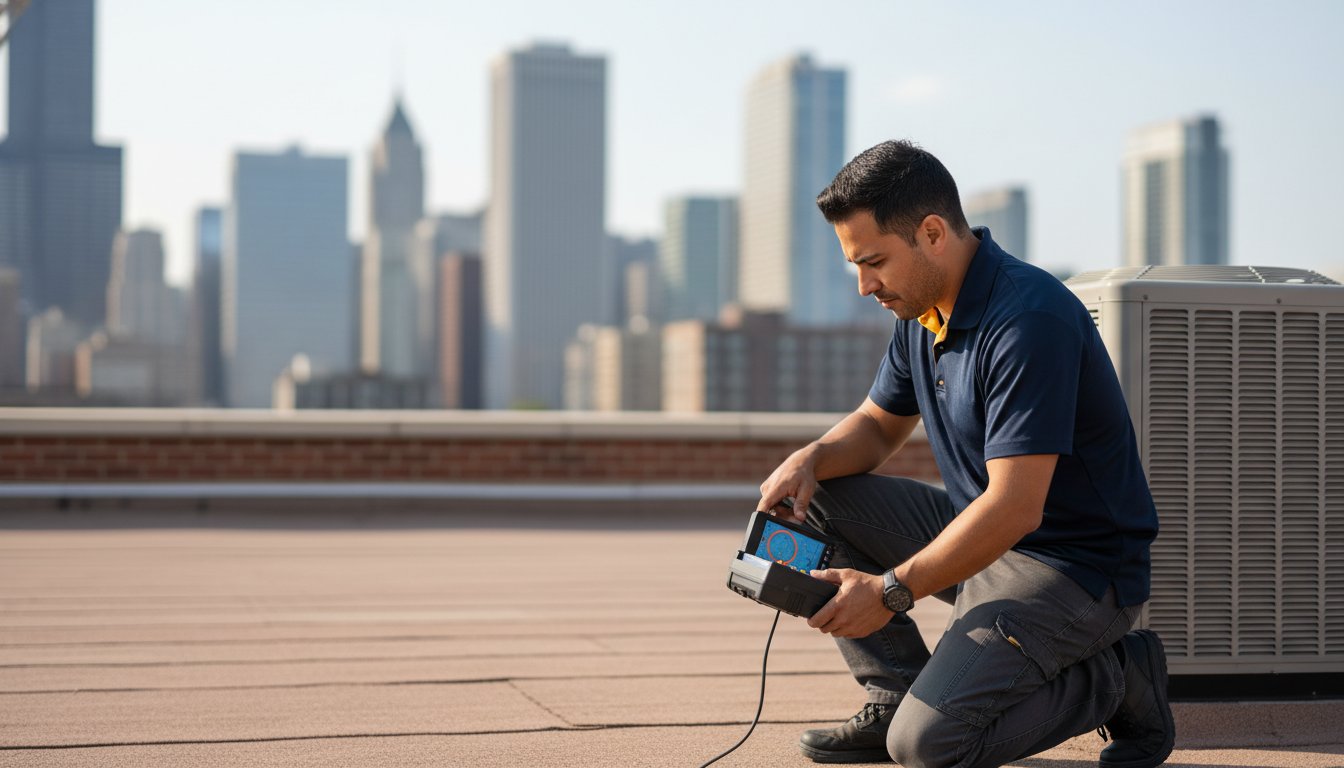
What if the “broken” AC unit costing you hundreds in peak summer energy bills isn’t actually failing, but simply suffocating under Lake Michigan’s relentless humidity? Chicago homeowners face a unique set of cooling challenges that often lead to premature system stress and the looming fear of an expensive, unnecessary replacement. When you’re searching for reliable air conditioning repair chicago, you need more than a quick fix. You need a solution that accounts for our city’s specific architectural constraints and the latest 2026 energy regulations.
We understand that a cooling failure in July feels like a crisis, especially when you’re worried about technical jargon or hidden costs. This reference guide empowers you to master the essentials of AC diagnostics and navigate the complex landscape of modern refrigerant changes and SEER2 efficiency standards. You’ll learn how to quickly identify if a problem is a simple mechanical hiccup or a major failure requiring professional intervention. We also provide a clear look at the factors that influence local service rates and how to find a partner with the technical expertise to keep your property comfortable and efficient through the most demanding heatwaves.
Key Takeaways
- Learn how Lake Michigan’s specific humidity levels impact your system’s evaporator coils and why Chicago’s environment requires a specialized approach to system optimization.
- Identify the critical differences between a simple airflow blockage and a complex refrigerant leak to ensure you prioritize the right air conditioning repair chicago solutions for your home.
- Apply the “$5,000 Rule” and evaluate modern SEER2 efficiency standards to determine if a mechanical fix or a full system replacement is your most cost-effective path.
- Understand the technical diagnostic process, from checking electrical draw to pressure levels, to help you make informed decisions during a professional service visit.
- Discover the advantages of choosing a seasoned local expert who understands Chicago’s unique architectural constraints and can provide comprehensive mechanical solutions.
Understanding Air Conditioning Repair in the Chicago Climate
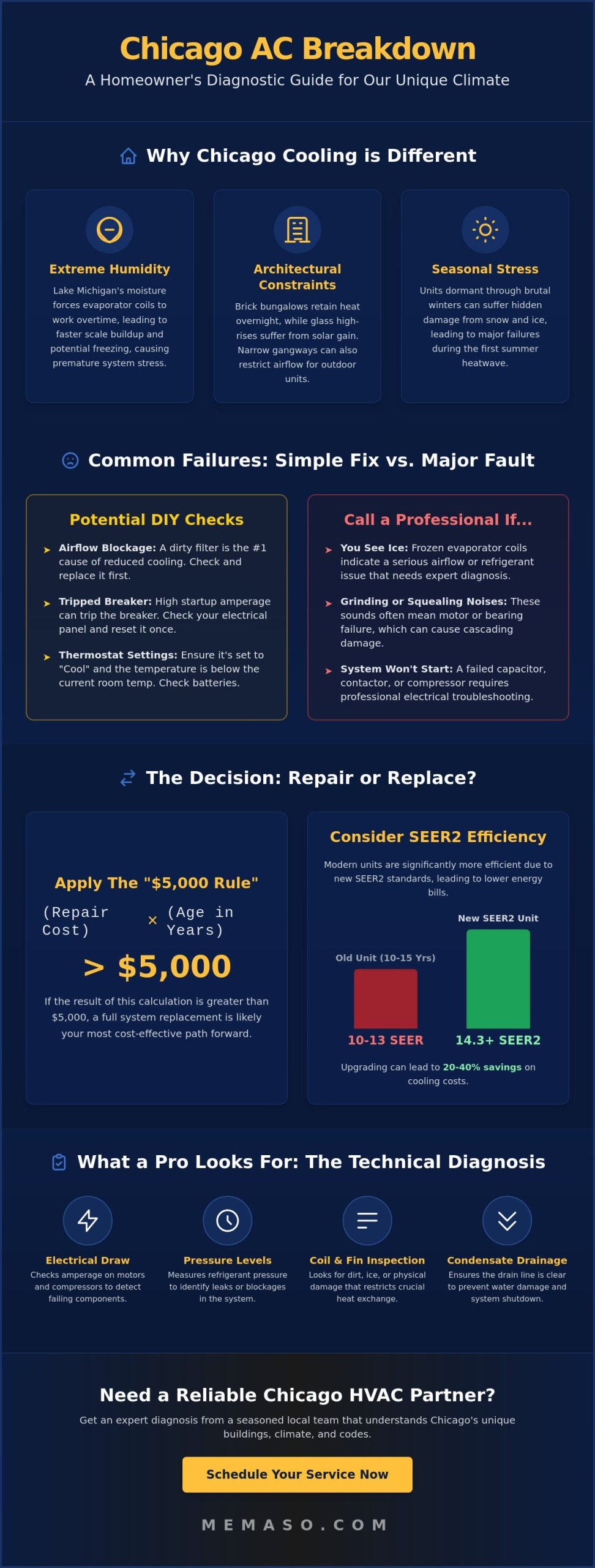
Effective air conditioning repair chicago is about more than just swapping out a faulty capacitor or patching a line. It’s a process of total system optimization. In a city where temperatures can swing sixty degrees in a single week, your cooling system acts as a vital comfort mechanism. To understand the underlying mechanics, it helps to review how air conditioning works; it’s a heat transfer process that relies heavily on consistent airflow and refrigerant pressure. In Chicago, Lake Michigan introduces a variable many national guides ignore: extreme humidity. This moisture forces evaporator coils to work double time to dehumidify the air before it can be cooled. This added stress leads to faster scale buildup and potential coil freezing if the system isn’t perfectly calibrated.
Most residential units in the Chicagoland area have a standard lifecycle of 10 to 15 years. After a decade of battling humid summers and corrosive winter salts, mechanical components begin to fatigue. A seasoned professional treats a repair visit as a strategic consultation to extend this lifecycle. Local expertise is also critical for navigating Cook County building codes. These regulations dictate specific requirements for condensate drainage and electrical safety that often differ from suburban or national standards. Understanding these nuances ensures your system remains compliant and safe.
The Impact of Chicago Architecture on Cooling
Historic Chicago brick bungalows are architectural treasures, but their thick walls act as thermal batteries. They hold heat long after the sun goes down, which keeps your AC running through the night. Conversely, modern glass high-rises face massive solar gain that can overwhelm undersized units. Older homes also present electrical challenges. If you haven’t invested in Electrical Panel Upgrades, the high amperage draw during AC startup can cause frequent breaker trips or damage the compressor. In dense neighborhoods like Lakeview or Lincoln Park, narrow gangways mean outdoor condensers often lack the necessary clearance for proper heat dissipation, leading to premature motor failure.
Seasonal Demands: The “Big Thaw” to the Summer Swelter
The “Big Thaw” in late spring is when most system issues surface. We see a massive surge in calls during the first 90-degree week in June because systems have sat dormant through a brutal winter. Even when they aren’t running, Chicago winters stress outdoor units. Heavy snow drifts and falling ice from rooflines can bend fan blades or crush delicate aluminum fins. These small mechanical imbalances turn into major vibrations when the system finally kicks on. Pre-season inspections are the only way to identify these hidden winter damages and avoid the mid-summer emergency rush when every contractor in the city is booked solid.
Common AC Failures: Why Your System Stopped Cooling
When your home starts feeling more like a sauna than a sanctuary, identifying the “why” is the first step toward a solution. Many homeowners assume a lack of cold air means the whole system is shot. In reality, specific mechanical or electrical failures are usually to blame. These issues often stem from common causes of AC failure such as neglected filters, debris buildup, or aging components. Understanding these symptoms helps you communicate effectively when you call for air conditioning repair chicago, ensuring a faster path back to comfort.
Frozen evaporator coils are a frequent culprit in our area. If you notice ice on the indoor unit or find that air isn’t blowing through the vents at all, your coils have likely dropped below freezing. This usually happens because restricted airflow prevents the refrigerant from absorbing enough heat. Similarly, refrigerant leaks represent a significant mechanical failure. We don’t recommend “topping off” a system. It’s a temporary band-aid that ignores the underlying leak, eventually leading to a more expensive Air Conditioning Replacement. A permanent repair involves finding the leak, sealing it, and performing a proper recharge.
Electrical failures often involve capacitors or contactors. Think of the capacitor as a large battery that provides the initial “kick” to start the motor. Chicago’s summer swelter puts immense thermal stress on these components. If you hear a humming sound but the fan doesn’t spin, a failed capacitor is the likely suspect. Clogged condensate lines are another byproduct of our local humidity. When the air is thick with moisture from the lake, your system pulls gallons of water out of the air. If the drain line is blocked by algae or debris, that water has nowhere to go but into your ceiling or flooring. If you see water pooling around the indoor unit, it’s time to act.
Electrical vs. Mechanical Issues
Distinguishing between a tripped breaker and a motor failure is vital. If your outdoor unit won’t turn on, check your electrical panel first. Frequent tripping might indicate that your system is drawing too much power, a common issue in older homes that may require Electrical Panel Upgrades to handle modern cooling loads safely. High-efficiency units in 2026 utilize complex sensors and microprocessors. Diagnosing these requires specialized digital tools rather than just a basic voltmeter.
Refrigerant Realities in 2026
The landscape of cooling chemicals changed significantly in 2025 when the manufacturing of R-410A was halted. Systems using this older coolant now face much higher servicing costs due to dwindling supplies. Illinois technicians must follow strict EPA Section 608 protocols for handling and disposal to protect the environment. As of 2026, R-32 and R-454B have become the new industry standard for residential systems because they offer a lower Global Warming Potential.
The Decision Matrix: When to Repair vs. Replace Your AC
Deciding between a quick mechanical fix and a total system overhaul is the most common stressor for homeowners. When you’re weighing the merits of air conditioning repair chicago, you need a logical framework to protect your investment. We often recommend using the “$5,000 Rule” as a professional benchmark. To apply this, multiply the age of your unit by the estimated repair cost. If the result exceeds $5,000, the data suggests that an Air Conditioning Replacement is the more financially sound path. For a twelve year old unit, even a mid-range repair can push you over this threshold, signaling that your money is better spent on new, warrantied equipment.
Energy efficiency is the other critical factor in this equation. Older systems typically operate at SEER ratings of 10 or lower, which pales in comparison to modern standards. As of January 1, 2023, all new residential central air conditioners in Illinois must meet a minimum SEER2 rating of 13.4. Transitioning to a higher efficiency system doesn’t just stop the cycle of repairs; it significantly reduces the energy load required to battle Chicago’s summer humidity. Furthermore, with the 2025 phase-out of R-410A refrigerant, repairing older “dry ship” units will only become more expensive as coolant supplies dwindle.
Signs Your System is Beyond Repair
Keep a log of “nuisance” repairs. If you’ve had to call a technician more than twice in a single cooling season, your system’s reliability has been compromised. Listen for excessive noise or “death rattles” coming from the outdoor compressor unit; these usually indicate internal mechanical failure that a simple part replacement won’t fix. You should also monitor your ComEd bills. If your costs are rising despite consistent usage patterns, your system is likely working overtime to compensate for failing internal components. Recognizing these signs you need AC replacement Chicago homeowners commonly overlook can save you from pouring money into a system that has already reached the end of its useful life.
The Evolution of Cooling: Heat Pumps in Chicago
Modern technology has changed the local landscape, and many Chicagoans are now choosing Heat Pump Installation as a versatile alternative to traditional AC. There is a common myth that these systems can’t handle Midwest winters, but today’s cold-climate models are designed to provide efficient cooling in July and reliable warmth when the mercury drops. This dual-fuel approach can often replace the need for both a separate AC and furnace. You can learn more by reading our detailed analysis: Are Heat Pumps Effective for Chicagoland Winters?
Federal and state-level programs, such as the Illinois Home Weatherization Assistance Program, often provide incentives for replacing aging, inefficient units. When choosing a qualified HVAC professional, ensure they are well-versed in these 2026 rebate structures. This ensures you receive the maximum financial benefit while upgrading your home’s long-term comfort and value.
What to Expect During a Professional Repair Visit
A professional service call is a methodical investigation into your home’s mechanical health. When you schedule air conditioning repair chicago, the process begins with a comprehensive diagnostic phase. A seasoned technician won’t simply guess at the problem. They use precision instruments to measure airflow through your ductwork, check refrigerant pressure levels, and monitor the electrical draw of your compressor and fan motors. These data points reveal the true state of your system, allowing for a targeted remedy rather than a series of trial-and-error part replacements.
Once the diagnostic is complete, you should expect a transparent consultation. A reliable partner provides a range of options that balance immediate comfort with long-term value. This might include a tiered approach where we discuss a basic mechanical fix alongside a more comprehensive system optimization. After you approve the plan, the execution involves strict safety protocols. We don’t just swap a component and leave. We perform rigorous system testing to verify that cooling performance is consistent across the entire building, ensuring every room reaches the desired setpoint on your thermostat.
How to Prepare for Your HVAC Technician
Helping your technician starts with clear access. Clear away any tall grass, weeds, or debris from around your outdoor condenser unit to ensure there’s enough clearance for the technician to work safely. Inside, make sure the path to your air handler or furnace is unobstructed and the area is clean. It’s also helpful to compile a brief list of symptoms before we arrive. Note any unusual smells, high-pitched noises, or specific times of day when the system seems to struggle most. This field data helps us pin down intermittent issues much faster.
Safety and Compliance Standards
Technical expertise is non-negotiable when handling modern cooling systems. Every technician on your property must hold a federal EPA Section 608 certification to handle refrigerants like R-32 or R-454B. Our Design-Build Construction Services mindset ensures that every repair follows manufacturer specifications, which is critical for maintaining your equipment warranty. If your AC is integrated with a gas-fired furnace, we prioritize safety by performing post-repair carbon monoxide testing. This ensures that the mechanical vibrations or airflow changes from the repair haven’t compromised your home’s air quality.
If your system isn’t performing at its peak, contact us today for a professional Heating System Repair assessment to restore your home’s comfort and safety.
Choosing a Reliable Chicago HVAC Partner
Selecting a partner for air conditioning repair chicago requires looking beyond simple star ratings or surface-level reviews. In a city defined by complex building codes and diverse architectural styles, you need a partner with deep local roots and a history of technical precision. Mechanical Management & Design Solutions (MEMASO) brings a level of stable, knowledgeable expertise that national chains often lack. Our collective tenure in the Chicagoland market serves as a badge of commitment to our neighbors, ensuring that every mechanical solution is rooted in professional reliability and local authority.
The most effective cooling strategies often require a multidisciplinary approach that accounts for the entire building’s mechanical health. This is where the value of integrated services becomes apparent. When your provider specializes in Design-Build Construction Services, they view your home or facility as a single, cohesive environment. Mechanical Management & Design Solutions utilizes this high-level perspective to troubleshoot issues that others might miss, such as how an aging electrical system or outdated building automation might be throttling your AC performance. This holistic approach ensures that your system is optimized for long-term dependability rather than just a quick, temporary fix.
Questions to Ask Every HVAC Contractor
Before you invite a technician into your home or commercial space, vet their credentials with these specific questions:
- “Are you licensed for both residential and commercial mechanical work in Chicago?” Local licensing ensures the contractor is accountable to city standards and specific Cook County building codes.
- “Do you provide a written warranty on both parts and labor?” A seasoned professional stands behind their work with clear, documented protections for the property owner.
- “How do you stay updated on 2026 energy efficiency regulations?” With the shift to SEER2 standards and new refrigerant mandates, your contractor must be an educational consultant, not just a service provider.
Why Mechanical Management & Design Solutions Stands Out in Chicagoland
Mechanical Management & Design Solutions positions itself as a stable partner for those who demand high standards and peace of mind. Our approach is methodical and transparent, moving from a broad promise of quality to a step-by-step explanation of how we render our services. We understand that a cooling failure in the middle of a July heatwave is a high-stakes situation, which is why we maintain 24/7 emergency availability for critical system failures. Whether you are managing a historic residence or a large-scale institutional facility, our expertise in complex environments translates directly to your personal comfort.
We believe in providing practical tips and transparent options that empower you to make the best decision for your property. Our goal is to lower your anxiety through seasoned capability and a commitment to precision. Schedule your professional AC diagnostic with Mechanical Management & Design Solutions today and experience the confidence that comes from working with a dedicated local expert.
Securing Your Home’s Comfort for the Seasons Ahead
You now possess a professional framework to navigate the technical complexities of air conditioning repair chicago. By identifying how Lake Michigan’s humidity stresses your evaporator coils and applying a logical decision matrix to your equipment’s lifecycle, you can protect your home’s efficiency and your own peace of mind. These insights transform you from a concerned homeowner into an informed advocate for your property’s mechanical health. Knowing when to invest in a repair and when to transition to a modern, high-efficiency system is the key to long-term comfort.
MEMASO provides the seasoned capability you need to handle these challenges with confidence. Our team has served the local market since 2000, offering a level of stable expertise that ranges from private residences to complex Building Automation Systems. We understand that mechanical failures don’t follow a schedule; this is why we provide 24/7 Emergency Electrical & HVAC Support to keep your environment safe and comfortable. Our commitment to technical precision ensures your system remains a reliable asset for years to come.
Contact MEMASO for Expert AC Repair and System Optimization. Your home deserves the reliability of a partner who understands the specific demands of the Chicago climate. Let’s ensure your system operates at peak performance throughout the 2026 season and beyond.
Frequently Asked Questions
How much does air conditioning repair typically cost in Chicago?
Industry data for May 2026 shows that the average cost for an HVAC repair in Chicago is $363, with typical ranges spanning from $135 to $2,072. These figures vary based on the specific mechanical failure and the parts required to restore the system. Local technicians generally charge labor rates between $75 and $150 per hour, though emergency fees can add up to $100 per hour to the total bill.
Why is my AC running but not blowing cold air?
This problem often stems from restricted airflow or a refrigerant deficiency that prevents the system from absorbing heat. When air cannot move freely over the evaporator coils, they drop below freezing and stop the cooling process entirely. It’s also possible that the outdoor compressor has failed to engage due to a faulty capacitor, even if the indoor fan continues to circulate room-temperature air through your vents.
Is it worth repairing a 15-year-old air conditioner?
Repairing a 15-year-old unit is rarely the most cost-effective path because the system has reached the end of its standard mechanical lifecycle. Applying the “$5,000 Rule” often shows that the cost of a significant air conditioning repair chicago multiplied by the unit’s age exceeds the value of the equipment. Investing in an Air Conditioning Replacement / Installation provides better long-term reliability and compliance with modern SEER2 efficiency standards. If you’re unsure whether your aging system warrants another repair, reviewing the definitive signs you need AC replacement in Chicago can help you make a confident, data-driven decision.
Do I need a permit for AC repair or replacement in Chicago?
You don’t need a permit for an in-kind replacement of an air conditioning unit in residential buildings up to four stories. However, installing a new permanent system where none existed before requires a permit from the Department of Buildings. All professional installations must be performed by a licensed contractor to ensure the property meets the strict requirements of the Chicago Energy Transformation Code.
How long should a typical AC repair take?
A standard diagnostic and minor mechanical repair typically takes between one and three hours to complete. Complex issues, such as locating and sealing a refrigerant leak or performing a blower motor replacement, can extend the service visit to a full afternoon. A seasoned professional will provide a clear timeline after the initial assessment of your system’s airflow, pressure levels, and electrical draw.
Can a dirty air filter really cause my AC to stop working?
Yes, a neglected air filter is a leading cause of total system shutdown in high-humidity environments. When dust restricts airflow, the evaporator coil cannot absorb heat and eventually freezes into a block of ice. This puts immense strain on the compressor and can lead to a complete mechanical failure if the system isn’t allowed to thaw and breathe properly through a clean filter.
What is the difference between a standard AC and a heat pump for Chicago homes?
A standard air conditioner only provides cooling by removing heat from your home, while a heat pump can reverse this process to provide warmth during the winter. For many local properties, a Heat Pump Installation serves as a highly efficient dual-fuel solution. It handles the summer swelter with technical precision and assists your furnace during the colder months to optimize your total energy usage.
Does MEMASO offer emergency AC repair on weekends?
MEMASO provides 24/7 Emergency Electrical & HVAC Support to ensure your home remains safe during extreme weather events. We understand that a cooling failure on a humid Chicago weekend is a high-stakes situation for any family. Our team is available to handle critical air conditioning repair chicago needs outside of standard business hours to restore your comfort and peace of mind quickly.