

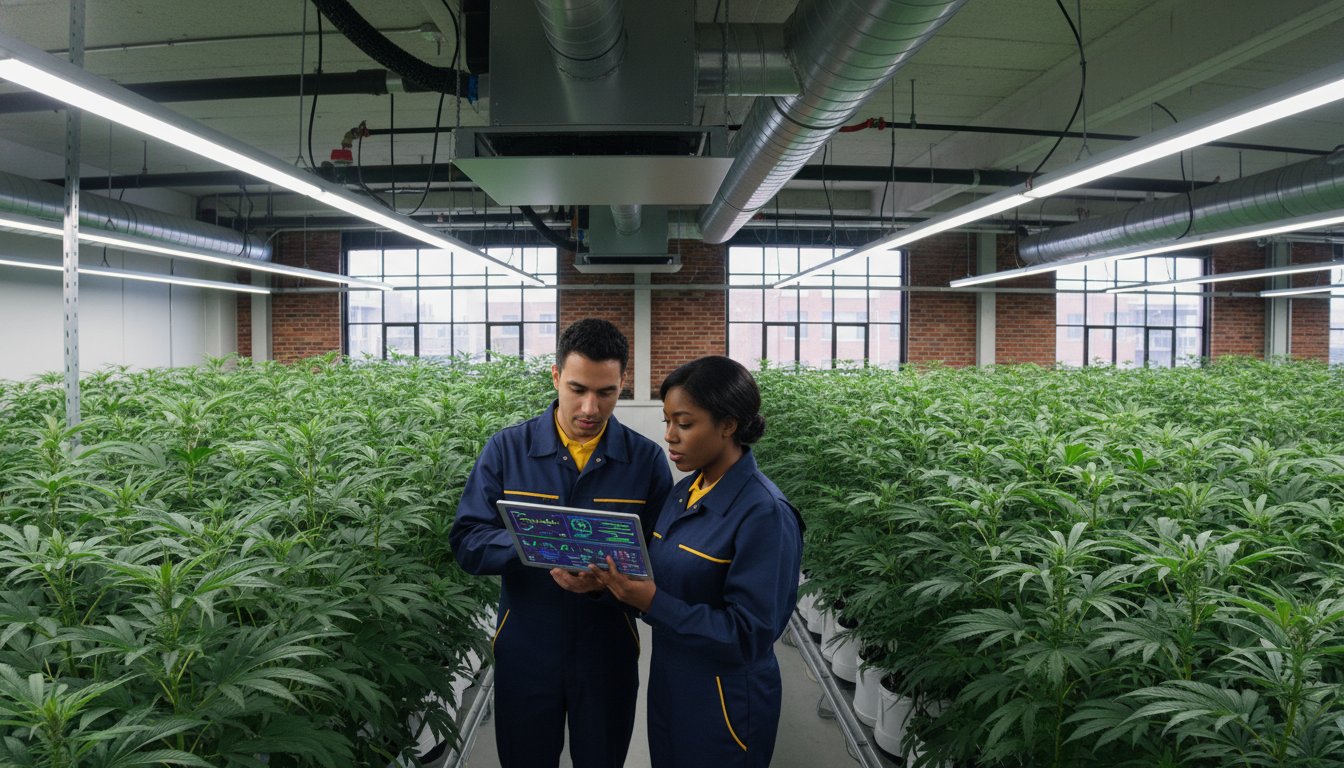
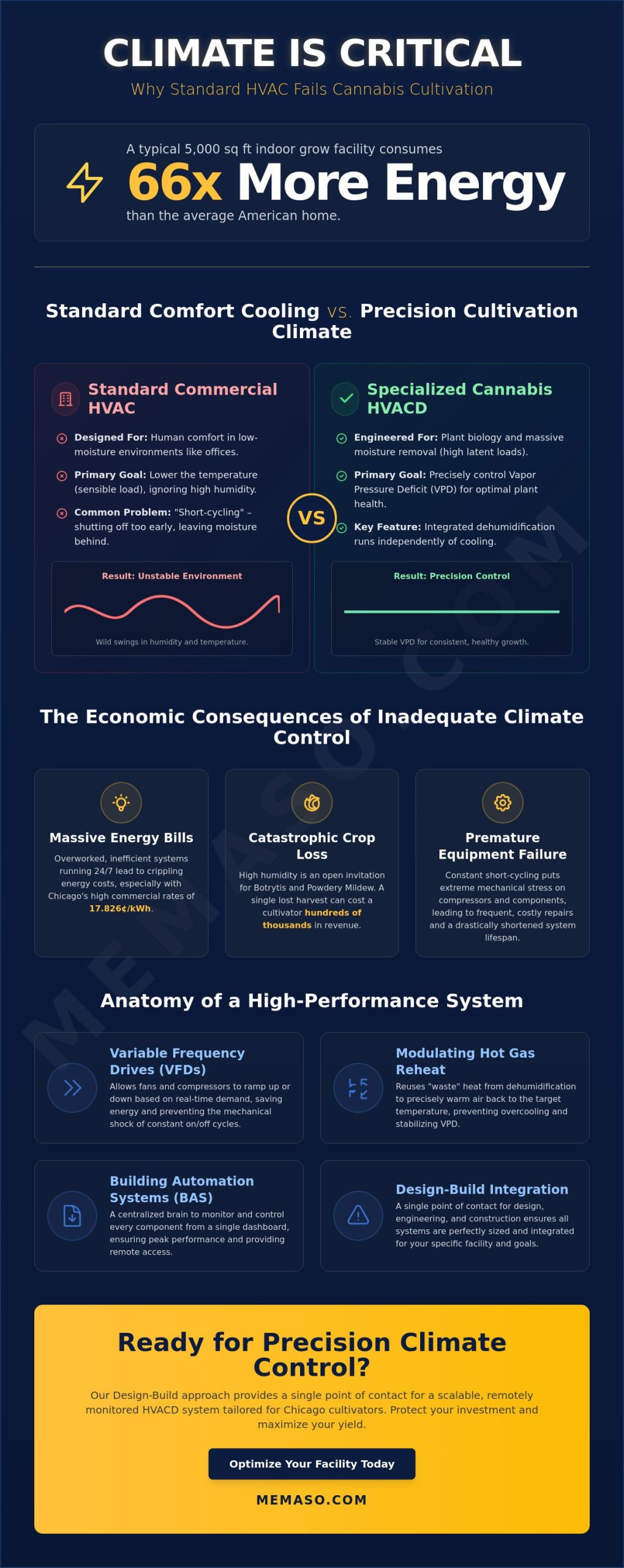
Did you know that a typical 5,000 square foot indoor grow uses 66 times more energy than the average American home? In Chicago, where ComEd commercial supply rates spiked to 17.826¢ per kWh in May 2026, that energy bill can quickly erode your margins if your cannabis hvac systems aren’t optimized for efficiency. Standard commercial units are built for human comfort. Your plants demand something much more rigorous.
You likely already know that managing a canopy in the Windy City means battling brutal humidity shifts and extreme seasonal temperature swings. It’s frustrating to watch VPD levels fluctuate or find mold because a system couldn’t handle the massive moisture levels plants release. This guide will show you how to implement precision climate control that stabilizes your environment while slashing those climbing operational costs. We will explore integrated HVACD technology, the impact of the 2026 EPA refrigerant regulations, and how a design-build approach creates a scalable infrastructure for your facility.
Key Takeaways
- Understand why standard commercial units struggle with plant-driven moisture and how specialized cannabis hvac systems manage high latent loads to prevent crop loss.
- Discover the role of modulating hot gas reheat in maintaining precise temperatures while pulling gallons of water from the air.
- Compare the pros and cons of packaged rooftop units versus split systems to optimize your facility’s square footage and airflow.
- Gain insights into sizing equipment for the Chicago climate, including strategies for managing humidity when outdoor air is freezing.
- Learn how Design-Build Construction Services and Building Automation Systems (BAS) provide a single point of contact for a scalable, remotely monitored facility.
Why Standard Commercial HVAC Fails in Cannabis Grow Rooms
Standard commercial HVAC units are designed for human comfort. An office building might house fifty people, but a grow room contains hundreds of plants constantly transpiring. This creates a massive latent load that most off-the-shelf RTUs simply cannot manage. These systems often reach the target temperature and shut down before they’ve pulled enough moisture from the air. This leads to a phenomenon called short-cycling. When a compressor turns on and off rapidly, it puts extreme mechanical stress on the system. It wears out the equipment prematurely and leaves your canopy sitting in a swampy, humid environment.
Inconsistent climate control is the fastest way to invite disaster into your facility. When temperatures and humidity levels swing wildly, you create the perfect breeding ground for pests and pathogens. Specialized cannabis hvac systems are built to handle these unique biological demands. They ensure that your mechanical infrastructure works with your plants rather than fighting against them.
The Science of Transpiration and HVAC Stress
Plants are essentially biological humidifiers. Through transpiration, they release water vapor to cool themselves and move nutrients from their roots to their leaves. In controlled conditions for indoor cultivation, the ratio of sensible heat to latent heat is completely flipped compared to a standard warehouse. Traditional air conditioning prioritizes lowering the thermostat. If your system doesn’t have a dedicated dehumidification circuit, it will struggle to maintain the Vapor Pressure Deficit (VPD) your crop needs to thrive. High-performance cannabis hvac systems use sophisticated sensors to balance these loads in real-time, ensuring the air stays moving and the moisture stays under control.
Economic Consequences of Inadequate Climate Control
Failing to manage these environmental loads isn’t just a technical glitch; it’s a direct threat to your bottom line. High humidity is an open invitation for Botrytis and powdery mildew. One lost harvest can cost a Chicago cultivator hundreds of thousands of dollars in potential revenue. Inefficiency is also a major drain on your overhead. With ComEd commercial rates hitting 17.826¢ per kWh in May 2026, running an unoptimized system is a luxury no business can afford. Overworked compressors lead to a heavy maintenance burden. You’ll find yourself paying for frequent repairs on a system that was never meant for this high-stakes environment. Investing in the right infrastructure from the start protects your crop and your long-term profitability.
The Core Components of a High-Performance Cannabis HVAC System
Building a reliable environment requires more than just a powerful air conditioner. It requires a synchronized network of specialized mechanical parts designed to work in tandem. High-performance cannabis hvac systems integrate cooling, heating, and dehumidification into a single, cohesive unit. This integration often relies on Variable Frequency Drives (VFDs). VFDs allow fans and compressors to ramp up or down based on actual demand rather than just slamming on at full power. This precision prevents the sharp temperature swings that stress your plants and helps manage the high energy costs common in the Chicago market. By modulating the motor speed, you’re not just saving energy; you’re extending the life of your equipment by avoiding the mechanical shock of constant starts and stops.
Integrating these complex mechanical components into a single, user-friendly interface is where Building Automation Systems become essential for modern cultivators. Having a centralized brain for your facility allows you to monitor every component from a single dashboard, ensuring your infrastructure is always performing at peak efficiency.
Precision Humidity Control and VPD
Vapor Pressure Deficit, or VPD, is the primary metric for plant health. It measures the difference between the moisture inside the leaf and the moisture in the surrounding air. If the air is too humid, the plant stops transpiring and nutrient uptake stalls. If it’s too dry, the plant closes its stomata to save water, which stunts growth. To keep VPD stable, you need modulating hot gas reheat. This technology captures the “waste” heat generated during the dehumidification process and uses it to warm the air back up before it’s delivered to the canopy. It prevents that “cold and clammy” room syndrome that occurs when a system cools the air to remove moisture but fails to bring it back to the target temperature. Strategic sensor placement throughout the room ensures the system reacts to microclimates before they become a problem.
Air Filtration and Biosecurity
Protecting your genetics is a non-negotiable part of facility management. Standard residential filters won’t cut it in a commercial grow. Most professional facilities require MERV 13 or higher, with many sophisticated operations opting for HEPA filtration to catch microscopic spores. Beyond physical filters, many cultivators now implement Photocatalytic Oxidation (PCO) and Ultraviolet Germicidal Irradiation (UVGI) to destroy airborne pathogens like powdery mildew on a molecular level. Chicago zoning laws also have strict requirements regarding odor control. Using high-intensity carbon scrubbers isn’t just about plant health; it’s about being a good neighbor and staying compliant with local ordinances. A multi-stage filtration strategy creates a biosecurity shield that keeps your crop safe from outside contaminants.
Comparing Cannabis HVAC Configurations: RTUs, Split Systems, and Integrated Units
Selecting the right mechanical layout is a pivotal decision for any Chicago cultivator. The choice between rooftop placement and indoor installation dictates your facility’s workflow, maintenance schedule, and long term energy efficiency. Most modern cannabis hvac systems fall into three primary categories: packaged rooftop units, indoor split systems, or chilled water loops. While separate HVAC and dehumidification setups were once the norm, the industry has shifted toward integrated units. These all-in-one systems manage both temperature and moisture in a single cabinet, reducing the number of failure points and simplifying your building automation.
For massive, high stakes operations, chilled water systems are often the heavy duty choice. These systems use a central chiller to cool a water and glycol mixture, which is then pumped to air handlers in each room. This configuration offers incredible precision and redundancy, though it requires a more complex piping infrastructure. Whether you’re retrofitting an old industrial space or starting a new build, the configuration must match your specific canopy goals.
Packaged Rooftop Units (RTUs) for Scalability
RTUs are the industry standard for large scale Chicago industrial grows. They sit on the roof, which saves valuable floor space for more plants. Installation is a significant logistical event. It requires cranes, roof curbs, and careful structural support analysis. This is where our Design-Build Construction Services become invaluable, as we handle the coordination between structural requirements and mechanical needs. One major benefit of RTUs is ease of maintenance. Technicians can service the units on the roof without ever entering the clean grow environment, which significantly reduces the risk of cross contamination or biosecurity breaches.
Indoor Split and Vertical Units
When roof access is limited or zoning restrictions intervene, indoor vertical or horizontal units are the better choice. These systems are highly modular. You can add units as you expand your canopy, making them ideal for growers who plan to scale in phases. Because these units are located inside the building, they require a way to reject heat to the outdoors. This usually involves dry coolers or cooling towers located on a small exterior pad or a reinforced section of the roof. Indoor units allow for very short duct runs, which can improve airflow efficiency and provide more granular control over individual flower rooms. It’s a flexible approach that works well in the diverse range of commercial buildings found throughout the Chicago area.
Selecting Your System: Sizing, Efficiency, and Chicago Climate Factors
Sizing cannabis hvac systems requires a deep dive into your specific cultivation methodology. It isn’t just about square footage. You have to calculate the total moisture load based on your plant count, irrigation volume, and lighting type. High-pressure sodium (HPS) lights generate significant heat that helps drive dehumidification, but modern LEDs require the HVAC system to do more of the heavy lifting. If you switch to LED without adjusting your mechanical capacity, you’ll likely face humidity spikes because the cooling coils aren’t running long enough to pull water from the air.
The Chicago Winter Factor is a common pitfall for local growers. When it’s sub-zero outside, the air contains almost no moisture. However, your grow room remains a tropical environment. Managing that massive vapor pressure difference without causing condensation on your walls or ceiling is a technical challenge. Traditional heating systems for warehouses aren’t built for this. You need a system that can provide precise heating without sacrificing humidity control. While “free cooling” via economizers sounds tempting, it often introduces too much dry air or vents out your expensive CO2, making it a risky choice for sealed rooms.
The Impact of Chicago Weather on Grow Ops
Chicago’s climate presents a unique set of hurdles. In July, we deal with outdoor humidity that’s already high, which taxes your system’s ability to reject moisture. In January, the focus shifts to maintaining warmth without drying out the canopy. Managing these extreme humidity swings from month to month requires a system with modulating components. Unlike a standard office building, your grow facility has a constant, 24/7 internal load. This means your winter heating needs are actually lower than a typical warehouse because your lights and plants generate their own microclimate. The challenge is balancing that internal heat with the freezing temperatures outside your walls.
Sizing Your System for Maximum ROI
Energy efficiency is a survival metric in the current market. With ComEd commercial supply rates spiking to 17.826¢ per kWh in May 2026, your choice of equipment directly impacts your monthly burn rate. Focus on the EER (Energy Efficiency Ratio) rating rather than SEER. EER measures efficiency at a steady state, which is exactly how a grow room operates. You should also verify that any new installation complies with the 2026 EPA AIM Act regulations. These federal rules mandate lower-GWP refrigerants like A2L blends for all new installations. Choosing a system that uses legacy refrigerants now could lead to massive maintenance costs down the road when those fluids become scarce.
Planning a facility that balances performance with local compliance takes a seasoned partner. Our Design-Build Construction Services ensure your mechanical layout is engineered for Chicago’s specific climate challenges from day one.
The Mechanical Management & Design Solutions Advantage: Design-Build HVAC Solutions for Chicago Cultivators
Success in the Chicago cannabis market requires more than just high end equipment. It demands a mechanical partner who understands how every component of your facility interacts. National manufacturers often ship cannabis hvac systems and leave the complex installation to third party contractors who may not understand the nuances of a sealed grow environment. This fragmented approach creates gaps in responsibility and technical errors. By choosing Mechanical Management & Design Solutions, you gain a consultant who manages the entire lifecycle of your climate infrastructure. We provide a single point of contact that bridges the gap between high level engineering and boots on the ground execution.
Mechanical failures don’t happen on a convenient schedule. In a high density flower room, even a few hours of equipment downtime can lead to heat stress or humidity spikes that ruin a harvest. Our team provides the peace of mind that comes from seasoned capability and local proximity. Beyond the initial setup, we offer long term maintenance plans designed to protect your investment. Regular calibration and preventative care ensure your system continues to meet the strict energy efficiency standards mandated by Illinois law, helping you manage those 17.826¢ per kWh ComEd supply rates effectively.
Integrated Design-Build Construction
Our Design-Build Construction Services streamline the MEP (Mechanical, Electrical, Plumbing) process by keeping everything under one roof. In a traditional build, the HVAC contractor, the plumber, and the electrician often work in silos. This leads to conflicts, such as ductwork blocking access to plumbing lines or electrical panels being undersized for the massive draw of a climate control system. We coordinate these disciplines during the design phase to ensure your facility is permit ready and built for performance. This integrated approach reduces project timelines and eliminates the costly change orders that often plague large scale technical projects in the Chicago area.
Building Automation and Precision Control
Precision is the hallmark of a professional grow operation. Our Building Automation Systems (BAS) act as the central brain of your facility, allowing you to monitor and adjust temperature, humidity, and CO2 levels from a single interface. These systems provide real time data logging, which is essential for both regulatory compliance and yield optimization. By tracking how your cannabis hvac systems respond to different stages of the plant lifecycle, you can fine tune your environment to maximize terpene production and cannabinoid content. This level of control allows you to scale your climate infrastructure with confidence, knowing that every room in your facility is performing at its absolute peak.
Protect Your Canopy and Your Bottom Line
Operating a cultivation facility in the Chicago area demands a level of mechanical precision that standard systems simply cannot provide. We have covered the critical importance of managing latent loads, the advantages of integrated HVACD units, and why navigating the sub-zero winters of the Midwest requires a localized engineering strategy. Investing in high-performance cannabis hvac systems is the only way to ensure stable VPD levels and protect your genetics from the pathogens that thrive in inconsistent environments.
With more than 25 years of Chicago mechanical expertise, Mechanical Management & Design Solutions offers the seasoned capability required to design, install, and maintain these complex infrastructures. Our integrated Design-Build approach and 24/7 Emergency Electrical and HVAC support mean your facility is never left vulnerable to equipment failure. Take the next step toward a more efficient, high-yielding operation. Schedule a Professional Cannabis HVAC Consultation with Mechanical Management & Design Solutions today. Let us help you secure your facility’s future with the precision and reliability your crop deserves.
Frequently Asked Questions
Why can’t I just use a standard commercial AC and a portable dehumidifier?
Standard commercial air conditioners are designed to lower the temperature and then shut off, which leaves humidity to spike when the cooling cycle ends. Portable dehumidifiers are built for residential basements; they lack the capacity to handle the gallons of water your plants transpire daily and actually add heat back into the room. High-performance cannabis hvac systems are engineered to manage both temperature and moisture simultaneously without overworking the compressor.
How much energy does a typical cannabis HVAC system consume?
In a professional indoor facility, the HVACD (heating, ventilation, air conditioning, and dehumidification) system typically accounts for more than 50% of the total electricity consumed. A 2019 report highlighted that a 5,000-square-foot grow room uses roughly 66 times more energy than the average U.S. household. This high intensity is why selecting efficient equipment is the most effective way to lower your long-term operational costs.
What is the ideal VPD for the flowering stage of cannabis?
The ideal Vapor Pressure Deficit (VPD) for the flowering stage generally falls between 1.2 and 1.5 kPa. This range allows for optimal transpiration and nutrient uptake while minimizing the risk of mold or fungal pathogens. If your environment stays outside this window for too long, you risk stunting the growth of your buds or inviting powdery mildew that can destroy an entire harvest.
How often do filters need to be changed in a commercial grow room?
You should inspect your filters every 30 days and replace them at least every 3 to 6 months to maintain proper airflow and biosecurity. In a high-pollen or dusty industrial area in Chicago, you might need more frequent changes to prevent clogs. Keeping your MERV or HEPA filters clean ensures that your system doesn’t have to work harder to push air through a dirty medium, which saves on energy and wear.
Does Chicago have specific building codes for cannabis HVAC installations?
Yes, Chicago requires all commercial facilities to comply with strict energy efficiency codes and zoning ordinances regarding odor mitigation. While Illinois doesn’t have a statewide HVAC license, the City of Chicago often requires a General Contractor license for any mechanical work that involves structural changes or building permits. You’ll also need to ensure your roof can support the weight of heavy RTUs if you aren’t using an indoor configuration.
Can I integrate my existing HVAC system with new building automation?
Integration is possible if your current equipment uses compatible controllers or can be retrofitted with modern sensors and gateways. Our Building Automation Systems can often bridge the gap between legacy hardware and new technology to provide a centralized dashboard for your facility. However, if your existing units are reaching the end of their lifecycle, it’s often more cost-effective to upgrade to native smart systems that offer deeper data logging and precision.
What happens to the grow room environment if the power goes out in Chicago?
Without power, the temperature and humidity in a sealed grow room will reach dangerous levels within an hour, potentially causing irreversible heat stress. This is why we recommend integrating your cannabis hvac systems with automated alerts and backup power solutions. We provide Emergency Electrical Services to help facility owners design redundant power systems that keep critical climate controls running during grid failures or severe weather events.
Is a chilled water system better than a DX (Direct Expansion) system for cannabis?
Chilled water systems offer incredible precision and are highly scalable for massive facilities, but they require a complex network of pipes and a higher upfront investment. DX systems are more common for small to mid-sized Chicago grows because they are simpler to install and maintain. The “better” choice depends entirely on your canopy size, long-term expansion plans, and your specific budget for the initial build-out.