


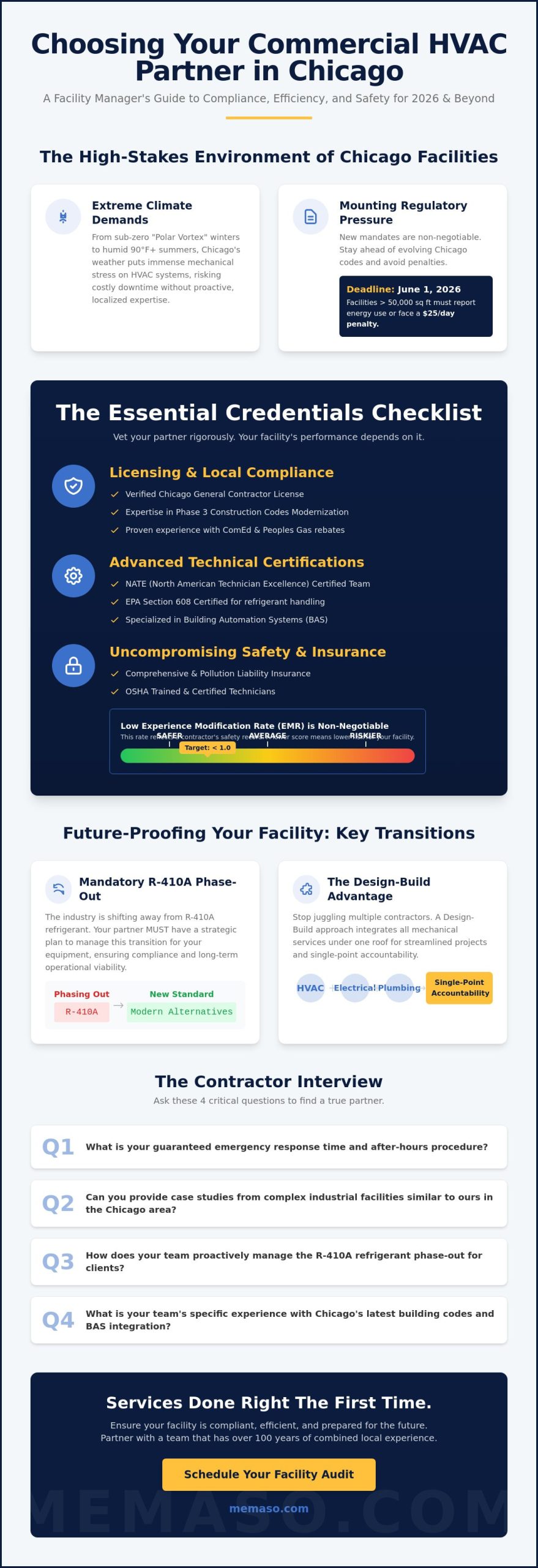
By June 1, 2026, every Chicago facility over 50,000 square feet must report its energy consumption or face a $25 daily penalty. Despite this, many managers still work with a commercial hvac contractor who treats modern efficiency standards like optional suggestions. You’re likely feeling the squeeze of rising energy costs and the headache of coordinating separate teams for your mechanical needs. It’s frustrating when poor maintenance leads to unexpected downtime, especially since the City of Chicago just launched Phase 3 of its Construction Codes Modernization Initiative this past April.
We know you need a facility that runs smoothly without constant oversight. This article provides a clear framework to evaluate and select a mechanical partner who understands the intersection of building automation and local compliance. You’ll learn how to audit potential partners for EPA Section 608 certifications and their specific strategy for the mandatory R-410A refrigerant phase-out. With over 100 years of combined experience in the local market, we’re here to help you achieve single-point accountability. Let’s ensure your systems are handled correctly the first time.
Key Takeaways
- Verify essential local credentials and specialized certifications to ensure your mechanical partner meets Chicago’s rigorous safety and insurance standards.
- Discover how a Design-Build approach streamlines your project by integrating HVAC, electrical, and plumbing services under a single point of accountability.
- Master the contractor interview by asking targeted questions about emergency response times and proven success with complex industrial facilities.
- Learn why selecting the right commercial hvac contractor in 2026 requires a partner who can manage both mechanical repairs and sophisticated building automation systems.
- Gain a clear framework for navigating the latest Chicago energy codes and refrigerant transitions to protect your facility from future compliance penalties.
Why Your Choice of a Commercial HVAC Contractor Matters in Chicago
Chicago isn’t just any market. Our city’s weather is famous for swinging from sub-zero “Polar Vortex” winters to sweltering, humid 90-degree July afternoons. For a facility manager, these extremes aren’t just conversation topics; they’re direct threats to building stability. Choosing the right commercial hvac contractor is the difference between a building that remains comfortable year-round and one that suffers from constant, expensive downtime.
Energy costs represent roughly 50% of a commercial building’s total utility usage. When your HVAC systems underperform, that percentage climbs even higher. National chains often lack the localized knowledge of how Chicago’s specific wind patterns and lakefront humidity impact rooftop units. We bring nearly twenty-five years of local market experience to every project. Our “Services Done Right The First Time” philosophy isn’t just a slogan; it’s a commitment to preventing the cycle of repeat repairs that drain your budget and your patience.
The Chicago Climate Challenge
The rapid temperature shifts we see in the Midwest place immense mechanical stress on boilers and industrial rooftop units. Without proper air balancing, high-rise tenants on upper floors might swelter while those at ground level freeze. As we look toward the 2026 winter season, proactive system audits are mandatory. A seasoned professional understands that Chicago’s infrastructure requires specialized care to prevent metal fatigue and motor failure during deep freezes. We focus on stabilizing these systems before the first frost hits.
Navigating Local Regulations and Codes
Compliance in Cook County is a moving target. With the April 2026 Phase 3 Construction Codes Modernization, standards for ventilation and energy efficiency have reached new heights. Your commercial hvac contractor must be a consultant who can navigate these legal waters. We help facility managers secure local energy rebates through programs like ComEd and Peoples Gas, effectively lowering the cost of high-efficiency upgrades. Staying compliant with 2026 indoor air quality standards isn’t just about avoiding fines; it’s about ensuring the safety and comfort of everyone in your facility.
The Essential Credentials Checklist: Vetting Your Partner
Vetting a commercial hvac contractor isn’t just about checking a box; it’s about protecting your capital investment. In Chicago, any work that requires a building permit necessitates a General Contractor license, with classes ranging from A to E based on the total project value. You should also demand proof of North American Technician Excellence (NATE) certification and rigorous OSHA safety training. These credentials guarantee that the technicians on your roof aren’t just laborers, but experts trained to handle high-pressure commercial environments.
Liability insurance is another critical pillar for facility managers. A standard residential policy won’t suffice for large-scale commercial facilities. Ensure your partner carries comprehensive coverage that includes pollution liability, which is essential when handling modern refrigerants. A low Experience Modification Rate (EMR) is a non-negotiable metric. It reflects a contractor’s safety history. A rate below 1.0 indicates a safer-than-average workplace, which translates to fewer delays and lower risk for your facility. Choosing a team with a proven track record and over 100 years of combined experience ensures these safety standards are part of the company culture, not just a manual on a shelf.
Technical Certifications to Look For
Modern facility management requires specialized knowledge of high-efficiency heat pumps and chillers, especially as the industry shifts away from R-410A. Your contractor should follow ASHRAE standards for ventilation and thermal comfort to ensure your building remains compliant with the latest 2026 codes. Credentials in Building Automation Systems (BAS) are also vital. These allow for smart monitoring and energy optimization that older systems simply can’t provide. If your building relies on Chicago’s legacy infrastructure, ensure the team has verified expertise in boiler maintenance and repair.
Financial and Operational Stability
Local references are the best predictor of future performance. Ask for case studies from facilities of similar scale, whether it’s a retail center, a school, or a hospital. A contractor’s ability to provide 24/7 emergency response is paramount during a Lake Michigan winter. You need a partner with a permanent physical presence in the Chicago area, not a national firm that subcontracts its labor to the lowest bidder. Our team provides the local authority needed to keep your systems running. If you’re ready to upgrade your facility’s efficiency, you can explore our design-build solutions to see how we integrate these high standards into every project.
Beyond HVAC: The Value of Integrated Mechanical Services
Managing a facility becomes a logistical nightmare when you have to play referee between three different companies. A premier commercial hvac contractor should offer more than just air conditioning; they should provide integrated mechanical, electrical, and plumbing (MEP) solutions. This holistic approach, often referred to as Design-Build, streamlines your project from the initial concept to the final construction phase. It eliminates the common “finger-pointing” that happens when a new chiller requires an electrical load that your current panel simply cannot handle.
When you consolidate these services, you gain single-point accountability. You no longer have to worry about the plumber’s schedule conflicting with the HVAC technician’s installation window. We understand that time is money in the Chicago market. By managing every mechanical aspect of your facility, we reduce the friction that typically derails large-scale construction projects. This ensures your project stays on schedule and within the projected budget. It’s about looking at the building as a single, living organism rather than a collection of separate parts.
Integrated Electrical and Plumbing Solutions
Your mechanical systems don’t live in a vacuum. Installing high-efficiency heat pumps often requires simultaneous electrical panel upgrades to support modern power demands. If your HVAC team doesn’t understand your building’s electrical capacity, you’ll face delays and unexpected change orders. Similarly, commercial plumbing maintenance is vital for boiler efficiency. Scale buildup in pipes directly impacts your heating system’s performance. We’ve seen projects stalled because a contractor didn’t realize a boiler replacement required specific plumbing modifications. Our team identifies these needs during the design phase, not during the middle of a cold snap. By managing these trades under one roof, we conduct holistic facility health checks that prevent cascading system failures.
Smart Buildings and Automation
Building Automation Systems (BAS) act as the central nervous system of your property. These smart controls allow for real-time monitoring, identifying a failing compressor or a leaking valve before it triggers a tenant complaint. In areas like Skokie or Northbrook, where utility rates fluctuate, energy optimization through automation can slash monthly bills. Automation isn’t just a luxury; it’s a 2026 necessity. With Chicago’s stricter energy standards, having a system that automatically adjusts temperature based on occupancy is the only way to remain competitive. We help you future-proof your facility for the technological demands of 2026 by integrating these controls directly into your mechanical infrastructure. One point of contact means one source of authority for your building’s entire “brain.”
The Contractor Interview: 5 Critical Questions to Ask
Once you’ve narrowed your list to a few local firms, the interview process begins. You’re looking for a partner, not just a vendor. A high-quality commercial hvac contractor should provide consultative answers that reflect a deep understanding of your facility’s unique challenges. Use these five questions to separate the seasoned professionals from the standard repair companies:
- “How do you handle emergency HVAC or electrical repairs during a Chicago heatwave?” You need a firm with enough localized manpower to respond when every building in Cook County is calling for service simultaneously.
- “Can you provide a case study of a Design-Build project similar to my facility?” This proves they can handle the integrated mechanical, electrical, and plumbing (MEP) coordination discussed earlier.
- “What is your process for ensuring indoor air quality and duct sealing efficiency?” With 2026 standards focusing heavily on health and efficiency, your contractor must have a clear protocol for air balancing and filtration.
- “How do you integrate new HVAC units with existing building automation systems?” A new chiller is only as good as the “brain” that controls it. Ensure they have in-house automation expertise.
- “What specific experience does your team have with industrial boiler maintenance in this region?” Chicago’s legacy infrastructure often relies on complex steam or hot water systems that require specialized knowledge.
Evaluating the Responses
Pay close attention to the specificity of their answers. A red flag is a vague response regarding local code compliance or emergency response times. If they can’t explain how they meet the April 2026 Chicago Construction Codes, they likely aren’t keeping up with the industry. A green flag is when a contractor mentions specific local projects or provides detailed technical explanations of how they’ve solved similar problems. Seasoned professionals provide consultative answers that focus on long-term facility health rather than a quick sales pitch. They should be able to explain the “why” behind every mechanical remedy they suggest.
The Site Walk-Through
A Building Audit is a comprehensive evaluation of all mechanical, electrical, and plumbing systems to establish a baseline for performance and identify necessary upgrades. This audit is a prerequisite for any major HVAC replacement. During the walk-through, a high-quality contractor looks for “low-hanging fruit” like leaking ductwork, outdated thermostats, or poorly insulated pipes. These are areas where you can see immediate energy savings with minimal investment. If you’re ready to see how a seasoned professional audits a facility, schedule your comprehensive building audit today to ensure your systems are handled correctly the first time.
Partner with MEMASO: Services Done Right The First Time
Selecting the right commercial hvac contractor is a decision that impacts your facility’s operational budget and tenant comfort for years. Mechanical Management & Design Solutions (MEMASO) represents a stable, knowledgeable partner with nearly twenty-five years of experience in the local Chicago market. We don’t just fix equipment; we act as consultants who understand how the lakefront humidity and brutal winters affect your mechanical infrastructure. Our team provides a reassuring presence that lowers the anxiety often associated with large-scale mechanical overhauls or complex construction projects.
Our integrated approach sets us apart from standard repair companies. By housing HVAC, electrical, and plumbing expertise under one roof, we provide a level of synergy that national chains simply can’t match. This single-point accountability means you won’t have to coordinate between separate teams for an electrical panel upgrade and a new heat pump installation. Whether your facility is located in the heart of the city or in suburbs like Glenview and Wilmette, we bring the same level of professional reliability and local authority to every job site. We focus on efficiency and precision to ensure your systems are reliable from day one.
Our Proven Process
We manage your project’s entire lifecycle, from the initial design-build phase to final construction and ongoing maintenance. This methodical rhythm ensures that every technical detail, such as air balancing or building automation integration, is handled correctly the first time. Our 24/7 emergency commitment means Chicago businesses never have to face a system failure alone, regardless of the hour. With over 100 years of combined experience, our technicians possess the seasoned capability to navigate the newest 2026 Chicago building codes while maintaining legacy industrial boilers. This deep-rooted expertise is your facility’s greatest asset when facing the challenges of modern energy transformation.
Get Started Today
Your facility deserves a mechanical partner who prioritizes safety, comfort, and long-term cost savings. We provide specialized solutions tailored to the unique demands of hospitals, retail centers, and large-scale industrial facilities. Don’t wait for a mechanical failure to realize the value of a comprehensive building audit. Reach out to our team to schedule your facility mechanical audit and discover how our top-notch, efficient services can protect your bottom line. You can Contact Mechanical Management & Design Solutions today to optimize your facility and ensure your mechanical systems are ready for the years ahead.
Secure the Future of Your Facility Today
Selecting a commercial hvac contractor in 2026 requires more than just comparing price points. It’s about finding a mechanical partner who understands the intersection of building automation, modern energy codes, and the harsh realities of Chicago weather. By prioritizing integrated services and rigorous vetting, you ensure your facility remains efficient and compliant while avoiding the stress of managing multiple vendors. You’ve learned how to spot red flags and how to ask the questions that reveal a contractor’s true technical depth.
We’ve spent nearly 25 years serving Chicago and its surrounding suburbs, bringing over 100 years of combined experience to every boiler repair and design-build project. Our 24/7 emergency electrical and HVAC support means you’re never left in the cold during a winter deep freeze. You deserve the peace of mind that comes with our commitment to excellence and precision. It’s time to move beyond reactive repairs and toward a proactive strategy for your building’s mechanical health.
Take the first step toward a more reliable, cost-effective mechanical system. Schedule Your Commercial Facility Audit with MEMASO and let our seasoned professionals handle the technical complexities for you. We’re ready to help your facility thrive in the years ahead.
Frequently Asked Questions
What is the difference between a general HVAC tech and a commercial HVAC contractor?
A general technician typically focuses on individual unit repairs, while a commercial hvac contractor manages complex, large-scale systems and integrated building infrastructure. Commercial partners handle the heavy lifting of project management, including Cook County permitting and compliance with the Chicago Construction Codes. They provide a high-level technical expertise that spans beyond simple fixes to include system design, load calculations, and long-term facility planning.
How often should a commercial HVAC system in Chicago be serviced?
You should schedule professional service at least twice a year to account for Chicago’s extreme seasonal shifts. A spring audit prepares your cooling systems for summer humidity, while a fall inspection ensures your boilers are ready for sub-zero temperatures. Facilities with high occupancy or sensitive equipment often benefit from quarterly maintenance to prevent unexpected downtime during peak load periods. Regular checks help you avoid the high cost of emergency repairs.
Does my Chicago business need a building automation system?
If your facility is 50,000 square feet or larger, a building automation system is almost essential for compliance with the Chicago Energy Benchmarking Ordinance. These systems track energy consumption in real-time, making it easier to report data to the city by the June 1st annual deadline. Beyond compliance, automation allows you to optimize heating and cooling schedules based on occupancy. This reduces wasted energy and lowers your monthly operational costs significantly.
Can a commercial HVAC contractor also handle electrical panel upgrades?
An integrated commercial hvac contractor can and should manage electrical panel upgrades alongside mechanical work. Modern high-efficiency heat pumps and chillers often require specific electrical configurations that your current system might not support. Having one team handle both trades ensures that the electrical load perfectly matches your new mechanical demand. This eliminates coordination errors between separate vendors and keeps your project on schedule.
What are the signs that my facility needs a full HVAC replacement instead of a repair?
Frequent breakdowns and skyrocketing energy bills are the most common indicators that your system has reached its limit. You should also consider the type of refrigerant your system uses. Because the AIM Act mandates an 85% reduction in HFC production by 2036, the cost of servicing older R-410A units will continue to rise. If your repair costs are approaching 50% of the value of a new system, replacement is usually the more financially stable choice.
How long does a typical commercial design-build project take in Cook County?
A standard design-build project usually spans three to six months from the initial concept to the final commissioning. The design and engineering phase typically takes four to eight weeks, followed by the permitting process through the Chicago Department of Buildings. Working with a local expert who understands the local code requirements can help streamline these approvals. Our integrated approach reduces the friction that often causes delays in multi-vendor projects.
What is the benefit of a preventative maintenance agreement for commercial plumbing?
Preventative plumbing maintenance protects the integrity of your entire mechanical system, especially your boilers. Scale buildup and pipe corrosion don’t just cause leaks; they force your heating system to work harder, which wastes energy and shortens equipment life. Regular inspections identify these issues before they lead to a catastrophic failure. It’s a proactive way to ensure your facility’s “arteries” remain clear and your building stays dry and operational.
Are there specific Chicago incentives for high-efficiency heat pump installation?
Yes, Chicago facility managers can access several financial incentives for upgrading to high-efficiency heat pumps. ComEd and Peoples Gas offer significant rebates for equipment that exceeds standard efficiency ratings. Additionally, the Illinois C-PACE program provides long-term, low-cost financing for energy-related building improvements. These programs are designed to help local businesses meet the strict standards set by the 2023 Chicago Energy Transformation Code while reducing upfront capital costs.