

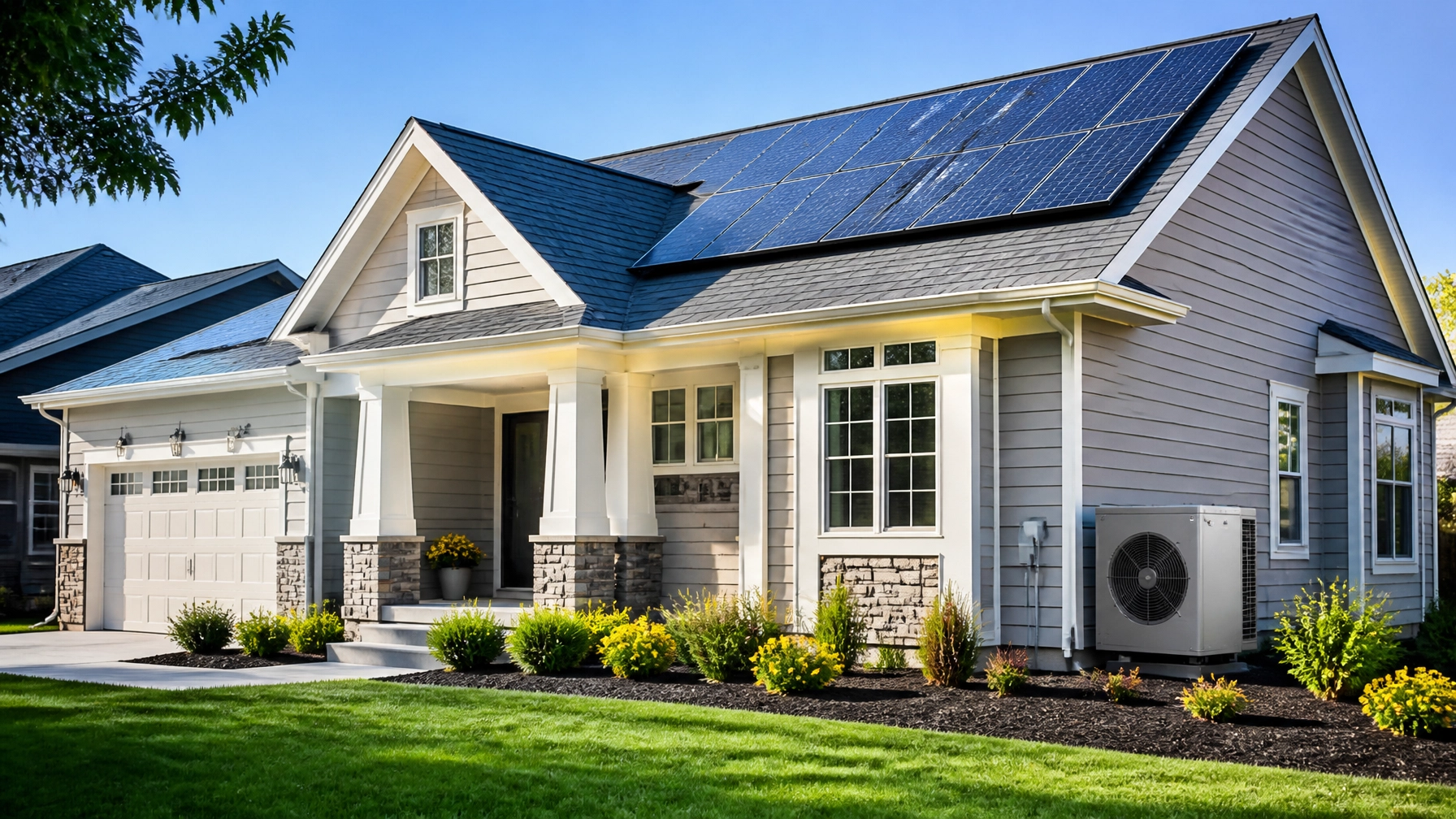
For homeowners in Wheeling and the Chicagoland area, the shift toward sustainable living is more than just a trend, it’s a practical response to rising energy costs and the desire for more resilient homes. If you have already invested in solar panels, or are considering them, your next logical step is looking at how you heat and cool your home.
Choosing between a heat pump and a traditional HVAC system (like a gas furnace paired with a central air conditioner) is one of the most significant decisions you will make for your property's long-term efficiency. While both systems provide comfort, they interact with your solar energy production in very different ways. At Mechanical Management & Design Solutions (MMDS), we specialize in helping local residents navigate these technical choices to maximize their comfort and their savings.
What is the difference between a heat pump and a traditional HVAC system?
A heat pump is an all-electric system that moves heat rather than creating it, providing both heating and cooling from a single unit. In contrast, a traditional HVAC system typically relies on a natural gas furnace to generate heat by burning fuel and a separate electric air conditioner to remove heat during the summer.
To understand why this matters for your solar-powered home, you first need to understand the mechanics. Traditional HVAC setups are "split" systems. In the winter, your furnace burns natural gas to create warmth. In the summer, your air conditioner uses electricity to cycle refrigerant and dump heat outside. This means your heating is tied to fossil fuels, while your cooling is tied to the electrical grid.
Heat pumps change the game by using electricity for both functions. Instead of burning fuel, a heat pump uses a refrigerant cycle to "scavenge" heat from the outdoor air, even when it's cold, and move it inside. Because it is moving heat rather than creating it, it can achieve efficiency ratings of 300% or more. This makes it an ideal partner for solar energy, which can power the entire HVAC lifecycle without needing a gas line.

Why is a heat pump the better choice for solar-powered homes?
A heat pump is superior for solar-powered homes because it runs entirely on electricity, allowing you to power your entire heating and cooling load with the energy your roof produces. Traditional gas furnaces cannot be powered by solar, meaning you remain dependent on fluctuating natural gas prices regardless of your solar capacity.
When you install solar panels, your goal is usually to reach "net zero" or at least drastically reduce your utility bills. If you stick with a traditional gas furnace, you are hitting a "glass ceiling" on your energy independence. No matter how many solar panels you have, they won't help you burn less gas in January.
By switching to a heat pump, you "electrify" your heating. This allows your solar array to offset your winter heating costs just as it does your summer cooling costs. Furthermore, because heat pumps are incredibly efficient, each kilowatt-hour (kWh) of solar electricity you produce goes much further. For every 1 unit of electricity your solar panels provide, a heat pump can deliver 2 to 4 units of heat to your living room.
Can heat pumps handle the Chicago winter?
Modern "cold-climate" heat pumps are specifically engineered to maintain high efficiency and performance even when temperatures drop well below zero, making them highly effective for the Chicagoland climate. While older models struggled in extreme cold, today’s inverter-driven units can keep your home warm even at -13°F or lower.
Many homeowners in Wheeling worry that a heat pump won't stand up to a "Polar Vortex." It’s a valid concern based on older technology. However, the HVAC industry has made massive leaps in recent years. Cold-climate heat pumps (CCHPs) use advanced compressors and refrigerant mixtures that can extract heat from freezing air.
At Mechanical Management & Design Solutions (MMDS), we often recommend a "dual-fuel" or "hybrid" approach for those who want ultimate peace of mind. In this setup, a heat pump handles the heating for the majority of the year, and your existing furnace (or a high-efficiency backup) only kicks in during the absolute coldest hours of the season. This ensures you are always comfortable while still maximizing your solar usage during 95% of the winter.

How much can you save by switching to a heat pump with solar?
Switching to a heat pump in a solar-powered home can save you hundreds of dollars annually by eliminating or drastically reducing your natural gas bill and maximizing the "self-consumption" of your solar energy. By using your own free electricity to heat your home, you avoid the seasonal price spikes common in the natural gas market.
The savings are two-fold. First, there is the operational efficiency. A heat pump is simply cheaper to run than electric resistance heating and often competitive with natural gas, depending on current rates. Second, there is the synergy with solar. If your solar panels produce more energy than you use during the day, that "extra" energy is essentially wasted or sold back to the grid for a low rate. Using that excess energy to power a heat pump keeps the value of that energy inside your home.
When we perform a heater installation and replacement in the Chicagoland area, we look at your energy production data to ensure the new system is sized correctly. A properly sized heat pump ensures you aren't paying for grid power when your sun-soaked roof could be doing the work for you.
What should you look for when upgrading your system?
When upgrading, you should prioritize equipment with high SEER2 (for cooling) and HSPF2 (for heating) ratings, and specifically look for "cold-climate" certification if you plan to use it as your primary heat source in Illinois. You should also ensure that the unit is compatible with smart thermostats that can optimize energy use based on solar production.
Not all heat pumps are created equal. For our local climate, the Heating Seasonal Performance Factor (HSPF2) is the most critical metric. This measures the efficiency of the unit over an entire heating season. The higher the number, the less electricity it uses.
It is also vital to consider your ductwork. If you are doing an ac installation and replacement, it is the perfect time to evaluate if your current ducts can handle the airflow of a modern heat pump. Sometimes, a "ductless" mini-split system is a better option for specific zones of the home, allowing for even more granular energy control.

How do I get started with a heat pump installation in Wheeling?
The first step is to schedule a professional home energy assessment with an HVAC expert who understands both solar integration and cold-weather performance. A qualified technician will calculate your home's "heat load" to determine the exact size and type of heat pump that will work best for your unique layout and solar capacity.
At Mechanical Management & Design Solutions (MMDS), we don't believe in one-size-fits-all solutions. We take the time to understand your home's insulation, your solar array's output, and your family's comfort preferences. Whether you are looking for a full system overhaul or a hybrid upgrade, we provide the technical expertise needed for a seamless transition.
Frequent Asked Questions
1. Do I need to remove my furnace to get a heat pump?
Not necessarily. Many homeowners choose to keep their furnace as a "backup" heat source in a dual-fuel configuration. This provides the best of both worlds: extreme efficiency most of the time and high-output gas heat for the coldest Chicago nights.
2. Is a heat pump noisier than an air conditioner?
Actually, modern heat pumps are often quieter than traditional AC units. Many use variable-speed technology, which means they ramp up and down slowly rather than "clunking" on and off at full blast.
3. Will a heat pump work with my existing solar panels?
Yes. Your solar panels produce electricity, and a heat pump runs on electricity. As long as your electrical panel has the capacity for the new circuit, your solar panels will naturally power the heat pump whenever they are generating energy.
4. How long do heat pumps last?
With regular maintenance, a high-quality heat pump typically lasts 15 to 20 years. Because they handle both heating and cooling, they do work year-round, so scheduling annual tune-ups is essential for longevity.
Maximize Your Savings with MMDS
If you're upgrading your HVAC system, help yourself and make sure the equipment you are purchasing qualifies for one of these discounts:
- Up to $900 on < 2.5 tons, ≥ 15.2 SEER2, ≥ 9.4 EER2, ≥ 8.1 HSPF2
- Up to $1,400 on ≥ 2.5 tons, ≥ 15.2 SEER2, ≥ 9.4 EER2, ≥ 8.1 HSPF2
- Up to $1,500 on < 2.5 tons, ≥ 17 SEER2, ≥ 9.4 EER2, ≥ 8.5 HSPF2
- Up to $2,000 on ≥ 2.5 tons, ≥ 17 SEER2, ≥ 9.4 EER2, ≥ 8.5 HSPF2
Discount with ENERGY STAR® certified smart thermostat:
- Up to $975 on < 2.5 tons, ≥ 15.2 SEER2, ≥ 9.4 EER2, ≥ 8.1 HSPF2
- Up to $1,475 on ≥ 2.5 tons, ≥ 15.2 SEER2, ≥ 9.4 EER2, ≥ 8.1 HSPF2
- Up to $1,575 on < 2.5 tons, ≥ 17 SEER2, ≥ 9.4 EER2, ≥ 8.5 HSPF2
- Up to $2,075 on ≥ 2.5 tons, ≥ 17 SEER2, ≥ 9.4 EER2, ≥ 8.5 HSPF2
To apply for these discounts, Call or Text MMDS at (847) 221-6280. Our team will help you select the eligible equipment and handle the necessary documentation to ensure you receive your savings.
Don't leave your solar energy's potential on the table. Mechanical Management & Design Solutions (MMDS) is proud to serve Wheeling and the Chicagoland area with expert HVAC advice and installation. Take a moment to ensure your home is as efficient as it can be.
Call or Text us today at (847) 221-6280 to schedule your consultation!