

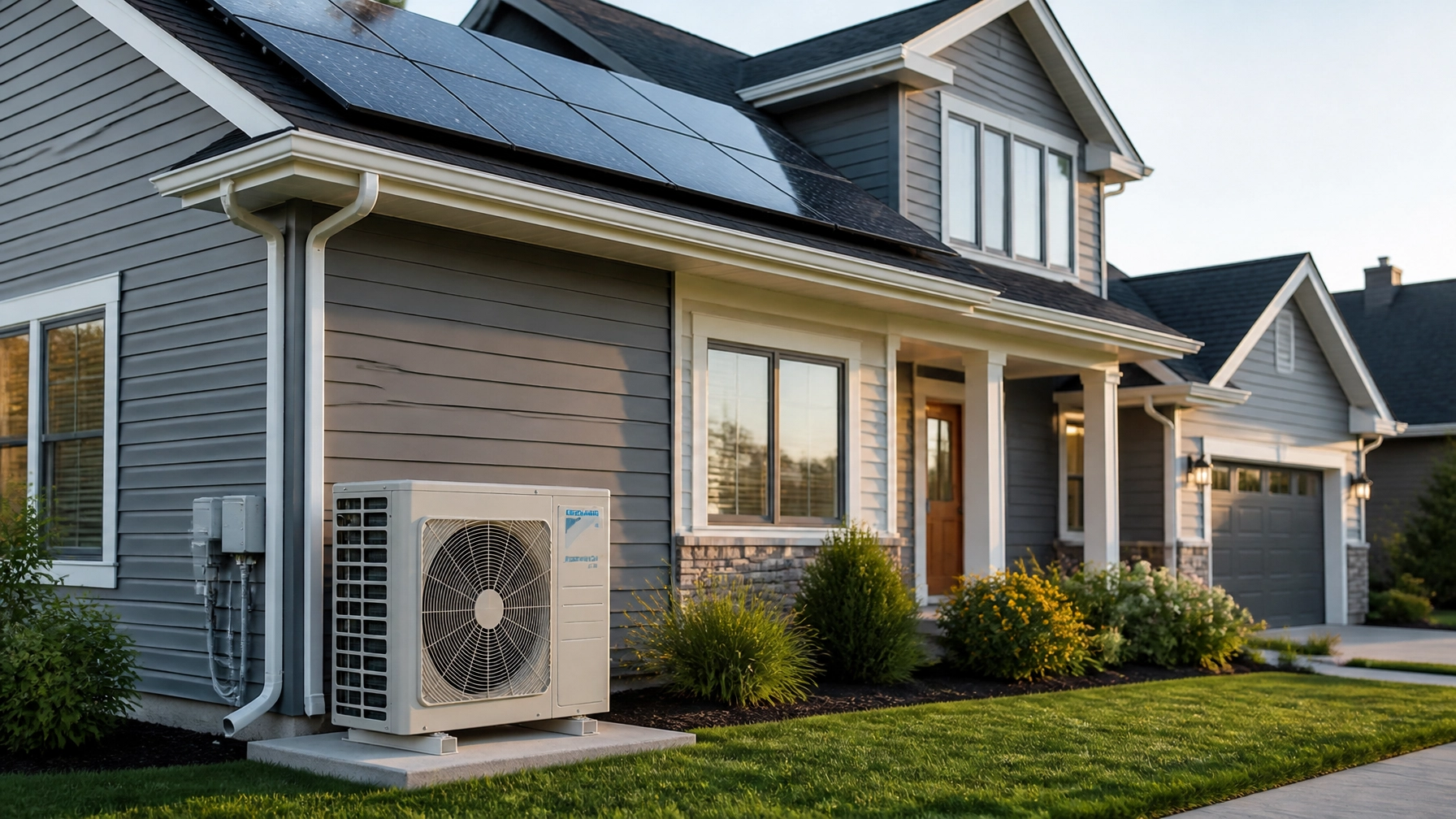
For homeowners in Wheeling and the Chicagoland area, managing energy costs is a year-round challenge. Between the humid, sweltering summers and the biting cold of a Midwest winter, your HVAC system is often the single largest consumer of electricity and gas in your home. At Mechanical Management & Design Solutions (MMDS), we are seeing a significant shift toward a more sustainable and cost-effective solution: the integration of high-efficiency heat pumps with residential solar panel systems.
Combining these two technologies allows you to take control of your utility bills by generating your own power and using it in the most efficient way possible. In this guide, we will explore how this integration works and why it is becoming the gold standard for residential comfort in our region.
How does a heat pump work with solar panels?
Heat pumps use electricity to move heat rather than create it, and when that electricity is generated by your solar panels, your operating costs drop significantly. This combination creates a self-sustaining cycle where your home uses renewable energy to power its most energy-intensive system.
Unlike traditional furnaces that burn fuel to create heat, a heat pump acts like a reversible air conditioner. In the summer, it pulls heat from inside your home and moves it outside. In the winter, it extracts heat from the outdoor air (even in cold temperatures) and brings it inside. Because moving heat is far more efficient than generating it, a heat pump can deliver up to three times more heat energy than the electrical energy it consumes.
When you install solar panels, you are essentially creating a personal power plant on your roof. By routing that "free" electricity to your heat pump, you are maximizing the value of every kilowatt-hour produced. Instead of selling excess solar power back to the grid for a minimal credit, you are using it to provide high-efficiency heating and cooling, which offers a much higher return on your investment.

What are the primary savings for Chicagoland homeowners?
Homeowners can see a reduction in total annual energy bills by a significant margin by offsetting both cooling and heating loads with solar production. The high efficiency of heat pumps multiplies the value of every solar-generated kilowatt-hour, often leading to a much faster payback period for both systems.
In the Chicagoland market, electricity and natural gas prices can fluctuate wildly. By integrating solar with a heat pump, you insulate your household from these price swings. During our peak summer months, solar production is at its highest, which perfectly aligns with the high demand for air conditioning. Your solar panels can often cover the entire cost of running your heat pump in cooling mode, effectively giving you free AC installation and replacement benefits through operational savings.
Furthermore, switching from a traditional gas furnace to an electric heat pump allows you to consolidate your energy needs. Instead of paying two separate utility bills (gas and electric), you can transition toward an all-electric home where your solar panels handle the bulk of the load. This "fuel switching" is particularly effective in Wheeling and the surrounding suburbs where modern electric rates make heat pump operation highly competitive compared to aging, inefficient gas systems.
Is a heat pump effective during a Chicago winter?
Modern cold-climate heat pumps are specifically engineered to operate efficiently at temperatures well below zero, making them a reliable primary heating source for the Chicagoland climate. These systems maintain high performance even when the outdoor air is freezing, ensuring your home remains comfortable throughout the winter.
A common misconception is that heat pumps only work in moderate climates. While older models struggled in the Midwest, today’s "cold-climate" heat pumps utilize variable-speed inverters and advanced refrigerants to extract heat even when it is -13°F outside. For homeowners in the Wheeling area, this means you can rely on your heat pump for the vast majority of the heating season.
To ensure maximum safety and comfort, many residents choose to keep their existing furnace as a backup (a "dual-fuel" system) or install supplemental electric heat strips. However, with professional sizing and installation from Mechanical Management & Design Solutions (MMDS), a properly selected heat pump can handle the bulk of Chicago’s winter demands. If you are considering a transition, we recommend reviewing our guide on heater installation and replacement to understand which system capacity fits your home’s specific layout.

Does solar power the heat pump during the night?
While solar panels do not produce power at night, the energy generated during the day can be credited back to you through net metering or stored in a battery system to offset the heat pump's evening usage. This balance ensures you maximize your savings regardless of the time of day or the position of the sun.
In Illinois, net metering policies allow homeowners to send excess electricity back to the grid during the day when the sun is shining. In exchange, the utility company provides credits on your bill that you can use at night when your heat pump is running. This effectively turns the power grid into a giant "battery" for your home.
For those who want even more independence, adding a physical battery storage system allows you to store that solar energy on-site. This is particularly useful for avoiding peak-time electricity rates and providing a layer of resilience during power outages. If you are interested in the technical side of how your home’s panel can handle these new loads, our electrical services team can help evaluate your current infrastructure to ensure it is ready for solar and heat pump integration.
How do I ensure maximum efficiency from my integrated system?
To get the most out of your investment, you must ensure that your heat pump is properly sized for your home and that your solar array is designed to meet the increased electrical demand. Regular maintenance and the use of a smart thermostat are also critical for optimizing energy consumption patterns.
Integration is about more than just installing equipment; it’s about creating a balanced ecosystem. If a heat pump is too small, it will struggle to heat your home during a Chicago blizzard, leading to higher energy use. If it is too large, it will "short cycle," which reduces equipment longevity and decreases dehumidification in the summer.
We encourage homeowners to:
- Schedule a Load Calculation: Never guess on size. We use industry-standard calculations to determine exactly how much heating and cooling your home needs.
- Optimize Your Solar Array: Inform your solar installer that you are moving to a heat pump so they can size the system to cover the additional electrical load.
- Use Smart Controls: An ENERGY STAR® certified smart thermostat can be programmed to pre-heat or pre-cool your home during the day when solar production is at its peak.
- Ensure Proper Insulation: A heat pump works best in a well-sealed home. Take a moment to check for drafts around windows and doors to keep that solar-generated comfort inside.

Take Action for a More Efficient Home
Integrating a heat pump with solar panels is a pragmatic, forward-thinking strategy for any property owner in Wheeling and the Chicagoland area. By combining these technologies, you enhance your home's value, improve your equipment longevity, and drastically reduce your monthly overhead.
At Mechanical Management & Design Solutions (MMDS), we specialize in the professional installation of high-efficiency HVAC systems that help you achieve these goals. Whether you are looking to replace an aging furnace or upgrade to a high-SEER2 air conditioning system, our team is here to provide expert guidance tailored to the local climate.
If you're upgrading your HVAC system, help yourself and make sure the equipment you are purchasing qualifies for one of these discounts:
- Up to $900 on < 2.5 tons, ≥ 15.2 SEER2, ≥ 9.4 EER2, ≥ 8.1 HSPF2
- Up to $1,400 on ≥ 2.5 tons, ≥ 15.2 SEER2, ≥ 9.4 EER2, ≥ 8.1 HSPF2
- Up to $1,500 on < 2.5 tons, ≥ 17 SEER2, ≥ 9.4 EER2, ≥ 8.5 HSPF2
- Up to $2,000 on ≥ 2.5 tons, ≥ 17 SEER2, ≥ 9.4 EER2, ≥ 8.5 HSPF2
Discount with ENERGY STAR® certified smart thermostat:
- Up to $975 on < 2.5 tons, ≥ 15.2 SEER2, ≥ 9.4 EER2, ≥ 8.1 HSPF2
- Up to $1,475 on ≥ 2.5 tons, ≥ 15.2 SEER2, ≥ 9.4 EER2, ≥ 8.1 HSPF2
- Up to $1,575 on < 2.5 tons, ≥ 17 SEER2, ≥ 9.4 EER2, ≥ 8.5 HSPF2
- Up to $2,075 on ≥ 2.5 tons, ≥ 17 SEER2, ≥ 9.4 EER2, ≥ 8.5 HSPF2
To apply for these discounts, Call or Text MMDS at (847) 221-6280. Our team will help you select the eligible equipment and handle the necessary documentation to ensure you receive your savings.
Don't wait for the next energy price spike. Take the first step toward energy independence today. Call or Text Mechanical Management & Design Solutions (MMDS) at (847) 221-6280 to schedule your consultation in Wheeling and the Chicagoland area.