

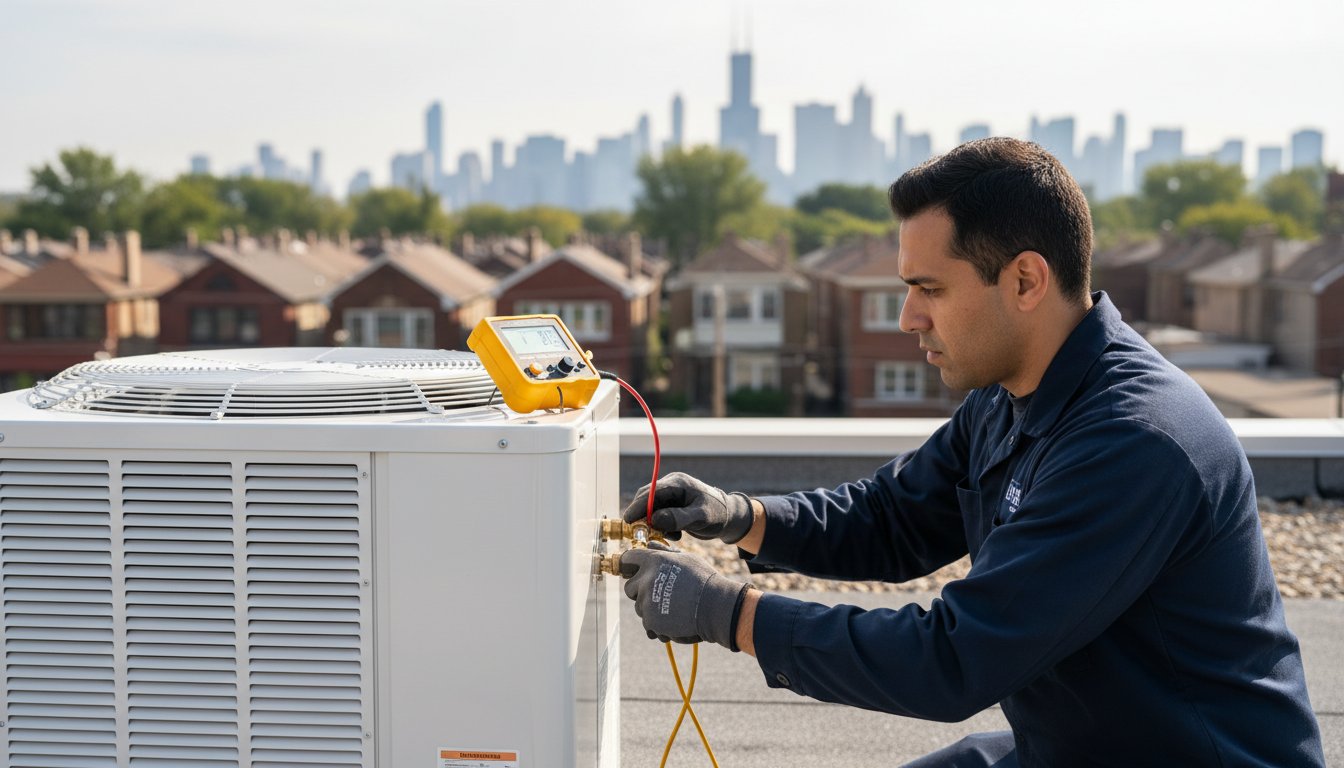
Most Chicago homeowners view a new air conditioner as a simple retail purchase, but treating it like a toaster instead of a complex engineering project is why many families face uneven cooling and premature system failure. You already know that surviving a July heatwave in a multi-story brick home requires more than just a box that blows cold air. It’s frustrating to pay for a professional ac installation only to deal with high energy bills and a second floor that never stays comfortable.
At Mechanical Management & Design Solutions, we believe in doing things right the first time by applying over 100 years of combined experience to our local climate. This 2026 buyer’s guide will help you understand the $7,200 to $7,500 average cost for mid-range 16 SEER2 systems while maximizing the 30% federal tax credit. We’ll break down how to handle Chicago’s 10.25% sales tax, secure ComEd rebates of up to $2,000, and select a system designed to provide reliable cooling for 15 years or more.
Key Takeaways
- Learn why custom-engineered cooling solutions outperform standard box swaps by addressing air balancing and system sizing.
- Navigate complex 2026 Chicago building codes and permit requirements to ensure your ac installation is fully compliant and safe.
- Compare central air and ductless mini-split systems to find the perfect fit for unique Chicago properties, including historic bungalows and graystones.
- Master the technical installation process, from EPA-standard refrigerant removal to electrical integration and initial site assessment.
- Discover how professional design-build expertise ensures your new cooling system delivers maximum energy efficiency and longevity for 15 years or more.
What is Professional AC Installation and Why Does It Matter?
Professional ac installation is far more than just hauling a heavy metal unit into your backyard or onto your roof. It’s a sophisticated integration of Heating, ventilation, and air conditioning (HVAC) principles that ensures your home’s mechanical ecosystem functions as a single, efficient unit. Unlike a “box swap,” where a contractor simply replaces an old unit with a new one of the same size, a custom-engineered solution involves precise load calculations. At Mechanical Management & Design Solutions, we analyze your home’s square footage, window orientation, and insulation levels to determine the exact tonnage needed for the Chicago climate.
In 2026, failing to hire a licensed expert doesn’t just risk your comfort; it effectively voids your manufacturer warranty. Major equipment brands now require documented professional startup and commissioning to honor their 10-year parts guarantees. Additionally, the labor behind your ac installation directly dictates your system’s SEER2 efficiency rating. A high-end 16 SEER2 unit can quickly drop to the efficiency of a decade-old model if the airflow isn’t balanced or the ductwork leaks. This leads to monthly utility bills that are 20% to 30% higher than they should be, erasing any savings from the initial purchase.
The Hidden Risks of Improper Installation
Improper installation creates a cascade of mechanical failures that are expensive to fix. If refrigerant levels are off by even 5%, it can cause liquid slugging that destroys a new compressor within the first few months of operation. We frequently see DIY attempts or budget installs where indoor and outdoor coils are mismatched. This creates excessive “sweating” and potential mold growth because the system cannot properly dehumidify the air during a humid Illinois July. Beyond performance, uncertified electrical wiring poses a genuine fire risk, especially in older Chicago homes where existing panels may not be rated for the draw of modern high-efficiency units.
Investment vs. Expense: The Long-Term ROI
Investing in a premier installation pays for itself through reduced operational costs and extended system longevity. By choosing a partner with over 100 years of combined experience, you ensure “Services Done Right The First Time.” This precision eliminates the $300 to $600 emergency service calls common with budget installs that fail during the first major heatwave. When calculated over a 10-year period, the energy savings and avoided repairs from a professional install often cover a significant portion of the initial equipment cost. AC installation is a precision engineering task designed to deliver consistent home comfort and peak mechanical performance for 15 years or longer.
Choosing the Right Cooling System for Your Property
Selecting the right equipment for your Chicago property requires more than just picking a brand from a catalog. You must choose from several types of HVAC systems based on your building’s structure and your long-term energy goals. For most modern homes in Cook County, central air conditioning remains the gold standard because it utilizes existing ductwork to provide uniform cooling. However, if you live in a historic graystone or have a finished basement with no air vents, ductless mini-splits offer a premier solution that avoids the mess of invasive construction. Your choice of ac installation technology will ultimately dictate your comfort levels during our intense July humidity.
Efficiency ratings have also evolved. In 2026, we focus heavily on SEER2 (Seasonal Energy Efficiency Ratio 2) ratings, which use more rigorous testing standards than previous years. A mid-range 16 SEER2 system is often the sweet spot for Chicago homeowners, balancing the initial purchase price with significant monthly savings. When you combine high-efficiency equipment with a 30% federal tax credit, the upgrade becomes a strategic investment rather than a simple expense. Our team can help you evaluate your cooling needs to ensure you select a system that qualifies for all available 2026 incentives.
Heat Pumps vs. Traditional AC
Electric heat pumps are rapidly becoming the primary choice for Illinois residents due to their versatility. Unlike a traditional air conditioner that only cools, a heat pump provides efficient heating during our shoulder seasons. During extreme 95°F days with high humidity, modern heat pumps perform exceptionally well. Many of our clients now opt for a dual-fuel system. This setup pairs an electric heat pump with a high-efficiency gas furnace, ensuring you have the most cost-effective heating source regardless of how low the temperature drops in January.
Sizing Your System: The Manual J Load Calculation
One of the biggest mistakes a contractor can make is sizing a system based solely on square footage. This “rule of thumb” approach is outdated and leads to poor performance. At Mechanical Management & Design Solutions, we perform a detailed Manual J Load Calculation for every ac installation. We analyze your home’s insulation R-values, the orientation of your windows toward the sun, and even the height of your ceilings. If a system is oversized, it will “short-cycle,” turning on and off too quickly. This prevents the unit from running long enough to remove humidity, leaving your home feeling clammy even if the air is cold. Getting the engineering right ensures your system runs efficiently for its full 15-year lifespan.

The Chicago Factor: AC Installation Challenges in Cook County
Chicago’s architectural diversity is a source of pride, but it presents significant hurdles during a professional ac installation. As of May 2026, the City of Chicago Department of Buildings requires specific permits for all permanent cooling systems. This isn’t just a bureaucratic step; it’s a safety requirement ensuring your system complies with the 2021 International Energy Conservation Code (IECC). Our team handles the complex filing process for you, drawing on nearly twenty-five years of experience in the local market to ensure every project meets the latest municipal standards.
Historic bungalows and graystones weren’t designed with modern climate control in mind. Their thick masonry walls and narrow floor plans often lead to uneven cooling and stagnant air pockets. We combat the heavy humidity rolling off Lake Michigan by recommending units with advanced dehumidification features. These systems are essential when the heat index exceeds 80°F, helping your home stay comfortable without overworking the compressor. Urban density also dictates design. In neighborhoods with tight lots, outdoor condensers often sit in narrow alleyways with minimal clearance. We prioritize precise placement to ensure your unit has the proper airflow to prevent overheating and premature mechanical failure.
Ductwork Integrity in Older Homes
Many 50-year-old duct systems were built strictly for heating. Modern high-efficiency blowers create higher static pressure that can cause these old joints to leak or whistle. Utilizing duct sealing services is often a necessary step to ensure your new unit doesn’t waste 25% of its cooling power in the attic or crawlspace. If your home’s historic structure cannot accommodate larger ducts without destroying original woodwork, we may suggest retrofitting with high-velocity systems or strategic ductless solutions to preserve your property’s character.
Electrical Readiness for New Systems
A modern 4-ton AC unit draws significant power that older Chicago electrical systems weren’t built to handle. We frequently find that homes with 100-amp service are already at their limit before the cooling season begins. Professional electrical panel upgrades are often a prerequisite for a safe ac installation. We provide dedicated circuits for every outdoor condenser, preventing tripped breakers during peak demand periods in August. This comprehensive engineering approach ensures your system remains reliable when you need it most, reflecting our commitment to providing services done right the first time.
Our Step-by-Step AC Installation Process
Our approach to ac installation follows a methodical design-build framework that treats your home as a high-stakes mechanical environment. We don’t just show up and start wrenching; we begin with an initial site assessment to verify the engineering foundation. This includes a final check of your electrical capacity, ductwork integrity, and condensate drainage paths. By the time our team arrives, we’ve already reviewed the Manual J load calculations discussed earlier to ensure the equipment perfectly matches your property’s specific cooling requirements.
The physical work begins with safe system removal. We utilize EPA-certified recovery equipment to capture old refrigerants, preventing harmful atmospheric release. Once the old unit is cleared, we focus on precision placement. We level the outdoor condenser on a reinforced pad to ensure proper oil return to the compressor and install the new evaporator coil with airtight seals. For the line set and electrical connections, we braze copper lines using a nitrogen purge to prevent internal oxidation and wire the system to meet all 2026 Chicago building codes. If you’re ready for a system that lasts, schedule your professional installation today with our expert team.
Vacuum Testing and Refrigerant Charging
Pulling a deep vacuum is the most critical step for ensuring your system’s 15-year longevity. We use high-precision microns gauges to verify that all moisture and non-condensable gases are removed from the lines. This prevents the internal acid buildup that often destroys compressors in budget-grade installs. Rather than “eyeballing” the refrigerant levels, we use digital scales to provide a precision charge based on the exact length of your line set. We also perform a high-pressure nitrogen leak test at 400 PSI to guarantee a lifetime of reliable, leak-free cooling.
Final Calibration and Homeowner Walkthrough
The final stage of our ac installation is commissioning and calibration. We don’t consider the job done until we’ve performed a multi-point performance test, checking static pressure and temperature splits across the coil. We also calibrate your thermostat and test any building automation features to ensure seamless operation. During the final walkthrough, we’ll show you exactly where your air filters are located and establish a maintenance schedule. We conclude by verifying air balancing in every room, ensuring that even the furthest bedroom in your Chicago bungalow reaches the exact temperature set on your thermostat.
Why Choose MEMASO for Your Chicago AC Installation?
Choosing a partner for your home’s mechanical needs shouldn’t feel like a gamble. While national retailers often outsource labor to the lowest bidder, Mechanical Management & Design Solutions provides direct accountability and technical authority. We approach every residential ac installation with the same rigor we apply to high-stakes commercial facilities. With nearly twenty-five years in the local market and over 100 years of combined experience, our team understands that cooling a Chicago home is a complex engineering task. We don’t just swap units; we design systems that integrate perfectly with your building’s unique requirements.
We provide comprehensive design-build capabilities that set us apart from standard contractors. Because we’re experts in mechanical, electrical, and plumbing systems, we manage every facet of the project in-house. This means you don’t have to coordinate between an HVAC tech and an electrician to upgrade your panel or fix a drainage issue. We handle the cooling, the wiring, and the plumbing to ensure a seamless fit. Once the job is finished, our relationship doesn’t end. We provide 24/7 emergency support for every system we install, giving you total peace of mind during the most brutal August heatwaves.
Services Done Right The First Time
Our core brand promise is simple: precision engineering leads to zero-defect results. Local Chicago businesses and homeowners trust our technical depth because we prioritize air balancing and system longevity over quick sales. You’ll have direct access to senior consultants who understand the physics of airflow, not just sales representatives looking to meet a quota. This commitment to “Services Done Right The First Time” prevents the frequent repairs and high energy bills that plague poorly executed projects. We take the anxiety out of home mechanical upgrades by delivering stable, high-performance results from day one.
Ready for a Cooler Summer?
Preparing for the 2026 cooling season starts with a professional load calculation. Our consultants will help you navigate the complex landscape of local utility rebates and federal incentives. You may be eligible for ComEd rebates of up to $2,000 for qualifying high-efficiency heat pumps or a 30% federal tax credit for new central air systems. We provide clear, methodical guidance to help you maximize these savings while ensuring your home remains a sanctuary of comfort. Don’t wait for the first 90-degree day to discover your old system is failing. Get your professional AC installation quote from MEMASO today.
Secure Your Home Comfort for the 2026 Season
A high-performance cooling system is more than a luxury; it’s a vital component of your home’s mechanical health. By prioritizing precision engineering over a simple equipment swap, you ensure your ac installation delivers the efficiency and reliability your Chicago property deserves. You now have the technical knowledge to navigate SEER2 ratings and local permit requirements with confidence. Making an informed decision today protects your investment and guarantees a comfortable living environment for the next 15 years.
Mechanical Management & Design Solutions brings over 100 years of combined experience to every project. We stand by our promise of services done right the first time, providing the technical depth and 24/7 emergency support you need for total peace of mind. Our team is ready to help you design a cooling solution that fits your budget and your home’s unique architecture. Schedule Your Professional AC Installation Consultation today and experience the difference that local authority and seasoned expertise can make for your family’s comfort.
Frequently Asked Questions
How long does a typical central AC installation take in Chicago?
A standard residential ac installation typically takes between 8 and 14 hours to complete. For straightforward replacements where ductwork is already in place, our team can often finish the project in a single day. If your historic graystone or bungalow requires significant electrical panel upgrades or custom ductwork modifications, the process might extend into a second day. We ensure every connection meets our engineering standards before signing off on the job.
Can I install a new AC unit myself to save money?
You cannot legally or safely install a permanent air conditioner yourself in Chicago. The City of Chicago Department of Buildings requires a licensed contractor to pull permits for all new installations to ensure code compliance. EPA Section 608 regulations also mandate that only certified professionals handle refrigerants. A DIY attempt voids your manufacturer warranty and risks catastrophic electrical errors that could damage your home’s infrastructure. It’s simply not worth the safety risk.
What is the average lifespan of a new air conditioner in the Chicagoland area?
A professionally installed and maintained air conditioner in the Chicago area typically lasts between 15 and 20 years. Your system’s actual longevity depends heavily on the quality of the initial installation and consistent annual service. Systems that operate with mismatched coils or restricted airflow often see their lifespan cut short by 30%. These units frequently fail well before the 12-year mark due to mechanical fatigue and overwork.
Should I replace my furnace at the same time as my AC installation?
Replacing your furnace alongside your new air conditioner is generally the most cost-effective and efficient choice. A matched system ensures that the indoor evaporator coil and the furnace blower motor work in perfect harmony to achieve peak SEER2 ratings. Combining these projects saves you roughly 15% to 20% on total labor costs compared to scheduling two separate installations over different years. It also ensures your entire HVAC system is under the same warranty.
What SEER2 rating is recommended for Chicago’s climate in 2026?
A 16 SEER2 rating is currently the recommended standard for balancing upfront costs with long-term energy savings in Cook County. While higher ratings exist, the 16 SEER2 level provides significant relief from high summer energy bills without the extreme price tag of ultra-premium units. Many systems at this efficiency level also qualify for the 30% federal tax credit. This credit provides up to $600 in savings for equipment placed in service through December 31, 2032.
What happens if my new AC installation isn’t sized correctly?
An incorrectly sized ac installation leads to poor humidity control and premature equipment failure. If a unit is too large, it will “short-cycle,” turning off before it can properly dehumidify the air. If it’s too small, the system will run constantly during a 90-degree heatwave, causing your utility bills to spike by 25% or more. We use precise Manual J calculations to ensure your system is sized perfectly for your specific square footage and insulation.
Are there any local Chicago rebates for high-efficiency AC installation?
ComEd offers substantial rebates for 2026, including up to $2,000 for qualifying high-efficiency heat pumps that provide both cooling and heating. You can also take advantage of the federal Energy Efficient Home Improvement Credit for a 30% tax break on qualifying central air systems. Our team helps you navigate these programs to ensure you receive every dollar of savings available. We stay updated on IRA-funded state rebates to maximize your return on investment.
How do I know if I need a full AC replacement or just a repair?
We recommend a full replacement if your current unit is over 12 years old or if a single repair exceeds 50% of the cost of a new system. If you’ve noticed a steady 20% increase in your cooling bills over the last two summers, your system’s internal components are likely failing. We’ll provide a detailed mechanical assessment to help you decide if a repair is a stable long-term solution. Often, the energy savings of a new unit pay for the upgrade within 5 to 7 years.