

Could a minor drop in water pressure or a faint, persistent odor in the mechanical room actually be the first warning of a five-figure structural repair? For facility managers overseeing Chicago’s older commercial stock, these subtle signs of commercial plumbing problems are often the only notice you’ll get before a pipe failure forces a total building shutdown. You already know that an unexpected plumbing emergency doesn’t just blow the quarterly budget; it disrupts tenants and can lead to long-term structural damage that’s difficult to remediate.
We understand the pressure of maintaining high standards in a city where aging cast iron systems and a complex combined sewer network are the daily reality. With Chicago water rates having increased to $37.18 in 2026, even a small, undetected leak impacts your operating costs immediately. This guide provides a reliable way to spot trouble early so you can protect your property and your bottom line. We’ll walk through five critical indicators, ranging from hidden moisture to drainage red flags, giving you a technical edge in facility maintenance and helping you minimize business disruption through proactive care.
Key Takeaways
- Understand how Chicago’s extreme temperature fluctuations and high-occupancy demands create unique mechanical stresses on commercial piping systems.
- Learn to identify the five most common signs of commercial plumbing problems, from unexplained utility bill spikes to persistent odors in mechanical rooms.
- Discover the hidden risks of slab leaks and how soil shifting in local terrain can lead to “silent” foundation pipe bursts.
- Implement a proactive monthly checklist to verify the stability of commercial boilers and the integrity of exposed shut-off valves.
- Explore how integrating plumbing into a total facility management strategy reduces the risk of costly downtime and long-term structural damage.
Why Commercial Plumbing Problems Are Different in Chicago
Managing a commercial facility in the Windy City requires a different level of vigilance than anywhere else. While residential systems deal with predictable, low-volume usage, Chicago’s commercial properties face high-occupancy demands that put constant stress on every joint and seal. In a downtown high-rise or a busy River North warehouse, the sheer volume of water moving through the system means that minor issues escalate into disasters within hours. Recognizing the early signs of commercial plumbing problems is the only way to stay ahead of the curve. It’s not just about a leaky faucet; it’s about the integrity of a high-pressure environment that serves hundreds or thousands of people daily.
Our local climate adds another layer of complexity. Chicago’s extreme temperature fluctuations cause pipes to expand and contract rapidly. When the temperature drops from a mild 40 degrees to sub-zero overnight, the physical stress on metal and PVC is immense. This thermal cycling often leads to hairline fractures or loosened fittings that remain hidden until they fail. Beyond the weather, facility managers must navigate strict Cook County health codes and Illinois Administrative regulations. For instance, food service establishments must maintain specific grease interceptor standards. Failing to meet these compliance markers doesn’t just risk a fine; it can lead to a full building closure and devastating operational downtime.
The Complexity of MEP Integration
Modern plumbing systems in a high-rise are far more than just pipes and drains. They are deeply integrated with your HVAC and building automation systems. A drop in water pressure can signal a problem with your commercial water heaters or boilers, potentially affecting your building’s climate control. In large-scale facilities, there’s a constant risk of cross-contamination if backflow prevention isn’t monitored. This is why specialized commercial maintenance is superior to general plumbing. A seasoned professional looks at the entire mechanical, electrical, and plumbing (MEP) ecosystem to ensure one failure doesn’t trigger a domino effect across your facility.
Chicago’s Aging Infrastructure Challenges
Many iconic buildings in the Loop or River North were constructed before 1970. These structures often rely on legacy piping, including cast iron drain systems that are prone to scaling, corrosion, and eventual collapse. The City of Chicago Department of Water Management is currently managing approximately 400,000 lead service lines across the city, highlighting the age of our shared infrastructure. Additionally, Chicago uses a combined sewer system. During heavy rainfall, these lines can become overwhelmed, leading to backflow issues for properties in low-lying areas. Identifying the signs of commercial plumbing problems in these older buildings requires a consultant who understands how historic materials interact with modern demands.
The 5 Most Common Signs of Commercial Plumbing Problems
Spotting a plumbing failure before it becomes a catastrophe requires a keen eye and an ear for the unusual. In large-scale Chicago facilities, the sheer size of the system can mask issues until they reach a breaking point. Vigilance isn’t just about walking the floors; it’s about interpreting environmental cues. These five indicators are the most reliable signs of commercial plumbing problems that require a prompt technical response.
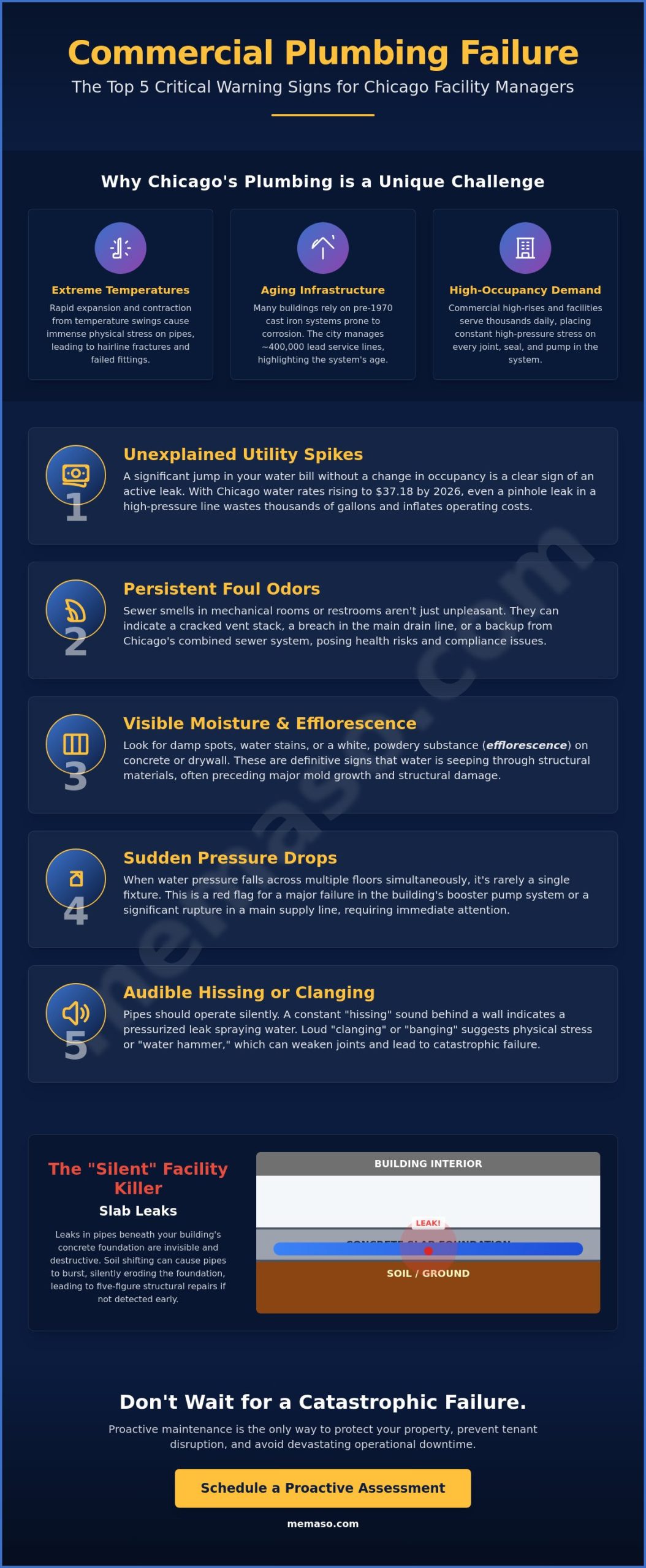
- Unexplained utility spikes: If your monthly water bill jumps significantly despite no change in occupancy, you have an active breach. With municipal water costs continuing to rise, even a pinhole leak in a high-pressure supply line can waste thousands of gallons and inflate your overhead.
- Persistent foul odors: Sewer smells in restrooms or mechanical rooms often point to dry P-traps, but they can also indicate a cracked vent stack or a backup in the municipal connection.
- Visible moisture and efflorescence: Look for a white, powdery substance on basement walls. This is efflorescence, a sign that water is seeping through the concrete. It often precedes structural damage or mold growth.
- Sudden pressure drops: When water pressure falls across multiple floors, it rarely involves a single fixture. This usually signals a failure in your building’s booster pump system or a major supply line rupture.
- Audible “hissing” or “clanging”: Pipes should be silent. A constant hiss behind a wall suggests a pressurized leak, while metallic clanging indicates physical stress on the system’s supports.
Staying ahead of these issues is easier with a partner who understands the intricacies of large-scale mechanical systems. Regular commercial plumbing maintenance can identify these red flags during a routine inspection, saving you from the high cost of emergency repairs.
Visual Indicators of Pipe Degradation
Examine exposed piping in utility closets for signs of oxidation. Greenish crust on copper or rusted “pimples” on steel pipes are clear warnings of imminent failure. You should also monitor water clarity. Rusty water often indicates internal pipe corrosion, while cloudy water might suggest sediment buildup in your commercial boilers. Slow drainage in high-traffic areas, like lobby restrooms, is rarely a simple clog; it’s often a sign of internal scaling within the building’s drainage network.
Acoustic Signs of Hidden Failures
A “water hammer” is a loud banging sound that occurs when a valve closes and the water’s momentum shakes the pipes. While it sounds like a nuisance, the resulting shockwaves can rupture joints over time. If you hear the sound of running water when no fixtures are active, your system is losing volume somewhere. You can often triangulate a leak by listening near wall cavities during quiet hours. If the sound is consistent, the breach is likely on the supply side, which requires immediate isolation to prevent flooding.
Slab Leak Repair: Detecting the “Silent” Facility Killer
A slab leak is perhaps the most insidious threat to a Chicago commercial property. Unlike a burst pipe in a wall, which usually makes its presence known quickly, a leak beneath your building’s concrete foundation can flow for months without detection. These failures often occur because of the city’s unique geological conditions. Chicago sits on clay-heavy soil that expands and contracts based on moisture levels and temperature shifts. This constant movement puts immense pressure on foundation pipes, leading to hairline cracks or full-scale bursts. Identifying these specific signs of commercial plumbing problems early is the only way to prevent the erosion of the soil supporting your building’s weight.
If you notice warm spots on a ground-level floor or see new cracks forming in the foundation or flooring, you likely have a sub-slab breach. A hot water line leak will actually radiate heat through the concrete, creating a localized “hot zone” that’s easy to feel. If you don’t catch it early, the water pressure beneath the slab can cause the foundation to heave or settle unevenly. This results in structural damage that requires far more than just a plumber to fix. It can eventually jeopardize the entire facility’s safety.
Slab Leaks vs. Standard Pipe Leaks
Repairing a standard leak in a ceiling or wall is a relatively straightforward mechanical task. A slab leak, however, is a major facility disruption. It often requires precision jackhammering or specialized tunneling to reach the breach. Modern facilities now rely on electronic leak detection. These tools use acoustic sensors to “hear” the leak through feet of concrete. This non-invasive approach is vital for minimizing downtime. From an insurance perspective, many commercial policies cover the resulting water damage but might not cover the cost of the foundation access itself. This makes early detection a financial necessity for any facility manager.
Early Detection Strategies for Slab Issues
The most effective way to confirm a sub-slab issue is a simple water meter test. During a period of low building activity, ensure all fixtures are shut off and check the main water meter. If the dial is still moving, you have an active leak. You should also watch for unexplained “wet spots” or darkening of concrete in basement or warehouse areas. Because these issues are so high-stakes, many local managers include annual video inspections of their main sewer lines. This lets you see the internal condition of foundation pipes before a collapse occurs. It’s a small investment to protect a massive asset.
The Facility Manager’s Monthly Maintenance Checklist
Proactive management is the difference between a controlled repair and an emergency building shutdown. While reacting to leaks is part of the job, a systematic monthly walkthrough allows you to document the early signs of commercial plumbing problems before they impact your tenants. This checklist is designed for the unique demands of Chicago’s high-density environments, where a single failure can have a massive ripple effect across multiple floors.
- Step 1: Inspect all exposed shut-off valves. Don’t just look for leaks; ensure the handles actually turn. Seized valves are a major liability during a crisis. Look for “green” oxidation on copper or salt deposits on steel, as these indicate slow, evaporating leaks.
- Step 2: Test temperature stability. Check your commercial water heaters and boilers. If the output temperature fluctuates significantly during peak hours, it often points to heavy scaling or a failing thermostat that needs immediate attention. Facilities with aging steam systems should consult a qualified boiler service Chicago specialist to ensure compliance with current Illinois mechanical codes.
- Step 3: Verify floor drain trap primers. Dry traps allow sewer gases to enter the building. Pour water into drains in mechanical rooms and basements to ensure the seals are intact and the primers are functioning.
- Step 4: Audit water meter readings. Compare your current usage against the same month from the previous year. If your occupancy hasn’t changed but your consumption has spiked, you have a hidden breach.
- Step 5: Cycle sump pumps and backflow preventers. Chicago’s combined sewer system can become overwhelmed during heavy rains. Manually lift the float switches on your pumps to ensure they engage and clear the pits effectively.
Establishing a baseline for your building’s performance makes it much easier to identify anomalies. To ensure your system remains in peak condition, consider scheduling a professional commercial plumbing maintenance audit to catch technical issues that a visual inspection might miss.
High-Traffic Area Inspection
Restrooms and industrial kitchens take the most abuse in any facility. Listen for “phantom flushing” in sensor-operated toilets, which can waste thousands of gallons of water if the diaphragm is worn. In commercial kitchens, check grease traps for surface accumulation or slow drainage. This is a critical step for staying compliant with local health codes. Finally, unscrew a few faucet aerators in public restrooms. If they’re filled with white grit or sediment, your pipes are likely scaling or your water heater is degrading internally.
Mechanical Room and Basement Audit
The mechanical room is the heart of your facility’s MEP system. Inspect boiler feed lines for pinhole leaks, which often appear as small, crusty bumps on the pipe surface. Check the floor area around HVAC-integrated plumbing for condensation or pooling water, as this can quickly lead to mold growth or electrical hazards. For true operational safety, verify that every emergency shut-off valve is clearly labeled and completely accessible. In a high-stakes environment, your team shouldn’t have to hunt for a valve while a main line is discharging water.
Proactive Commercial Plumbing Solutions with MEMASO
Managing a facility in Cook County requires a partner who looks beyond individual fixtures. At Mechanical Management & Design Solutions (MEMASO), we view your infrastructure as a unified mechanical ecosystem. By choosing a partner who understands the relationship between water supply, HVAC, and electrical systems, you move beyond simply reacting to the signs of commercial plumbing problems. Our approach is rooted in seasoned capability and a deep understanding of the local landscape, ensuring your facility remains operational and efficient year-round.
We provide customized commercial plumbing maintenance plans specifically engineered for the high-occupancy demands of urban buildings. Our team offers 24/7 emergency response for critical plumbing and electrical failures, recognizing that downtime in a high-stakes environment is never an option. Whether you are dealing with a complex boiler failure or a sudden system outage, our local expertise ensures a precise technical remedy that restores safety and comfort to your tenants immediately. We position ourselves as consultants who understand the local landscape and the unique stresses it places on your building.
From Design-Build to Emergency Repair
Our roots in design-build construction services give us a unique advantage when diagnosing hidden system failures. Because we understand how these systems are engineered and installed from the ground up, we can identify structural weaknesses or design flaws that lead to chronic issues. We prioritize high-efficiency replacements and boiler maintenance and repair strategies that offer a clear return on investment. With a collective tenure that spans decades in the Chicago market, Mechanical Management & Design Solutions serves as a stable, knowledgeable partner for our clients, moving from a call to action to a step-by-step resolution of your technical needs.
Schedule Your Professional Facility Assessment
A professional facility assessment with our team is a comprehensive deep dive into your building’s health. We evaluate the efficiency of your heaters and the integrity of your entire distribution network. We also specialize in integrating building automation systems to provide real-time monitoring of your mechanical assets. These smart sensors can alert you to pressure drops or unusual flow patterns before they manifest as visible signs of commercial plumbing problems. This predictive technology, combined with our methodical audit process, provides the peace of mind that comes from true professional reliability. Contact us today for a comprehensive facility evaluation and let our experts help you secure your property’s future.
Securing Your Facility’s Infrastructure
Chicago’s unique climate and aging pipes make constant vigilance essential for any facility manager. We’ve explored how to spot the early signs of commercial plumbing problems, from subtle utility bill spikes to the silent, structural threat of slab leaks. Implementing a consistent monthly checklist is your first line of defense against catastrophic operational downtime and costly foundation repairs. By staying proactive, you protect both your building’s integrity and your tenant’s comfort. For those who also manage residential assets, it is equally important to explore Residential Roof Replacement and maintenance to prevent moisture-related structural issues.
Mechanical Management & Design Solutions (MEMASO) brings over 25 years of Chicago facility experience to every project. Our integrated MEP design-build expertise allows us to look beyond individual fixtures to the health of your entire building system. Whether you need a comprehensive audit or 24/7 emergency support for critical failures, we are here as your stable, local partner. Professional oversight ensures that minor technical issues don’t escalate into building-wide emergencies.
Protect your facility with expert commercial plumbing maintenance from Mechanical Management & Design Solutions. Let’s work together to keep your Chicago property running at peak efficiency for years to come.
Frequently Asked Questions
How much does a commercial slab leak repair cost in Chicago?
The cost of a commercial slab leak repair depends on the depth of the line and the detection method used to locate the breach. Because these projects often require specialized electronic equipment and concrete removal, the final expense is determined by the complexity of the foundation access and the extent of the structural restoration needed. Professionals typically evaluate these on a case by case basis to account for facility disruption and technical requirements.
Is a slab leak covered by commercial property insurance?
Commercial property insurance usually covers the damage caused by the leaking water, such as ruined flooring or structural remediation, but it may not cover the actual pipe repair. It’s important to check your policy for “resultant damage” language. This distinction means the insurance provider might pay to fix the foundation but leave the facility owner responsible for the plumbing mechanical work itself.
How often should a commercial building have its plumbing inspected?
Most commercial facilities require a professional inspection at least once a year to ensure system integrity. High occupancy buildings or those with industrial kitchens often benefit from semi annual audits. Regular commercial plumbing maintenance helps identify small leaks and scaling before they evolve into building wide emergencies or expensive code violations.
What causes low water pressure in high-rise commercial buildings?
Low water pressure in high rise structures is frequently traced back to a failing booster pump or a malfunctioning pressure reducing valve. Since these buildings rely on mechanical lift to overcome gravity, any drop in pump efficiency immediately impacts the upper floors. It can also be caused by sediment buildup in the main supply lines, which restricts flow throughout the entire MEP system.
Can I perform commercial plumbing maintenance myself?
Facility managers can handle visual inspections and usage audits, but the City of Chicago Department of Buildings requires licensed plumbers for actual repairs. Any work that involves altering or replacing parts of the system must be performed by a professional with a specific city license. This ensures your building remains compliant with local codes and prevents the risk of improper installation.
What are the most common causes of sewer line failure in Chicago?
Sewer line failures in the city are often the result of aging cast iron pipes and the heavy load on the combined sewer system. Many historic buildings still use original lines that are prone to corrosion and scaling. When heavy rainfall overwhelms the city’s infrastructure, these weakened pipes can collapse or experience significant backups into lower level mechanical rooms.
How do I know if my commercial water heater is about to fail?
Temperature fluctuations and metallic “popping” sounds are common signs of commercial plumbing problems within a water heater. These noises indicate that sediment has hardened at the bottom of the tank, causing it to overheat and eventually crack. If you notice rusty water or a drop in hot water volume during peak hours, the internal heating elements or the tank itself are likely nearing the end of their service life.
What is the difference between residential and commercial plumbing codes in Cook County?
Commercial codes in Cook County are much more stringent regarding backflow prevention and grease management. Unlike residential settings, commercial facilities must install and regularly certify backflow preventers to protect the city’s water supply. They also face specific requirements for high capacity grease interceptors and drainage loads that are designed to handle high occupancy usage patterns.