

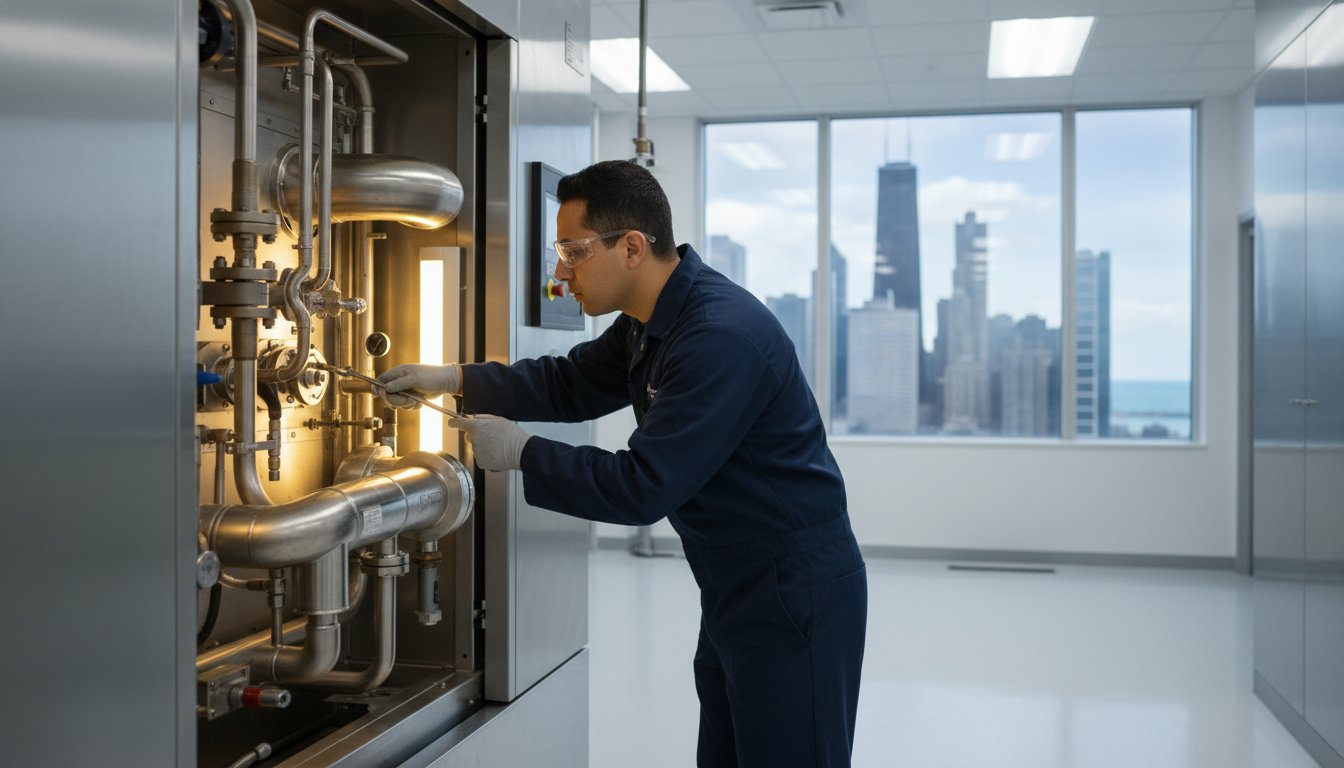
Imagine it’s a Tuesday in January on Michigan Avenue. The wind chill is hitting -20, and your building’s heating system suddenly goes silent. This isn’t just a cold office; it’s a high-stakes financial emergency that often stems from an unclear strategy regarding your commercial boiler maintenance cost Chicago. You’ve likely felt the stress of balancing rising energy demands with the need for predictable operational spending. It’s frustrating to manage complex safety codes while trying to keep tenants comfortable and your overhead low.
Managing a large facility in the city requires more than just technical knowledge; it requires a partner who understands the local landscape. It’s a challenge to keep up with the June 1st Chicago Energy Benchmarking deadline and varying inspection cycles for high-pressure and low-pressure systems. You want your equipment to run efficiently without being surprised by a $25 per day penalty for non-compliance. This guide provides the clarity you need to budget effectively for the 2026 season and ensure your mechanical room isn’t a source of anxiety.
You’ll learn the primary factors driving maintenance costs and how to secure long-term system reliability. We’ll provide a clear look at maintenance ROI and a checklist to help you compare contractor quotes fairly. By the end, you’ll have a roadmap to ensure your facility remains safe and fully compliant with all local Chicago boiler inspections.
Key Takeaways
- Understand how Chicago’s extreme temperature swings accelerate wear on mechanical components and impact your total commercial boiler maintenance cost Chicago.
- Identify the specific cost drivers for your facility by comparing the maintenance needs of fire-tube, water-tube, and high-efficiency condensing units.
- Learn why professional combustion analysis and heat exchanger inspections are essential for maintaining peak efficiency and preventing costly soot buildup.
- Discover how integrating Building Automation Systems (BAS) and formal maintenance agreements can transition your facility from reactive repairs to predictable, proactive care.
- Evaluate mechanical partners based on their local tenure and technical expertise in specific regional markets like Skokie, Northbrook, and Wilmette.
Understanding Commercial Boiler Maintenance in the Chicago Climate
Commercial boiler maintenance is fundamentally different from a standard residential tune-up. While a home system might only support a single family, a commercial unit is a high-capacity pressure vessel designed to meet the heavy demands of schools, hospitals, or high-rise offices. To understand the complexity, it helps to ask: What is a Commercial Boiler? These systems are engineered for industrial-scale heat transfer, involving intricate burner assemblies and thick-walled heat exchangers that require specialized care. Predicting your commercial boiler maintenance cost Chicago requires understanding how our local environment forces equipment to work harder than the manufacturer intended.
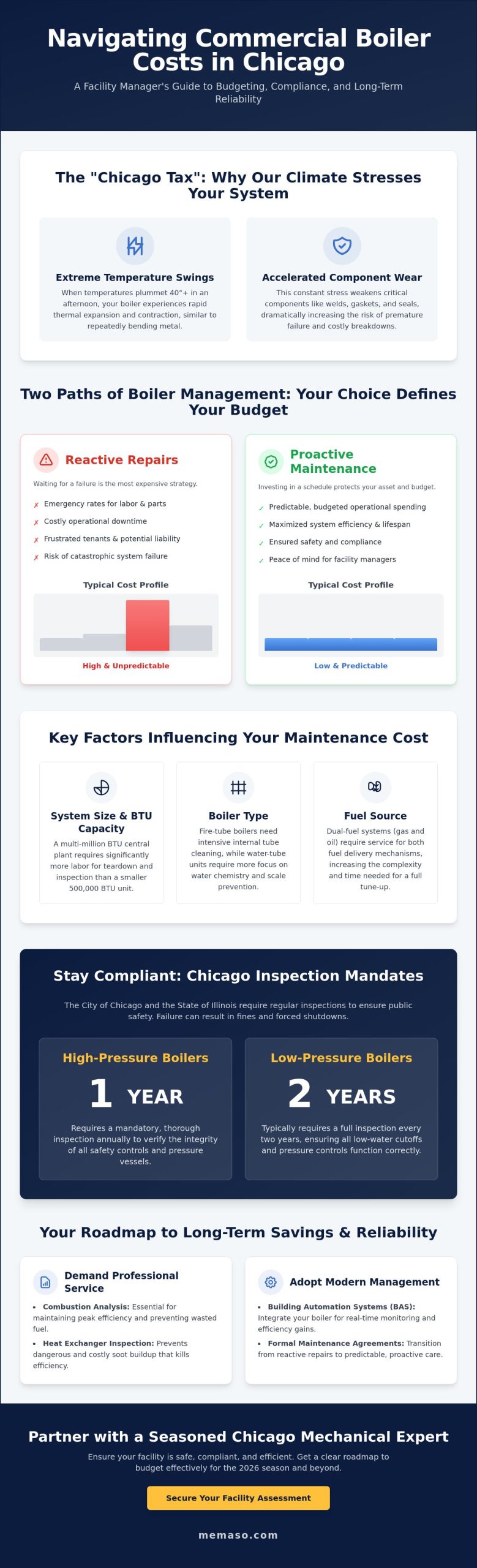
In the industry, we often refer to the “Chicago Tax.” This isn’t a line item on an invoice, but rather the physical toll our extreme temperature swings take on mechanical components. When the thermometer drops 40 degrees in a single afternoon, your boiler undergoes rapid thermal expansion and contraction. This cycle puts immense stress on welds, seals, and refractory materials. For high-occupancy buildings in Cook County, preventative care isn’t just a suggestion; it’s a survival strategy. The Illinois Boiler and Pressure Vessel Safety Act mandates strict oversight because a neglected system in a crowded environment poses a significant safety risk. Consistent maintenance ensures you stay on the right side of state law while protecting the integrity of your property.
The High Cost of Reactive Repairs in Winter
Waiting until a system fails during a January deep freeze is the most expensive way to manage a facility. When the city enters a cold snap, the demand for emergency service spikes, often leading to increased costs for urgent parts and labor. Regular checks prevent catastrophic heat exchanger failure, which can sideline a building for days. Beyond the immediate repair bill, downtime leads to frustrated tenants and potential liability issues if pipes freeze or business operations halt. Investing in a proactive schedule helps you control your commercial boiler maintenance cost Chicago by catching small leaks or sensor drifts before they turn into midnight emergencies. Facility managers who recognize the early signs of commercial plumbing problems alongside boiler issues are far better positioned to prevent the kind of cascading failures that shut down entire buildings during peak winter demand.
Compliance and Safety Inspections in Chicago
The City of Chicago Department of Buildings maintains rigorous inspection cycles to ensure public safety. Following state-level requirements, high-pressure boilers must undergo an inspection every year, while low-pressure units typically require a check every two years. These audits are often conducted in coordination with the National Board of Boiler and Pressure Vessel Inspectors standards. Professional maintenance prepares your system for these official visits, ensuring all safety valves, low-water cutoffs, and pressure controls function perfectly. Failing a city audit can lead to fines and forced shutdowns, so keeping your mechanical room in top shape is essential for uninterrupted operation.
Key Factors Influencing Commercial Boiler Maintenance Costs
Calculating your commercial boiler maintenance cost Chicago isn’t as simple as looking at a flat service fee. Several variables dictate the final investment, ranging from the physical footprint of the unit to the specific technology powering your heating plant. For instance, a historic warehouse in the West Loop utilizing a legacy steam system will have vastly different requirements than a modern LEED-certified office tower in the Loop. Understanding these variables helps facility managers move away from guesswork and toward a data-driven budget that protects their bottom line.
- System Size and BTU Capacity: The scale of your equipment is the most direct influence on labor. A small commercial unit under 500,000 BTU requires significantly less time for a full teardown and inspection than a multi-million BTU central plant.
- Boiler Type: Fire-tube boilers often require more intensive internal cleaning of the tubes, while water-tube units might need more attention regarding water chemistry and scale prevention.
- Fuel Source: Natural gas units are common, but dual-fuel systems (gas and oil) require double the attention to ensure both burner assemblies are ready for a fuel switch during peak demand.
- System Age: Older units in Chicago’s historic districts often require more manual labor to source specialized gaskets or to address the wear and tear on aging refractory materials.
The complexity of your mechanical room directly influences the commercial boiler maintenance cost Chicago. Larger facilities often require specialized diagnostic tools and a higher number of billable man-hours to complete a safe and thorough inspection. By identifying these factors early, you can avoid the “sticker shock” that often accompanies reactive repairs during the first cold snap of the season.
BTU Output and Scaling Complexity
Scale dictates the man-hours required for a thorough service. While a technician might complete a standard tune-up on a light commercial unit in four to six hours, a large-scale industrial plant can require a team of specialists working for several days. Industrial maintenance involves heavy-duty equipment like high-pressure washers for tube cleaning and advanced combustion analyzers to handle the massive fuel throughput. This complexity is why it’s vital to partner with a team that has the scale and experience to handle high-capacity environments without cutting corners.
Technological Sophistication: High-Efficiency vs. Standard
Modern high-efficiency condensing boilers offer impressive fuel savings, but they come with unique maintenance needs. These units produce acidic condensate that must be neutralized, and their stainless steel heat exchangers require specific cleaning protocols to prevent corrosion. Adhering to energy-efficient boiler standards ensures your investment pays off over time, but it requires precise calibration of modulating burners. Certain Chicago zones also have strict low-NOx emission requirements, necessitating specialized burner adjustments to stay compliant. If you want to protect these sophisticated assets, scheduling professional boiler maintenance and repair is the most effective way to ensure long-term performance.
Breakdown of Professional Boiler Service Procedures
When evaluating your commercial boiler maintenance cost Chicago, it’s helpful to understand exactly what occurs during a high-level technical audit. A professional service isn’t a simple visual check; it’s a methodical deconstruction and testing of the system’s core functions. Our seasoned technicians approach each mechanical room as a complex ecosystem where every sensor and valve must operate in perfect harmony. This precision ensures that your facility remains a safe and comfortable environment for tenants, even when the Chicago winter is at its most unforgiving.
A comprehensive maintenance visit typically includes several critical procedures designed to maximize the lifespan of your equipment:
- Heat Exchanger Inspection: Technicians examine the internal surfaces for signs of soot, scale, or stress fractures. Even a thin layer of soot, as little as 1/32 of an inch, can act as an insulator and significantly reduce heat transfer efficiency.
- Safety Device Testing: This is a non-negotiable step for compliance. We verify the operation of low-water cutoffs and pressure relief valves. These components are the primary line of defense against catastrophic system failure or vessel explosions.
- Burner Assembly Service: We clean and adjust the pilot lights, igniters, and burner ribbons. Ensuring a clean flame pattern prevents uneven heating of the heat exchanger and reduces the risk of carbon monoxide production.
- Control Calibration: Modern systems rely on precise electronic controls. We test the operating and high-limit settings to ensure the boiler cycles correctly and doesn’t waste fuel through excessive short-cycling.
The Combustion Efficiency Audit
The core of any professional tune-up is the combustion efficiency audit. Using calibrated flue gas analyzers, we measure the levels of oxygen, carbon monoxide, and carbon dioxide in the exhaust. This data allows us to tune the fuel-to-air ratio for maximum energy savings. Proper tuning can lead to noticeable reductions in monthly gas utility bills from providers like Peoples Gas or Nicor. We also conduct draft pressure testing and venting system integrity checks to ensure that all combustion byproducts are safely exiting the building without risking backdrafting into occupied spaces.
Hydronic System and Water Treatment
The water inside your pipes is just as important as the boiler itself. We perform a detailed water chemistry analysis to check for proper pH balance and mineral content. In the Chicago area, freeze protection is a major concern, so we test glycol concentrations to ensure the system won’t freeze during a power outage. Our team also inspects pump seals, expansion tanks, and zone valves. For facilities utilizing high-efficiency units, we evaluate the cost-benefit of flushing tankless water heaters to remove mineral buildup. Maintaining proper hydronic health prevents internal corrosion and protects your long-term commercial boiler maintenance cost Chicago by avoiding premature component failure.
How to Minimize Long-Term Operating and Repair Costs
Strategic facility management in Cook County requires moving beyond the “break-fix” cycle. While the upfront commercial boiler maintenance cost Chicago might seem like an added expense, it’s actually a shield against the unpredictable price surges of emergency winter repairs. Proactive planning allows you to control your budget rather than letting the weather dictate your spending. By shifting to a preventative mindset, you protect your capital and extend the operational life of your mechanical assets.
Cost mitigation is achieved through a combination of structured service, smart technology, and team education. These pillars help you maintain a predictable bottom line:
- Consistent Scheduling: Regular intervals for service prevent minor component wear from cascading into a total system shutdown.
- Predictive Analysis: Using data to identify trends in fuel consumption or pressure fluctuations before they reach critical levels.
- Staff Empowerment: Teaching on-site teams to recognize the early warning signs of system stress, such as unusual noises or minor leaks.
- Efficiency Upgrades: Replacing aging burners or pumps with high-efficiency alternatives that provide a rapid return on investment through lower utility bills.
Preventative Maintenance Agreements (PMAs)
Preventative Maintenance Agreements provide a structured approach to mechanical care. These contracts often lock in labor rates, protecting you from inflation and seasonal demand spikes. By scheduling quarterly or semi-annual visits, you ensure your system is tuned for the specific demands of the upcoming season. A PMA usually costs significantly less than a single emergency heat exchanger replacement or an after-hours service call during a polar vortex. If you are looking to stabilize your annual budget, securing a boiler maintenance and repair agreement is the most effective strategy.
Building Automation and Smart Monitoring
Modern Chicago facilities are increasingly turning to Building Automation Systems to gain a competitive edge. These platforms integrate directly with your boiler controls to provide real-time performance tracking. Instead of waiting for a tenant to complain about the cold, a BAS can alert your team to a minor sensor drift or a pressure drop instantly. This early detection reduces labor costs by allowing for scheduled repairs during normal business hours. This technology is vital for complying with the Chicago Energy Benchmarking Ordinance, which requires buildings over 50,000 square feet to report energy consumption by June 1st every year. Failing to meet this deadline can result in a $25 per day penalty, making automated tracking a financial necessity for large-scale properties.
Choosing a Seasoned Chicago Mechanical Partner for Boiler Care
Selecting a mechanical partner is about more than finding someone to turn a wrench. It’s about finding a consultant who understands how a single component fits into your building’s entire ecosystem. In our region, local expertise is a baseline requirement. A technician serving facilities in Skokie, Northbrook, or Wilmette understands the specific environmental stressors and water quality issues unique to the North Shore. This localized knowledge allows for more accurate diagnostic work, which ultimately helps stabilize your commercial boiler maintenance cost Chicago by preventing misdiagnosed issues and redundant labor hours. A truly knowledgeable partner will also help you identify broader signs of commercial plumbing problems that often present alongside boiler inefficiencies, giving you a complete picture of your mechanical room’s health.
When you evaluate potential partners, look for transparency in their reporting and a deep bench of cumulative team experience. A seasoned professional won’t just tell you that a part needs replacing; they’ll provide a detailed service report explaining the “why” behind the recommendation. This documentation is vital for multi-year budgeting and for proving compliance during city audits. High safety standards and technical certifications are non-negotiable markers of a firm that takes its responsibility to your tenants and your property seriously. By choosing a partner with a long-term tenure in the local market, you gain a stable ally who’ll be there when the next record-breaking cold front arrives.
Mechanical Management & Design Solutions: Your Local Chicago Mechanical Experts
At Mechanical Management & Design Solutions, we’ve built our reputation on professional reliability and a neighborly approach to high-level technical service. Facility managers across Cook County trust us because we offer a truly integrated perspective. Our team doesn’t just look at the burner; we understand how your heating system interacts with your electrical panel and plumbing infrastructure. This holistic view is a result of our extensive experience in Design-Build Construction Services and large-scale institutional projects. We translate that high-stakes expertise into dependable care for every client we serve. If you’re ready to move toward a more predictable budget, contact us today for a tailored boiler maintenance and repair quote.
The Mechanical Management & Design Solutions Difference: Seasoned Professionals
What sets our team apart is the direct access we provide to high-level technical consultants. We don’t believe in one-size-fits-all solutions. Whether your facility relies on a historic steam boiler or a cutting-edge network of modern heat pumps, we have the specialized knowledge to keep it running at peak efficiency. For our maintenance agreement partners, we provide 24/7 emergency support to ensure you’re never left in the dark during a winter crisis. We also help you leverage Building Automation Systems to gain real-time insights into your mechanical room’s performance. This proactive approach is the most effective way to manage your commercial boiler maintenance cost Chicago while ensuring the long-term safety and comfort of your building’s occupants.
Secure Your Facility’s Future for the 2026 Season
Mastering your commercial boiler maintenance cost Chicago is about more than managing a line item; it’s about ensuring the safety and comfort of everyone in your building. We’ve explored how proactive tuning and hydronic system health shield your budget from the unpredictable “Chicago Tax” of extreme weather. By integrating smart technology and adhering to strict city inspection cycles, you transition from reactive stress to predictable operational excellence. Our decades of local Chicago experience and design-build expertise allow us to provide solutions that are as dependable as they are efficient.
Don’t wait for the first deep freeze to test the limits of your mechanical room. Partnering with a seasoned team that offers 24/7 emergency service to maintenance agreement holders ensures you have peace of mind all year round. We invite you to Request a Professional Boiler Maintenance Quote from Mechanical Management & Design Solutions today. Let’s work together to keep your facility running smoothly and your tenants warm, regardless of what the lakefront wind brings our way.
Frequently Asked Questions
How often is commercial boiler maintenance required in Chicago?
High-pressure boilers require annual inspections according to the Illinois Boiler and Pressure Vessel Safety Act. Low-pressure units typically need an inspection every two years. Most facility managers schedule a professional tune-up every autumn to ensure the system is ready for the intense Chicago winter regardless of the legal minimum requirements.
What is the average duration of a commercial boiler service visit?
A thorough service for a standard commercial unit typically takes between four and eight hours. For larger institutional facilities or complex central plants, the process can span several days. The time depends on the BTU capacity and whether a full teardown of the burner assembly is required for cleaning.
Does insurance require professional boiler maintenance in Illinois?
Most commercial insurance providers require building owners to follow manufacturer guidelines and local safety codes to maintain coverage. If a boiler fails and you can’t provide records of professional maintenance, the insurer might deny your claim for property damage or business interruption. Keeping a detailed service log is a baseline requirement for risk management.
What happens if I skip my annual boiler inspection?
Skipping an inspection puts your building at risk for safety hazards and legal penalties. The Chicago Department of Buildings can issue fines or force a system shutdown. If your building is over 50,000 square feet, neglecting efficiency checks could also lead to a $25 per day penalty for non-compliance with the Chicago Energy Benchmarking Ordinance.
Can regular maintenance lower my commercial building energy bills?
Professional tuning significantly reduces fuel consumption. Cleaning the heat exchanger and calibrating the burner ensures you aren’t wasting gas through the flue. This proactive care is the best way to manage your commercial boiler maintenance cost Chicago by preventing high utility bills and expensive emergency service calls during peak demand months.
How much does it cost to flush a commercial tankless water heater in Chicago?
The investment for a professional flush depends on the number of units and the severity of mineral buildup. This service involves circulating a descaling solution through the heat exchanger to remove calcium and lime. While we don’t provide flat rates here, this procedure is vital for maintaining flow rates and preventing premature heat exchanger failure in high-demand environments.
Is emergency boiler repair more expensive than scheduled maintenance?
Emergency repairs are almost always more costly than planned maintenance. You’ll often face higher labor rates for after-hours service and premium pricing for expedited parts shipping. Scheduling your commercial boiler maintenance cost Chicago during the shoulder seasons allows you to avoid these crisis premiums and ensures your system is reliable before the first freeze.
What are the signs that my commercial boiler needs immediate repair?
Look for visible water leaks, unusual “kettling” noises, or soot buildup around the burner door. A yellow or flickering flame instead of a steady blue one indicates poor combustion. If you notice a sudden spike in fuel usage or frequent cycling, it’s time to call a professional before the system fails completely during a deep freeze.