

In Chicago, your HVAC system isn’t just an appliance; it’s a complex mechanical ecosystem that must survive a 100-degree temperature swing in a single week. Finding a reliable hvac service chicago partner is about more than a quick fix. It’s about engineering a system that stands up to the Windy City’s relentless demands while navigating the Phase 3 Construction Codes introduced in April 2026. You likely know the frustration of skyrocketing energy bills during a polar vortex or the anxiety of a cooling system failing during a humid July peak.
We understand that true comfort comes from knowing your property is managed by experts who see the big picture. This guide will show you how to optimize efficiency and lower utility costs through high-efficiency heat pump installation and smart mechanical design. We’ll walk through the shift toward state-administered incentives following the expiration of federal tax credits, the impact of new refrigerant regulations, and how a design-build approach ensures your heating and electrical systems work in harmony. You’ll gain the clarity needed to choose a stable, seasoned professional who treats your building with the technical precision it deserves.
Key Takeaways
- Learn why Chicago’s extreme sub-zero winters and humid summers require a specialized approach to mechanical system maintenance to protect your building’s “lungs.”
- Understand the critical link between your electrical panel and modern HVAC performance to ensure your high-efficiency units operate safely and reliably.
- Identify the five most common mechanical failures in the Chicagoland area, including frozen coils and ductwork inefficiencies, before they lead to emergency repairs.
- Discover how to choose between traditional gas furnaces and modern cold-climate heat pumps when seeking professional hvac service chicago to maximize your year-round comfort.
- Explore the benefits of the design-build model for seamless integration from engineering to installation, ensuring your property’s mechanical ecosystem is built for longevity.
What is Comprehensive HVAC Service in Chicago?
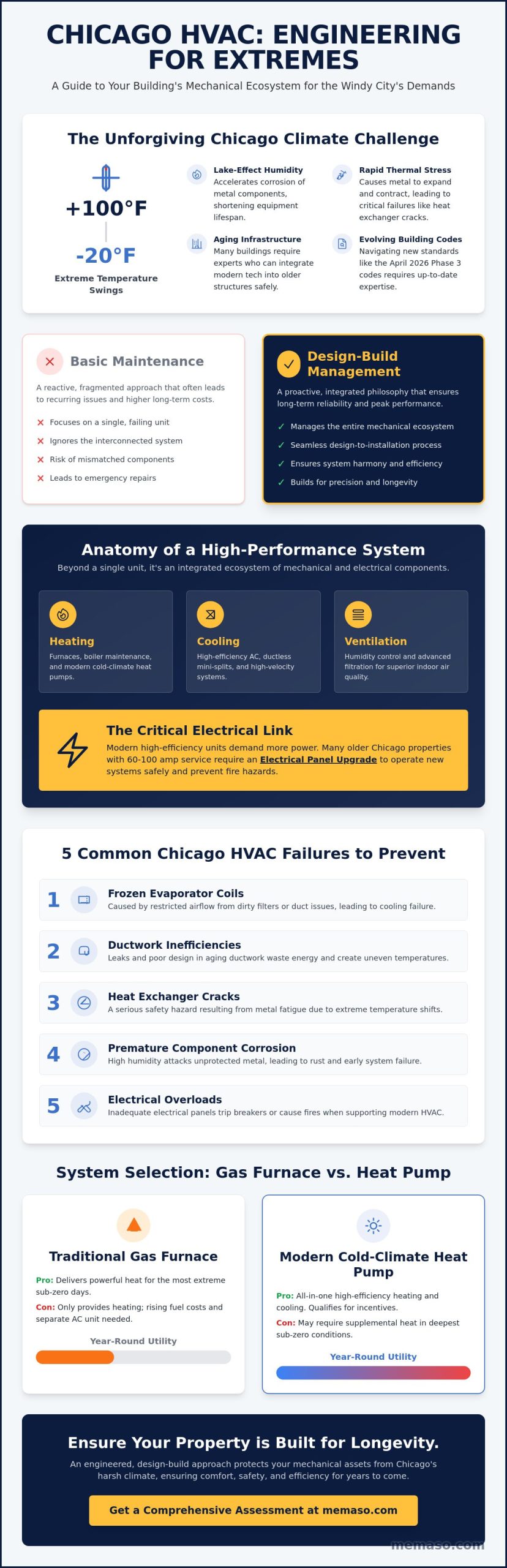
Think of Heating, ventilation, and air conditioning (HVAC) as the lungs of your property. These systems don’t just move air; they regulate the health, safety, and comfort of everyone inside. In a city where the mercury swings from -20°F to 100°F, a standard hvac service chicago visit shouldn’t be a surface-level inspection. It requires a deep understanding of mechanical management. While basic maintenance focuses on keeping a single unit running, comprehensive service looks at the entire ecosystem. This includes how your heating replacement interacts with your existing ductwork and whether your electrical panel can support a new high-efficiency heat pump.
Our approach is rooted in a Design-Build philosophy. This method bridges the gap between engineering theory and practical installation. Instead of hiring separate consultants who might not understand the physical constraints of your building, you work with a partner who designs the system and then executes the build. This eliminates communication gaps that often lead to system failures during Chicago’s peak seasons. It’s about building for long-term reliability and precision, ensuring your mechanical assets are an investment rather than a recurring headache.
The Core Components of Your Mechanical System
Your system’s health depends on three integrated pillars. Heating in Chicago isn’t limited to standard furnaces; it encompasses complex boiler maintenance and modern heat pump installation. Cooling goes beyond basic air conditioning replacement to include ductless mini-splits and high-velocity systems designed for tight spaces. Finally, ventilation ensures your indoor air quality remains high. This involves sophisticated humidity control and filtration systems that keep the air clean and breathable even when the windows stay shut for six months at a time.
Why Chicago Properties Require a Specialized Approach
Chicago’s environment is notoriously harsh on mechanical equipment. Lake-effect humidity can corrode components prematurely, while extreme temperature shifts cause metal to expand and contract rapidly, leading to cracks in heat exchangers. We also navigate the complexities of local building codes, including the April 2026 Phase 3 updates which set new standards for energy efficiency. In neighborhoods like Skokie and Northbrook, many properties feature aging infrastructure. These buildings require a seasoned professional who understands how to integrate modern technology like building automation systems into older structures without compromising the building’s integrity or safety.
The Anatomy of a High-Performance HVAC System
A high-performance mechanical system operates like a finely tuned orchestra where every component must be in sync. For a comprehensive hvac service chicago, this means looking beyond the physical furnace or air conditioner. The thermostat serves as the command center; it communicates precise data to the air handler and the outdoor unit to maintain a steady climate. When these parts aren’t communicating correctly, you see efficiency drops and uneven temperatures. Modern energy-efficient heating and cooling systems rely on this digital handshake to adjust output based on real-time demand.
Plumbing plays an equally vital role in this anatomy. Condensate lines must be properly pitched to prevent water damage, while boiler piping requires expert welding to withstand the high pressures of a Chicago winter. In many commercial settings, Building Automation Systems (BAS) act as the brain, managing these variables across thousands of square feet. These systems don’t just run the heat; they balance airflow and monitor pressure to ensure the building stays pressurized against the lakefront winds.
The Electrical Link: Why Your Panel Matters
Upgrading to a high-efficiency AC or a modern heat pump often places new demands on your home’s power supply. Many older Chicago homes have 60-amp or 100-amp services that simply can’t support the draw of 2026-standard equipment. This makes Electrical Panel Upgrades a necessary step in many installations. Attempting DIY electrical work during an HVAC install is dangerous and often violates local codes. Matching your HVAC system’s amperage to your electrical panel’s capacity is the fundamental safeguard against circuit overloads and potential fire hazards.
Advanced Building Automation and Smart Controls
By 2026, smart controls have evolved from simple scheduling to predictive maintenance. Building Automation Systems now use sensors to track performance metrics in real time. This remote monitoring is crucial for Chicago property owners because it can detect a failing heating element before the indoor temperature drops enough to freeze the pipes. This shift toward integrated facility management means your cooling and heating aren’t isolated; they’re part of a managed ecosystem. If you’re planning a major renovation, exploring Design-Build Construction Services ensures these technical layers are integrated from day one.
5 Common Chicago HVAC Problems and How to Prevent Them
Chicago’s climate acts as a relentless stress test for mechanical systems. When you seek hvac service chicago, it’s usually because one of five common local stressors has reached a breaking point. First, extreme temperature cycles cause metal components to expand and contract rapidly, often leading to heat exchanger cracks or frozen coils. In older neighborhoods with pre-1970s housing stock, outdated ductwork often chokes airflow, forcing modern units to work twice as hard. This inefficiency doesn’t just raise bills; it shortens the lifespan of your equipment. A seasoned professional understands that these aren’t just isolated failures but symptoms of a system under environmental duress.
Electrical overloads are another frequent casualty of humid July peaks. When every AC in the block is drawing maximum amperage, older electrical panels can fail, leading to tripped breakers or burnt-out motors. For those with hydronic systems, Chicago’s hard water causes sediment buildup. This leads to “kettling” in boilers, where trapped steam bubbles create a banging sound like a tea kettle. Finally, even the most advanced smart homes face communication errors where the thermostat and air handler lose their digital sync, leaving you without climate control despite the system being physically intact. These issues require technical remedies that go beyond a simple “quick fix.” Comprehensive evaluations are the first step in resolving such complexities; for property owners in other regions, HVAC Inspections Los Angeles offers specialized diagnosis and solutions to ensure mechanical systems operate at peak performance.
Spotting the Red Flags Before a Breakdown
You don’t need to be an engineer to notice when something is wrong. Whistling sounds often indicate air leaks or restricted filters, while grinding noises suggest a bearing failure in the blower motor. If your unit turns on and off every few minutes, a phenomenon called short-cycling, it’s often a sign of an oversized system or a faulty sensor. With the average cost for an HVAC repair in Chicago sitting at $363 as of 2026, catching these signals early prevents a relatively minor fix from becoming a multi-thousand-dollar replacement. Sudden spikes in your utility bills are another clear indicator that your system is losing its mechanical edge.
The Power of Preventative Maintenance
The most effective way to avoid these pitfalls is through methodical, seasonal tune-ups. Professional maintenance involves cleaning the “invisible” parts that homeowners often overlook, such as flame sensors, burners, and condensate drains. This proactive approach ensures your system meets the 2026 standards for efficiency and safety. Because your building’s mechanical health is interconnected, we also recommend a Chicago Commercial Plumbing Maintenance Guide to ensure your boiler and water lines remain clear of the mineral deposits common in our region. Investing in a seasoned partner now guarantees reliable comfort when the next lake-effect storm hits.
Selecting the Right System for the Chicagoland Climate
Choosing a mechanical system in Chicago is a high-stakes decision that dictates your property’s operational costs for the next fifteen years. Professional hvac service chicago begins with a technical evaluation that moves beyond simple square footage. We use Manual J load calculations to determine the exact heating and cooling needs of your space. This is critical because an oversized system cycles too quickly, failing to remove the thick lake-effect humidity that plagues our summers. Conversely, an undersized unit will struggle to keep up when the polar vortex arrives. In 2026, efficiency ratings like SEER2 for cooling and AFUE for heating are the standard benchmarks we use to ensure your investment meets the latest Phase 3 Chicago Construction Codes.
With the expiration of federal 25C and 25D tax credits at the end of 2025, the focus has shifted toward state-level incentives and utility programs. For example, ComEd customers can still access rebates of up to $75 for qualifying smart thermostats through December 31, 2026. These small components are essential for managing modern, high-efficiency equipment. Whether you are looking at a traditional gas furnace or a modern electric system, the goal is to create a balanced mechanical ecosystem that provides reliable 24/7 comfort regardless of the outdoor temperature.
Heat Pumps vs. Furnaces: The 2026 Verdict
The most resilient strategy for our region is often a dual-fuel or hybrid approach. This setup pairs a high-efficiency gas furnace with an electric heat pump, allowing the system to switch between fuel sources based on whichever is most efficient at the current outdoor temperature. Modern cold-climate heat pumps maintain high heating capacities even when outdoor temperatures drop well below zero, significantly reducing reliance on fossil fuels. If you are questioning Are Heat Pumps Effective for Chicagoland Winters?, the answer lies in the engineering of the specific unit and its integration with your home’s existing infrastructure. We focus on Heat Pump Installation that is designed specifically for the Midwest’s unique thermal demands. Homeowners ready to upgrade their existing equipment should also review our comprehensive guide on heat pump replacement in Chicago for 2026, which covers the latest Illinois Stretch Energy Code requirements and available ComEd rebates.
Commercial vs. Residential Considerations
The scale of the project dictates the mechanical architecture. For commercial properties in Cook County, we often utilize Rooftop Units (RTUs) that consolidate heating and cooling into a single, space-saving package. Residential projects, especially in high-end areas like Wilmette, often require sophisticated zoning systems. These allow you to maintain different temperatures in a master suite versus a guest wing, maximizing both comfort and energy savings. We also provide specialized Design-Build Construction Services for complex environments, such as cleanrooms or cannabis grow operations, where precise humidity and temperature control are non-negotiable. Contact our team today to begin a professional load calculation for your property.
The MEMASO Difference: Integrated Mechanical Management
Choosing an hvac service chicago provider often feels like a gamble between high-priced national chains and unverified contractors. At Mechanical Management & Design Solutions, we eliminate that uncertainty by treating your property as a single, integrated mechanical asset. We don’t just swap out broken parts. We look at how your Boiler Maintenance and Repair needs might be impacted by your building’s electrical capacity or plumbing layout. This holistic view is what we call Integrated Mechanical Management, a strategy that prioritizes the long-term health of your facility over quick, temporary fixes.
Our Design-Build Construction Services provide a seamless transition from the initial engineering phase to the final installation. In the traditional model, an engineer designs a system and a contractor installs it, often leading to conflicts when the design doesn’t fit the physical reality of a Northbrook basement or a Skokie commercial roof. By keeping these disciplines under one roof, we ensure that the system we build is the system that was engineered for your specific load requirements. This precision reduces the risk of system strain and premature failure, giving you peace of mind throughout the year.
Safety remains our primary directive. Whether we are performing Electrical Panel Upgrades to support a new heat pump or providing Emergency Electrical Services, our team operates with a level of technical rigor that only decades of collective experience can provide. We understand the high stakes of a Chicago winter. That’s why we position ourselves as stable, long-term partners who understand the local landscape. We are seasoned professionals who value reliability as much as you do.
A Consultative Approach to Facility Performance
We analyze your entire facility’s performance to identify hidden inefficiencies that drive up costs. Having HVAC, electrical, and plumbing expertise in one place means we catch the invisible issues that others miss. Our deep roots in Chicago and surrounding suburbs like Skokie and Northbrook allow us to anticipate the specific challenges of local architecture and environmental conditions. We aren’t just here to fix a machine; we’re here to act as your technical consultants and neighbors.
Ready to Optimize Your Comfort?
The path to a more efficient property starts with a professional facility assessment. During a MEMASO service call, you can expect a methodical inspection of your mechanical systems, a clear explanation of our findings, and a logical plan for any necessary remedies. We provide the data you need to make informed decisions about your property’s future. Experience professional reliability with MEMASO’s HVAC services and secure the long-term health of your building’s mechanical lungs today.
Securing Your Property’s Mechanical Future
Managing a property in Chicago requires more than just reactive repairs. It demands a holistic understanding of how heating, cooling, and electrical systems interact to withstand our unique environmental stressors. By prioritizing a Design-Build approach and seasonal preventative maintenance, you ensure your building remains a sanctuary regardless of the outdoor temperature. These technical layers are the foundation of a high-performance facility that lowers utility costs and eliminates the anxiety of unexpected breakdowns during a polar vortex or a humid summer peak.
Finding the right hvac service chicago partner is the final step in moving from system failure to long-term mechanical stability. With over 25 years of local Chicago expertise, MEMASO provides fully integrated Design-Build mechanical solutions and 24/7 emergency support for your heating, cooling, and electrical needs. We focus on precision engineering and neighborly service to keep your property running at peak efficiency. Schedule your professional HVAC assessment with MEMASO today to begin optimizing your facility’s performance. Your comfort and safety are our priority; let’s build a more efficient home or business together.
Frequently Asked Questions
How often should I have my HVAC system serviced in Chicago?
You should schedule professional hvac service chicago twice per year, once in the spring for your cooling system and once in the fall for your heating equipment. This frequency is necessary because Chicago’s extreme temperature shifts place significant mechanical stress on components. Regular tune-ups identify small issues like worn belts or dirty sensors before they cause a total system failure during a peak weather event.
What is the most efficient heating system for Illinois winters in 2026?
A hybrid or dual-fuel system is the most efficient heating option for Illinois residents in 2026. This configuration uses an electric cold-climate heat pump for moderate temperatures and a high-efficiency gas furnace for extreme cold. It allows you to leverage the most cost-effective energy source while maintaining a reliable heat source during the coldest months of the year.
Can a heat pump really handle a Chicago polar vortex?
Modern cold-climate heat pumps are specifically engineered to extract heat from outdoor air even when temperatures drop well below zero. While older models struggled in extreme cold, 2026 technology ensures these units remain effective during a polar vortex. We often recommend pairing them with a gas furnace for a fail-safe hybrid system that guarantees comfort regardless of the outdoor mercury.
Why is my commercial building’s energy bill so high?
High utility bills in commercial properties are frequently caused by inefficient Building Automation Systems or neglected boiler maintenance. If your BAS isn’t calibrated correctly, your heating and cooling systems might be fighting each other, wasting significant energy. We also look for airflow obstructions or sediment buildup in boilers that force the equipment to run longer cycles to meet demand.
Does MEMASO offer emergency HVAC repair in the Chicago suburbs?
We provide emergency support for heating, cooling, and electrical systems throughout the Chicago suburbs, including Skokie and Northbrook. Our team of seasoned professionals is equipped to handle complex mechanical failures that require immediate technical expertise. We prioritize safety and rapid response to ensure your property remains protected from the elements.
What are the benefits of a design-build approach for HVAC installation?
The design-build approach integrates the engineering and installation phases into a single, streamlined process. This eliminates the common communication gaps between separate designers and contractors that often lead to costly field modifications. You receive a system that is perfectly tailored to your building’s specific structural and electrical constraints, ensuring higher long-term reliability.
When should I consider replacing my HVAC system instead of repairing it?
You should consider a full hvac service chicago replacement if your current unit is over 15 years old or requires a repair that costs more than half the price of a new system. Additionally, new 2026 regulations regarding refrigerants with lower Global Warming Potential (GWP) mean that older systems using phased-out coolants are becoming increasingly expensive to maintain. Upgrading often pays for itself through significantly lower monthly energy bills. For a detailed breakdown of what to expect during this process, our expert heat pump replacement guide for Chicago homeowners outlines current R-32 refrigerant options and how to maximize available local incentives.
How does indoor air quality affect my building’s mechanical performance?
Poor indoor air quality creates physical resistance within your mechanical system, forcing blower motors to work harder to push air through clogged filters and dirty coils. This increased friction leads to higher energy consumption and premature wear on moving parts. Maintaining high IAQ standards through proper filtration and ventilation isn’t just about health; it’s a critical strategy for extending the life of your mechanical assets.