

Relying solely on a gas furnace to survive a Chicago winter is no longer the most cost-effective way to keep your home comfortable. With ComEd residential rates sitting at approximately 17.07¢ per kWh and Peoples Gas proposing a $202 million rate hike this year, the traditional “gas only” approach is hitting your wallet harder than ever. You likely feel stuck between soaring utility bills and the fear that a modern electric heat pump will fail you when the temperature drops well below zero. It’s a common concern for our neighbors across the region, especially as complex HVAC jargon like SEER2 and HSPF2 makes the decision process feel overwhelming.
This 2026 guide explains why a dual fuel heat pump system Chicago homeowners are now choosing is the most reliable solution for our unique climate. By combining the high-efficiency cooling of an electric heat pump with the brute strength of a gas furnace backup, you get a system that switches automatically based on the outdoor temperature. We will walk you through the current 13.4 SEER2 minimum standards, analyze the latest utility costs, and show you how to maximize available rebates. You will learn how to secure year-round comfort without the anxiety of sub-zero mechanical failures or unpredictable energy spikes.
Key Takeaways
- Learn how a dual fuel heat pump system Chicago residents rely on uses an automatic switchover to manage the transition between electric efficiency and gas reliability.
- Discover why treating natural gas as a tactical backup rather than a primary fuel source is the key to surviving extreme sub-zero weather events.
- Compare the operating costs of ComEd electricity versus Peoples Gas rates to identify the exact temperature range where heat pumps offer the best return on investment.
- Decode complex 2026 efficiency metrics like SEER2 and HSPF2 to ensure your new installation meets the most recent Illinois energy conservation codes.
- Understand how a professional design-build methodology creates a custom-engineered heating solution that fits the specific architectural requirements of your home.
The Chicago Hybrid: What is a Dual Fuel Heat Pump System?
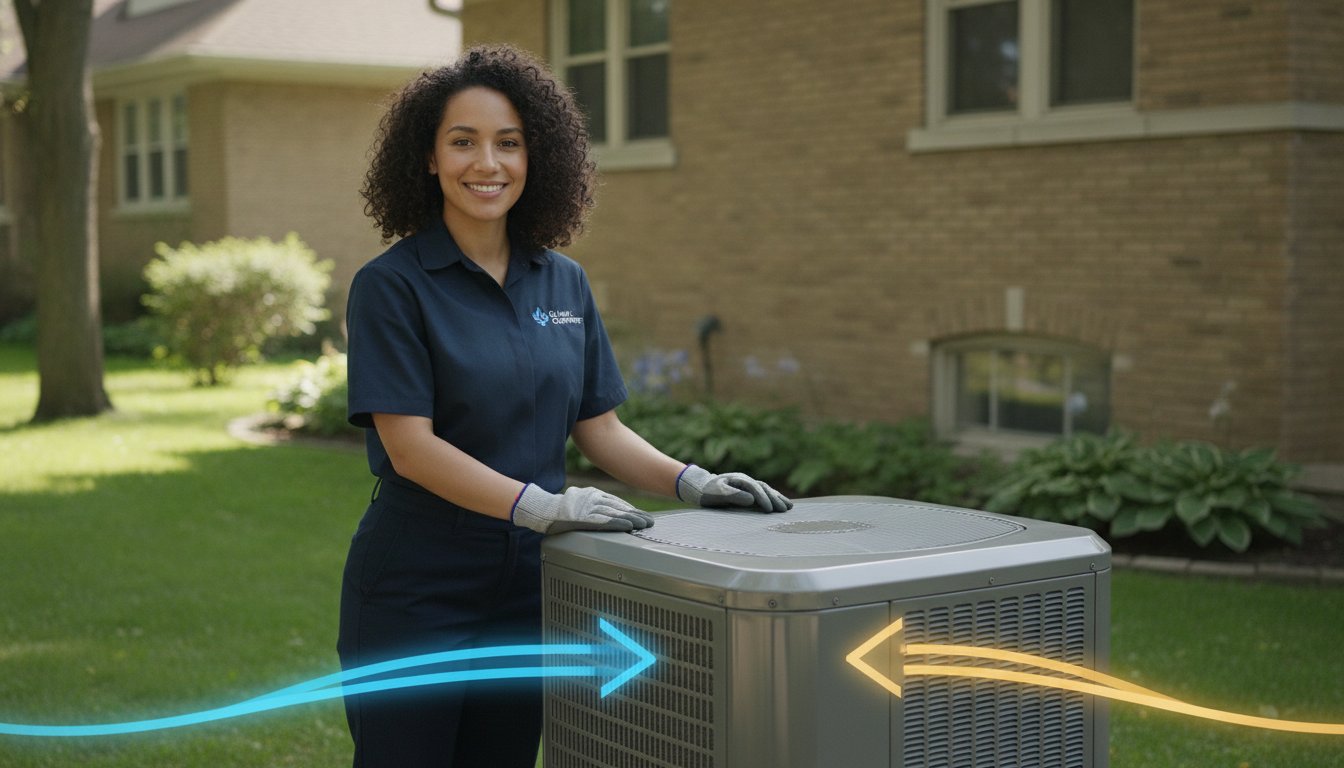
A dual fuel heat pump system Chicago residents rely on is a sophisticated hybrid heating and cooling solution. It integrates an electric air-source heat pump with a high-efficiency gas furnace. Think of it like a hybrid vehicle. Just as a hybrid car switches between a battery and a gasoline engine to optimize performance, this HVAC configuration chooses the most efficient fuel source based on the temperature outside. It’s a strategic response to the volatile Illinois climate, where a mild 45 degree afternoon can plummet into a sub-zero night in hours.
The physical setup consists of three primary components. First, the outdoor unit acts as both an air conditioner and a primary heater. Second, an indoor evaporator coil sits atop your furnace to transfer thermal energy. Finally, the gas furnace provides the heavy-duty heating required for our harshest winter months. A What is a Dual Fuel Heat Pump System? works by using a smart thermostat or an integrated control board to manage the “switchover point.” This is the specific temperature where it becomes more cost-effective or mechanically necessary to stop using electricity and start burning natural gas.
Heat Pump vs. Dual Fuel: Knowing the Difference
Standard all-electric heat pumps often struggle when the mercury drops below freezing. To keep up, they typically use “emergency heat” strips. These are electric resistance coils that function much like a giant toaster. In the Chicago market, where electricity rates have risen significantly, running these strips is incredibly expensive. A dual fuel system eliminates this problem. It replaces those inefficient electric strips with a powerful gas furnace. In a typical Chicago basement or utility closet, the footprint remains nearly the same as a traditional furnace and AC unit, but the technology inside is far more capable. You get the comfort of gas heat without the massive bills of an all-electric backup.
The Role of the Gas Furnace in a Hybrid Setup
The gas furnace is the “heavy lifter” of the system. When a Polar Vortex brings temperatures into the negatives, the outdoor heat pump shuts down to protect its compressor. The furnace takes over completely, delivering the high-temperature air needed to maintain safety and comfort. In 2026, modern models are also designed to handle Chicago’s high-humidity winters more effectively. They prioritize gas heat during “defrost cycles.” When the outdoor unit frosts over, the system briefly runs the furnace to ensure you don’t feel a cold draft while the heat pump clears itself of ice. This maintains airflow integrity and keeps your indoor environment stable even during the messiest winter storms.
How Dual Fuel Solves the Chicago Polar Vortex Problem
Chicagoans know the dread of a Polar Vortex. When wind chills hit -20°F, you need more than just hope; you need a mechanical guarantee. A dual fuel heat pump system Chicago homeowners install acts as an ultimate insurance policy against the unpredictable. While standard air-source units are remarkably efficient, they eventually reach a physical limit where extracting heat from frozen air becomes less effective. This is How Dual Fuel Solves the Chicago Polar Vortex Problem. By integrating a gas furnace, you ensure that your home remains a safe sanctuary even when the ambient air temperature is under extreme stress. It provides redundancy that all-electric systems simply can’t match.
During these deep freezes, your home stays sealed for weeks. This can lead to stagnant air and a buildup of pollutants. Modern hybrid systems often incorporate advanced filtration and ventilation controls that work in tandem with the heating cycles. Since the system switches between the heat pump’s steady, lower-temperature flow and the furnace’s high-intensity heat, it keeps air moving more effectively than a single-stage system. This constant movement helps maintain better indoor air quality throughout the most claustrophobic months of the year, preventing the “stuffy” feeling common in older Chicago bungalows.
The 35°F Threshold: Understanding the Balance Point
The “Economic Balance Point” is the specific outdoor temperature where it becomes cheaper to burn natural gas than to use electricity. In Cook County, this usually hovers around 35°F, though it fluctuates as utility rates shift. Mechanical Management & Design Solutions technicians use local data from ComEd and Peoples Gas to calibrate your system’s switchover point with seasoned precision. Setting this correctly ensures your compressor doesn’t work harder than necessary when gas is the more logical choice. Correct calibration prevents the system from short-cycling and causing premature wear on expensive internal components.
Smart Controls and Automation Integration
Automation is the brain behind the brawn. Dual-fuel compatible thermostats are essential for managing these two heat sources without manual intervention. For larger residential estates or multi-unit properties, we often implement building automation systems that monitor real-time weather feeds. This allows the system to prepare for a drop in temperature before it actually happens. If a massive storm is forecasted, your remote monitoring setup can ensure the gas burner is primed and ready before the first snowflake falls. If you aren’t sure if your current setup is compatible, you can explore our design-build construction services to see how we integrate these smart technologies into modern Chicago homes.

Comparing Efficiency: ComEd vs. Peoples Gas Operating Costs
Understanding the financial transition to a dual fuel heat pump system Chicago households are adopting requires a look at the raw numbers. In June 2026, ComEd’s all-in residential rate is approximately 17.07¢ per kWh, while the Peoples Gas charge sits at $0.3676 per therm. While natural gas remains a powerful fuel source, its efficiency is limited by combustion. Heat pumps operate on a Coefficient of Performance (COP). In the 40°F to 60°F range, a high-quality unit can achieve a COP of 3.0 or higher. This means it delivers three times more heat energy than it consumes in electricity, making it the clear winner for those long Chicago autumns and springs.
During these shoulder seasons, the heat pump is significantly more efficient than even a high-end 96% AFUE gas furnace. As the temperature drops, the COP decreases, and the math begins to shift. This is where the dual fuel strategy saves money. By switching to gas when electricity costs per BTU exceed gas costs, a typical home in Skokie or the city can see substantial reductions in annual utility spending. With Peoples Gas proposing a $202 million rate hike in May 2026, the ability to pivot between fuel sources provides a necessary hedge against unpredictable energy markets and rising infrastructure costs.
Leveraging 2026 Rebates and Incentives
Navigating the financial landscape of HVAC upgrades is easier when you understand the 2026 incentives. The Energy Efficient Home Improvement Credit (Section 25C) is a vital tool, potentially offering 30% of the cost for qualifying heat pumps up to a $2,000 annual limit. Since there is conflicting information on 2026 availability, we recommend consulting a tax professional to verify your eligibility. Local utilities like ComEd and Peoples Gas also provide active rebates for hybrid installations that meet specific Key Features for a Chicago Dual Fuel Setup. Our design-build methodology ensures that all technical documentation is precisely filed, which is often the difference between a rejected application and a successful rebate approval.
Long-Term Maintenance and System Lifespan
A hybrid system doesn’t just save on monthly bills; it preserves your equipment. By splitting the workload, you reduce the mechanical wear and tear on your gas furnace. The furnace stays dormant during the mild months, while the heat pump handles the cooling and light heating. Mechanical Management & Design Solutions takes a methodical approach to seasonal maintenance, inspecting both the refrigerant circuits of the heat pump and the combustion components of your furnace or boiler. Predicting repair costs becomes more manageable because the system isn’t redlining for six months straight. This balanced usage typically extends the functional lifespan of both units compared to a gas-only setup that carries the entire load.
Buying Guide: Key Features for a Chicago Dual Fuel Setup
Selecting the right hardware for a dual fuel heat pump system Chicago requires looking beyond the sticker price. Since the federal efficiency shift in 2023, we now measure performance using SEER2 and HSPF2 metrics. In our Northern region, the minimum standard for split-system air conditioners is 13.4 SEER2. However, for a hybrid setup, you should prioritize the HSPF2 rating. This measures heating efficiency over a full season. A higher number here means the electric side of your system remains cost-effective even as temperatures approach that 35°F switchover point we discussed earlier.
Inverter technology is the most significant hardware upgrade you can choose. Unlike traditional units that are either 100% on or completely off, variable-speed compressors adjust their output in tiny increments. This is essential for Chicago comfort because it eliminates the dramatic temperature swings common in older homes. To get this right, a Manual J load calculation is mandatory. We never size a system based on square footage alone. We account for the specific insulation levels of your masonry, the orientation of your windows, and local wind patterns. This precision is especially vital in suburbs like Northbrook or Wilmette, where tight lots mean outdoor units must also meet strict decibel ratings to keep the peace with neighbors.
Choosing the Right Furnace Pairing
Your choice of furnace pairing dictates how well the two halves of your system communicate. While many assume a 96% AFUE furnace is always better, an 80% AFUE model is often a practical choice for Chicago’s historic homes. These units don’t require the complex PVC venting that can be difficult to route through old brick chimneys. The key is ensuring the furnace features a high-static blower motor. These motors are designed to push air through the thicker evaporator coils required for modern heat pumps without overheating or reducing airflow. Pairing a modulating furnace with a variable-speed heat pump offers the highest level of precision available in 2026.
Advanced Filtration and IAQ Add-ons
Chicago winters are notoriously dry, which can damage wood floors and irritate your respiratory system. A whole-home humidifier is a non-negotiable add-on for any hybrid installation. You can also integrate HEPA filtration or UV lights to scrub the air while it circulates through your ductwork. Professional air duct sealing ensures that the low-intensity, high-efficiency heat produced by your heat pump actually reaches your living spaces instead of leaking into the attic or crawlspace. If you are ready to upgrade your home’s infrastructure, our team provides expert Heat Pump Installation tailored to the unique demands of the local landscape.
Professional Installation with Mechanical Management & Design Solutions: Your Local Partner
Selecting a dual fuel heat pump system Chicago homeowners can trust requires more than just picking a high-rated brand. It requires an installation partner with the seasoned capability to handle complex mechanical and electrical integrations. At Mechanical Management & Design Solutions, we bring the same commercial-grade precision used in large-scale institutional facilities directly to your residence. Whether you are located in Skokie, Wheeling, or the heart of the city, our team understands that every local floorplan presents unique challenges that a one-size-fits-all approach simply cannot solve. We position ourselves as consultants who understand the local landscape, ensuring your home remains a safe and comfortable sanctuary regardless of the weather outside.
Our background in both mechanical systems and emergency electrical services provides a level of reliability that is rare in the residential HVAC market. We don’t just swap out units; we engineer solutions. This methodical approach is rooted in professional reliability and a commitment to high standards. By choosing a local entity with deep roots in the community, you gain a partner who is invested in your long-term comfort and safety. We move from a clear call to action to a step-by-step explanation of how your system will be rendered, lowering the anxiety often associated with large-scale technical projects. Our team focuses on the qualitative details that denote high quality, dependability, and efficiency in every circuit and duct connection.
The Design-Build Advantage for HVAC
Our design-build construction services offer a distinct advantage by integrating mechanical, electrical, and plumbing needs into a single, cohesive workflow. This eliminates the friction often caused by hiring separate contractors who may not communicate effectively. For instance, a recent hybrid installation in a classic Chicago bungalow required significant electrical panel upgrades to support the new heat pump while maintaining the integrity of the existing ductwork. Because we manage the entire process from the initial engineering design to the final circuit breaker installation, we ensure that every component works in perfect harmony. This holistic view prevents common installation errors that can lead to system inefficiency or premature mechanical failure.
Getting Started with Your Hybrid Upgrade
Your journey toward a more efficient home begins with a comprehensive site audit and consultation. We don’t just look at your old furnace; we examine your entire building envelope and existing electrical capacity. This thorough assessment allows us to recommend a custom-engineered system that fits your specific needs and qualifies for the maximum available rebates. Our commitment to high-efficiency replacements and long-term reliability means we are always looking ahead to ensure your system performs as expected for years to come. If you are ready to stabilize your utility costs and enhance your home’s comfort with a hybrid setup, schedule your Chicago dual fuel consultation with Mechanical Management & Design Solutions today.
Securing Your Home’s Future Efficiency
Investing in a dual fuel heat pump system Chicago is a strategic move to insulate your household from rising utility rates while ensuring absolute reliability during a Polar Vortex. By utilizing the electric heat pump for moderate temperatures and the gas furnace for extreme cold, you achieve a level of year-round efficiency that single-fuel systems can’t match. Meeting the 2026 SEER2 and HSPF2 standards isn’t just about compliance; it’s about building a sustainable, high-performance home environment that stands up to the Illinois climate.
MEMASO brings over 25 years of local mechanical expertise to every project, applying commercial-grade design-build quality to residential installations. We understand the specific architectural needs of our region and provide 24/7 emergency support for all mechanical systems to ensure your home remains a safe sanctuary. If you are ready to take control of your energy bills and upgrade your comfort, Request a Professional Dual Fuel Consultation from MEMASO. You deserve the peace of mind that comes from a custom-engineered heating solution designed by local experts who truly know the Chicago landscape.
Frequently Asked Questions
Is a dual fuel heat pump system worth it in Chicago?
A dual fuel heat pump system Chicago homeowners install is worth the investment because it protects against volatile energy prices. With ComEd residential rates at roughly 17.07¢ per kWh and Peoples Gas proposing a $202 million rate hike, having the ability to switch fuel sources is essential. It provides a strategic advantage by using electricity for efficiency and gas for raw heating power during the coldest months.
At what temperature does a dual fuel heat pump switch to gas?
Most systems are calibrated to switch to gas at an “Economic Balance Point” around 35°F. This is the temperature where natural gas becomes more cost-effective than electricity for heating in Cook County. Our technicians use your specific utility rates to set this threshold, ensuring your home remains comfortable without overspending on energy during a typical Illinois autumn or spring.
Can I install a heat pump with my existing gas furnace?
You can often integrate a new heat pump with an existing gas furnace, provided the blower motor can handle the increased static pressure of the new evaporator coil. This is a common way to transition into a hybrid setup without a full mechanical replacement. We conduct a thorough site audit to verify compatibility with your current electrical capacity and ductwork dimensions before beginning the project.
How much can I save with a dual fuel system in Illinois?
Homeowners typically see significant savings during the “shoulder seasons” when temperatures range from 40°F to 60°F. During these periods, a heat pump operates with a Coefficient of Performance (COP) of 3.0 or higher. This means it delivers three times more heat energy than it consumes in electricity, far exceeding the efficiency of even the highest-rated gas furnaces during mild weather.
What are the 2026 tax credits for dual fuel heat pumps?
The Section 25C Energy Efficient Home Improvement Credit is available in 2026, offering 30% of the cost for qualifying heat pumps up to $2,000 per year. Because specific eligibility requirements can change, we recommend consulting with a tax professional and checking the latest IRS guidelines. This credit is a powerful tool for lowering the initial cost of a dual fuel heat pump system Chicago residents choose for their homes.
Do heat pumps work during a Chicago Polar Vortex?
Modern heat pumps are highly capable, but their efficiency naturally declines during a Chicago Polar Vortex. This is why the hybrid approach is superior. When temperatures drop well below zero, the system automatically shuts down the compressor and engages the gas furnace. This redundancy ensures your home stays warm and safe even when the outdoor air is too cold for effective electric heat extraction.
How long does it take to install a hybrid HVAC system?
A standard residential hybrid installation typically takes one to two business days. This timeline includes the removal of old equipment, the installation of the new outdoor unit and indoor coil, and any necessary electrical panel upgrades. If your project requires complex ductwork modifications or custom design-build engineering, the process may take slightly longer to ensure every component meets our professional standards.
What maintenance does a dual fuel system require?
A dual fuel system requires seasonal maintenance for both the heat pump and the gas furnace to ensure long-term reliability. This includes cleaning the outdoor refrigerant coils and inspecting the furnace’s heat exchanger and burner assembly. Keeping both sides of the system in top condition prevents the excessive wear and tear that occurs when a single unit handles the entire Chicago weather load alone.