

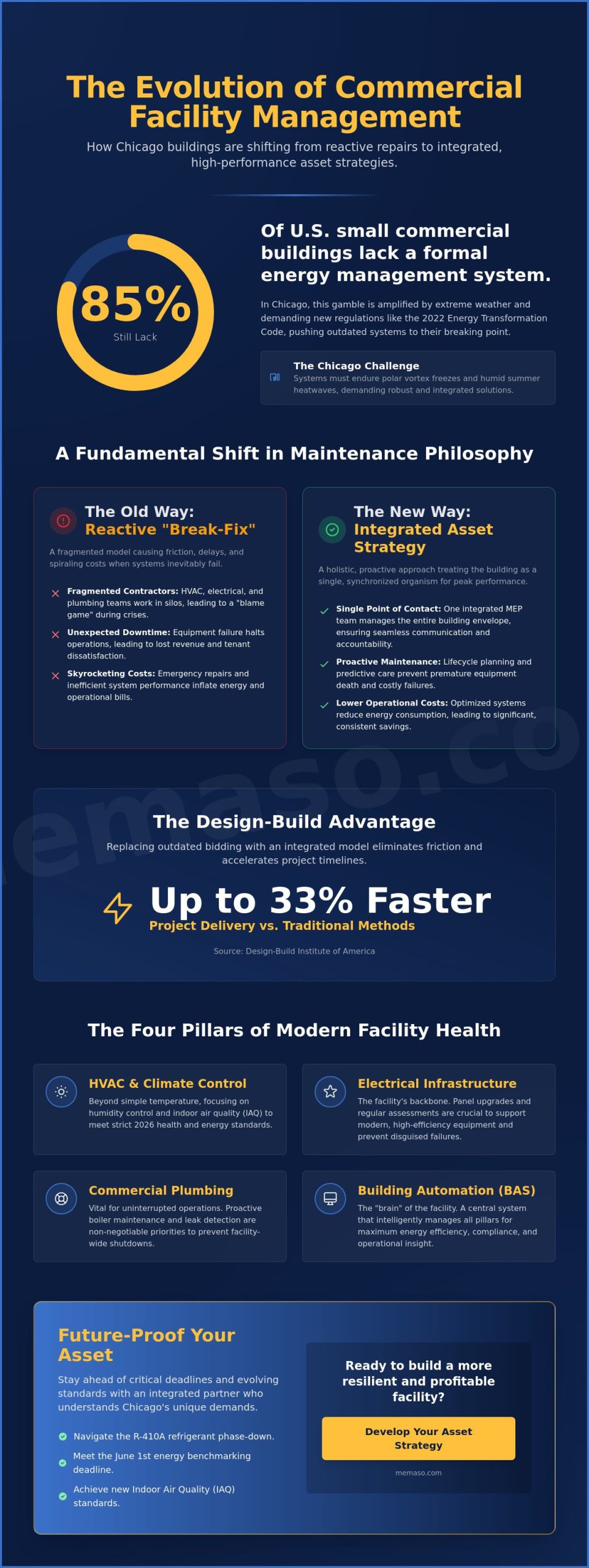
Did you know that 85% of small commercial buildings in the U.S. still lack a formal energy management system? In a city like Chicago, where a sudden polar vortex or a humid July heatwave can push equipment to its breaking point, relying on outdated or fragmented commercial mechanical services is a gamble you can’t afford to take. You’ve likely felt the frustration of an HVAC technician blaming an electrician while your operational costs climb and your energy bills skyrocket. It’s exhausting to manage multiple contractors who don’t communicate, especially when the 2022 Chicago Energy Transformation Code demands higher efficiency standards than ever before.
We understand that your facility is more than just a building; it’s a critical asset that requires a steady, expert hand to remain profitable. Discover how modern mechanical, electrical, and plumbing integration is transforming Chicago facilities into high-performance assets. You’ll learn how to lower energy bills through better efficiency, reduce downtime with building automation systems, and simplify your life with a single, reliable point of contact. This guide previews the essential 2026 trends, from the R-410A refrigerant phase-down to the June 1st energy benchmarking deadline, so you can stay ahead of the curve.
Key Takeaways
- Learn how modern commercial mechanical services have evolved into an integrated “building envelope” approach that connects HVAC, electrical, and plumbing for peak performance.
- Discover why the design-build model is replacing traditional bidding to eliminate contractor friction and significantly shorten project delivery schedules.
- See how shifting your maintenance strategy from a “fix-it-when-it-breaks” mindset to a proactive asset plan can prevent premature equipment death and lower operational costs.
- Explore the role of Building Automation Systems (BAS) as the “brain” of your facility, managing everything from energy efficiency to 2026 indoor air quality standards.
- Identify why local technical knowledge is the most critical factor in ensuring your systems remain compliant with Chicago’s unique energy codes and weather demands.
What are Modern Commercial Mechanical Services in 2026?
In the past, property managers viewed commercial mechanical services as a reactive necessity. You called a technician when the boiler leaked or the AC quit during a July heatwave. By 2026, this fragmented “break-fix” model has become a liability. Modern facility management now treats a building as a single, synchronized organism where every system relies on the others to function efficiently. This shift toward lifecycle management means we look at the long-term health of your assets rather than just patching a temporary problem.
For Chicago facilities, the “building envelope” perspective is now a requirement for survival. Our local weather swings are legendary; your systems must fight through sub-zero winters and humid summers. If your building envelope is compromised, your mechanical systems work twice as hard, leading to premature equipment death. By integrating your mechanical strategy with the physical realities of your structure, you increase the overall valuation of your property. A building with documented, high-performance mechanical history is a much more attractive asset to investors and tenants alike.
The Four Pillars of Commercial Facility Health
A healthy facility stands on a foundation of three core disciplines, tied together by intelligent oversight. First, HVAC and climate control have moved beyond simple temperature settings. In 2026, we focus heavily on humidity management and indoor air quality to meet stricter health standards. This often involves precision heating replacement or modern heat pump installation to align with the 2022 Chicago Energy Transformation Code.
Second, your electrical infrastructure is the backbone of everything. We often find that mechanical failures are actually electrical issues in disguise. Regular electrical panel upgrades ensure your system can handle the load of modern, high-efficiency equipment. Finally, commercial plumbing remains vital, particularly regarding boiler maintenance and repair. In larger Chicagoland institutions, a single boiler failure can halt operations entirely, making proactive care a non-negotiable priority.
Why Integration Matters for Your Bottom Line
When you use a single integrated provider, you eliminate “contractor friction.” This is the common headache where the HVAC guy blames the electrician, and the plumber is caught in the middle. Integrated Mechanical, electrical, and plumbing (MEP) is a unified engineering approach that ensures all systems speak the same language. This synergy is critical during extreme weather events when synchronized systems prevent cascading failures.
By coordinating your commercial mechanical services through a design-build model, you ensure that every upgrade or repair considers the entire facility’s ecosystem. This holistic approach doesn’t just save time during installation; it creates a more resilient building that costs less to operate every single month. It’s about moving from being a “service customer” to a “facility partner.”
The Rise of Integrated Design-Build and MEP Synergy
The traditional “bid-spec” model often leaves Chicago building owners caught between a designer’s vision and a contractor’s reality. It’s a system built on fragmentation, where the lowest bid frequently leads to the highest number of change orders. By 2026, savvy facility managers are moving toward integrated Design-Build Construction Services to eliminate this friction. This model combines design and installation into a single workflow, ensuring that your commercial mechanical services are executed with a unified vision from day one.
One of the most significant advantages of this synergy is speed. Research from the Design-Build Institute of America indicates that design-build projects are delivered up to 33% faster than traditional methods. In the fast-paced Chicago market, choosing integrated commercial mechanical services can cut months off a renovation timeline, which directly translates to earlier occupancy and faster ROI. This approach also ends the “blame game” between different trades. When the same team handles both the engineering and the installation, there’s no finger-pointing when a complex HVAC system meets an aging electrical grid.
The Design-Build Advantage for Chicago Renovations
Navigating the permit process in Cook County is notoriously complex. An integrated approach streamlines compliance because the engineers and installers are already on the same page regarding the latest 2022 Chicago Energy Transformation Code. This early-stage coordination provides cost certainty that the “bid-spec” model simply can’t match. You avoid the “change order trap” because potential conflicts are resolved on a screen before a single wrench is turned. This foresight doesn’t just save money; it improves system longevity by ensuring every component is perfectly sized for its specific environment.
Synchronizing Electrical and Mechanical Systems
Modern upgrades, like high-efficiency Heat Pump Installation, demand more from your building’s heart than older systems. We often see facilities attempt to install advanced equipment without considering the existing electrical capacity. This mismatch is a recipe for system failure. True MEP synergy involves performing necessary Electrical Panel Upgrades alongside mechanical changes to ensure your infrastructure can handle the new load. This holistic view is vital for energy efficiency in commercial buildings, as it prevents aging wires from bottlenecking high-performance machines. For those critical moments when the unexpected happens, having integrated emergency electrical services ensures your facility stays online even in the harshest conditions.
Why Maintenance is an Asset Strategy, Not a Cost
Owners often tell us they can’t afford a maintenance contract right now. It’s a common objection, but it overlooks the “hidden cost of neglect.” When you delay commercial mechanical services, you aren’t saving money; you’re just deferring a much larger bill. Neglected systems lose efficiency quickly, leading to ballooning energy waste and premature equipment death. In the high-stakes environment of a Chicago winter, where temperatures can plummet to -20°F, an unmaintained boiler isn’t just inefficient. It’s a liability waiting to happen.
By 2026, we’ve moved beyond reactive repairs. We use predictive maintenance driven by IoT sensors to monitor system health in real-time. This allows us to address a failing component before it causes a total shutdown. It’s the difference between a scheduled $500 fix and a catastrophic $50,000 replacement. According to data on energy consumption, HVAC and lighting account for nearly half of a building’s energy use. Keeping these systems tuned is the fastest way to protect your bottom line and ensure long-term stability.
Boiler and HVAC Longevity in the Midwest
Chicago’s high-rise and industrial facilities face unique challenges. Our local water is notoriously hard, which causes mineral scaling inside commercial plumbing and heat exchangers. Over time, this scale acts as an insulator, forcing your boiler to work harder to achieve the same temperature. We perform seasonal “deep dives” every April and October. This ensures your cooling is ready for a humid July and your heating is prepared for a January freeze. Proactive Boiler Maintenance and Repair is the only way to ensure your system survives the decade.
Quantifying the ROI of Proactive Service
Regular tuning typically reduces energy consumption by 15% to 20%. This isn’t just a guess; it’s a measurable result of keeping coils clean and sensors calibrated. You also avoid the “emergency premium.” The cost of a 2 a.m. Heating System Repair during a blizzard is significantly higher than a scheduled afternoon visit. To put it in perspective, the total cost of ten years of comprehensive service is often less than a quarter of the price of a single new chiller. Maintaining your current assets through professional commercial mechanical services is simply smarter than replacing them early. Just as a structured approach to HVAC care pays dividends, implementing a commercial plumbing maintenance plan is equally essential to preventing costly water damage and keeping your facility’s infrastructure running without interruption.
Future-Proofing: Automation and Energy Efficiency Trends
Facility management is undergoing a fundamental shift toward digital intelligence. It isn’t just about comfort anymore; it’s about survival in a market where energy costs and regulatory pressures continue to climb. By 2030, the global Energy Management Systems market is expected to reach $112 billion, reflecting a massive shift in how we oversee facility operations. For your building to remain a high-performance asset, your commercial mechanical services must evolve to include sophisticated oversight that goes beyond simple thermostat adjustments.
The Impact of Building Automation (BAS)
A modern facility needs a “brain” to coordinate its complex systems. Building Automation Systems (BAS) provide this central intelligence, allowing for real-time monitoring of every mechanical component. This technology can spot an electrical surge or a minor leak in your plumbing before it escalates into a catastrophic failure. If you manage multiple Chicago properties, a BAS allows you to oversee every dashboard from a single remote location. These systems also optimize energy loads by adjusting HVAC and lighting based on actual occupancy and current weather patterns, ensuring you never pay to heat an empty warehouse or cool a vacant office suite.
Indoor Air Quality (IAQ) as a Competitive Edge
Since the pandemic, indoor air quality has become a primary factor in tenant retention and employee productivity. High-performance filtration and advanced ventilation strategies are no longer optional upgrades; they are 2026 standards for any Class A office space. We focus on the “invisible” side of commercial mechanical services, such as precision duct sealing and air care, to ensure your ventilation system isn’t just moving air, but actively cleaning it. Investing in IAQ protects your occupants’ health and serves as a powerful selling point for prospective tenants who prioritize wellness in their workspace.
Decarbonization is another driving force in the current market. The American Innovation and Manufacturing (AIM) Act mandates an 85% reduction in HFC refrigerants by 2036, which is already pushing the industry toward lower-GWP alternatives like R-32 and R-454B. While the EPA recently updated rules to allow the continued installation of some R-410A systems manufactured before 2025, the transition to high-efficiency Heat Pump Installation is the clearest path to future-proofing your building. This shift toward electrification helps you stay ahead of the Chicago Energy Benchmarking Ordinance, which requires buildings over 50,000 square feet to report their energy use by the June 1st deadline every year. Staying compliant with these local sustainability mandates ensures your facility avoids penalties and remains a leader in the local landscape.
Choosing a Local Chicago Partner for Integrated Solutions
Navigating commercial mechanical services in a city as complex as Chicago requires more than just technical skill. It requires an intimate understanding of the 2022 Chicago Energy Transformation Code and the unique stresses our climate places on aging infrastructure. National chains often lack the local authority needed to navigate specific Cook County permitting or the annual June 1st benchmarking deadline. Choosing a partner with deep roots in the Chicagoland area ensures you aren’t just getting a contractor; you’re getting a consultant who knows exactly how a January freeze affects a high-rise boiler system. Our seasoned professionals bring decades of local tenure to every project, providing a level of stability that newer competitors simply can’t match.
Transitioning from fragmented vendors to an integrated partner is the most effective way to lower operational anxiety. When your HVAC, electrical, and plumbing teams work in silos, critical details fall through the cracks. An integrated approach ensures that a high-efficiency Heating replacement / installation is supported by the necessary Electrical Panel Upgrades from the start. This method eliminates the “blame game” and creates a single, reliable point of contact for all your facility needs. It’s about moving away from the stress of unpredictable system failures and toward a model of professional reliability and peace of mind.
The MEMASO Difference: From Design to Emergency Repair
Our Design-Build Construction Services are specifically tailored to Chicago’s architectural diversity. Whether you’re managing a historic Loop office building or a modern industrial site, our philosophy remains the same: integrate every trade from the beginning. This comprehensive MEP coverage means you only need one number in your phone for everything from Heat Pump Installation to commercial mechanical services like complex Boiler Maintenance and Repair. We maintain a strict commitment to safety and high technical standards, ensuring your facility remains a comfortable, high-performance asset. If a system fails at the worst possible moment, our 24/7 emergency support for the Chicagoland area provides the rapid response you need to keep your operations running.
Get Started with a Facility Performance Assessment
The first step toward optimization is a clear-eyed look at your current assets. During our initial mechanical and electrical audit, we examine your entire building envelope to identify inefficiencies. We look for immediate “energy wins,” such as calibrating Building Automation Systems or spotting the need for Heating System Repair before the peak of winter. We also help you map out long-term capital improvements, such as a phased Air Conditioning Replacement / Installation plan, so you aren’t caught off guard by a sudden equipment death. It’s time to stop reacting to crises and start managing your facility with confidence. Schedule your Chicago facility consultation with MEMASO today to see how we can optimize your building’s ROI.
Securing Your Facility’s Future in a Changing Chicago
The evolution of 2026 facility management proves that a building’s success depends on the harmony of its internal systems. By embracing integrated MEP solutions and data-driven automation, you move beyond the stress of reactive repairs and toward a model of sustained high performance. Proactive maintenance isn’t just a line item; it’s a strategic choice to protect your asset’s valuation and keep your operational costs predictable. Navigating these technical shifts requires a partner with the seasoned capability to handle everything from complex boiler repairs to modern heat pump installations.
With over 25 years of cumulative experience in the Chicagoland area, we understand the local landscape and the specific demands of our regional climate. Our comprehensive approach to commercial mechanical services ensures that your mechanical, electrical, and plumbing systems work as one cohesive unit. We provide 24/7 emergency support for critical infrastructure, giving you the peace of mind that your facility is always protected. Don’t let fragmented vendors or outdated systems drain your bottom line. It’s time to transform your building into a resilient, efficient environment that stands the test of time.
Optimize your facility with Chicago’s trusted mechanical experts
Frequently Asked Questions
What exactly are commercial mechanical services?
These services represent the integrated management and maintenance of a facility’s HVAC, electrical, and plumbing systems. In 2026, commercial mechanical services focus on a holistic “building envelope” approach, ensuring that heating, cooling, and power infrastructure work together to maximize energy efficiency. This includes everything from precision boiler maintenance to critical electrical panel upgrades that keep a building running smoothly.
Why should I choose a design-build contractor for my facility?
A design-build contractor provides a single point of responsibility by combining engineering and installation into one streamlined workflow. This model eliminates the common “blame game” between designers and installers that often occurs in traditional bidding. It also helps you avoid unexpected change orders and can significantly speed up project delivery times, allowing your facility to become operational much faster.
How often does a commercial HVAC system need professional maintenance in Chicago?
Most Chicago facilities require professional maintenance at least twice a year to handle our extreme temperature swings. We recommend a comprehensive inspection in the spring to prepare for humid summers and another in the autumn before sub-zero winter temperatures arrive. Regular boiler maintenance and repair are particularly critical for local high-rise buildings to prevent catastrophic failures during a polar vortex.
What are the benefits of integrating building automation with my mechanical systems?
Building Automation Systems (BAS) act as the central intelligence of your facility, allowing you to monitor and control mechanical loads in real-time. These systems can detect minor leaks or electrical surges before they become expensive disasters. By adjusting HVAC and lighting based on actual occupancy, a BAS helps you lower energy bills and remain compliant with local sustainability mandates.
Does MEMASO provide emergency electrical and plumbing services 24/7?
Yes, we provide 24/7 emergency support for critical infrastructure throughout the Chicagoland area. Our team is ready to handle urgent needs such as Emergency Electrical Services or sudden heating system failures. This constant availability ensures that your operations remain stable and your occupants stay safe, regardless of the time of day or the severity of the weather.
How can commercial mechanical upgrades help me meet Chicago’s energy benchmarking requirements?
Upgrading to high-efficiency systems like heat pumps or modern boilers directly improves your building’s energy performance score. The Chicago Energy Benchmarking Ordinance requires buildings over 50,000 square feet to track and report energy use by June 1st each year. Implementing commercial mechanical services focused on efficiency helps you avoid penalties and demonstrates your commitment to the 2022 Chicago Energy Transformation Code.
What is the difference between a residential and a commercial mechanical contractor?
Commercial contractors handle much larger, more complex systems that must meet rigorous institutional and industrial standards. While residential work focuses on individual domestic comfort, commercial mechanical work involves large-scale boilers, integrated MEP systems, and building-wide automation. The technical expertise required for commercial facilities involves understanding high-load electrical panels and complex plumbing maintenance that residential technicians don’t typically encounter.
Can upgrading my electrical panel really improve my HVAC efficiency?
An outdated electrical panel can bottleneck modern high-efficiency HVAC equipment, leading to poor performance. Electrical Panel Upgrades ensure that your infrastructure can handle the specific power demands of new heat pumps or air conditioning units without surging. When your electrical system is properly sized for your mechanical load, your equipment runs more reliably and consumes less energy over time.