

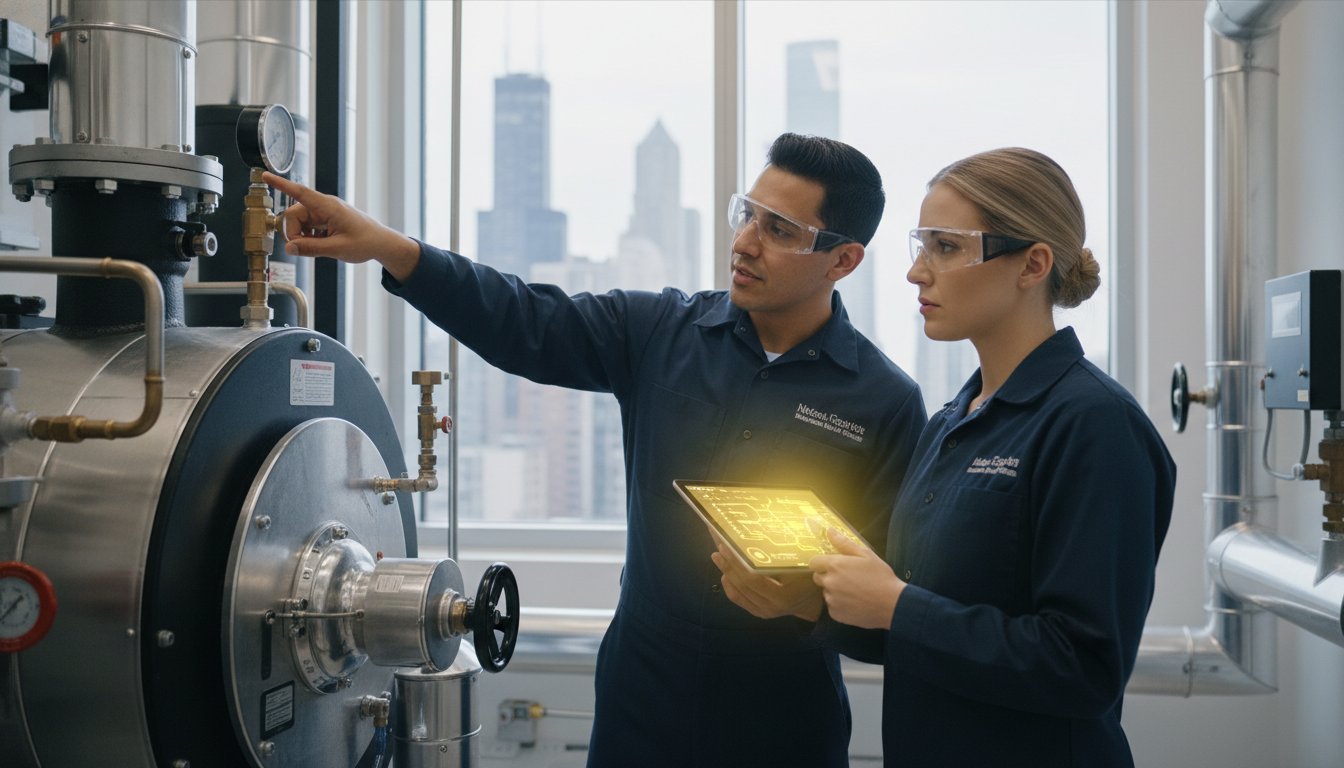
Did you know that non-weather-related water damage drains over $16 billion from the insurance industry every single year? In a city like Chicago, where a single 5mm pipe crack can leak 950 liters of water in a day, waiting for a visible puddle to appear is a gamble your budget can’t afford. You likely already feel the pressure of rising operational costs, especially with the city’s water rates set to increase by 1.85% this June. It’s a constant challenge to balance daily facility management while staying ahead of complex building codes and the threat of a $600,000 business interruption loss.
A proactive commercial plumbing maintenance plan is the most effective tool to transform these technical headaches into predictable, manageable outcomes. We’ll show you how a strategic plan prevents costly downtime, ensures your facility remains compliant with the latest Phase 3 Construction Code updates, and uses smart technology to protect your infrastructure. From surviving extreme winter freezes to navigating the new $600 permit application fees, you’ll learn how to secure your facility’s future and extend the life of your critical boiler and water systems.
Key Takeaways
- Identify how the “Failure Curve” transforms minor leaks into major structural damage and learn to stop the cycle before it starts.
- Navigate strict Chicago building codes with a professional focus on backflow prevention testing and high-capacity drain jetting.
- Transition from reactive repairs to predictive care by integrating a commercial plumbing maintenance plan with Building Automation Systems (BAS).
- Secure your facility against Chicagoland’s extreme winter freezes through specific winterization protocols for commercial boilers and exposed piping.
- Understand the strategic advantage of an integrated MEP approach that considers how your electrical and heating systems impact your plumbing health.
The High Cost of Reactive Plumbing: Why Chicago Businesses Can’t Afford to Wait
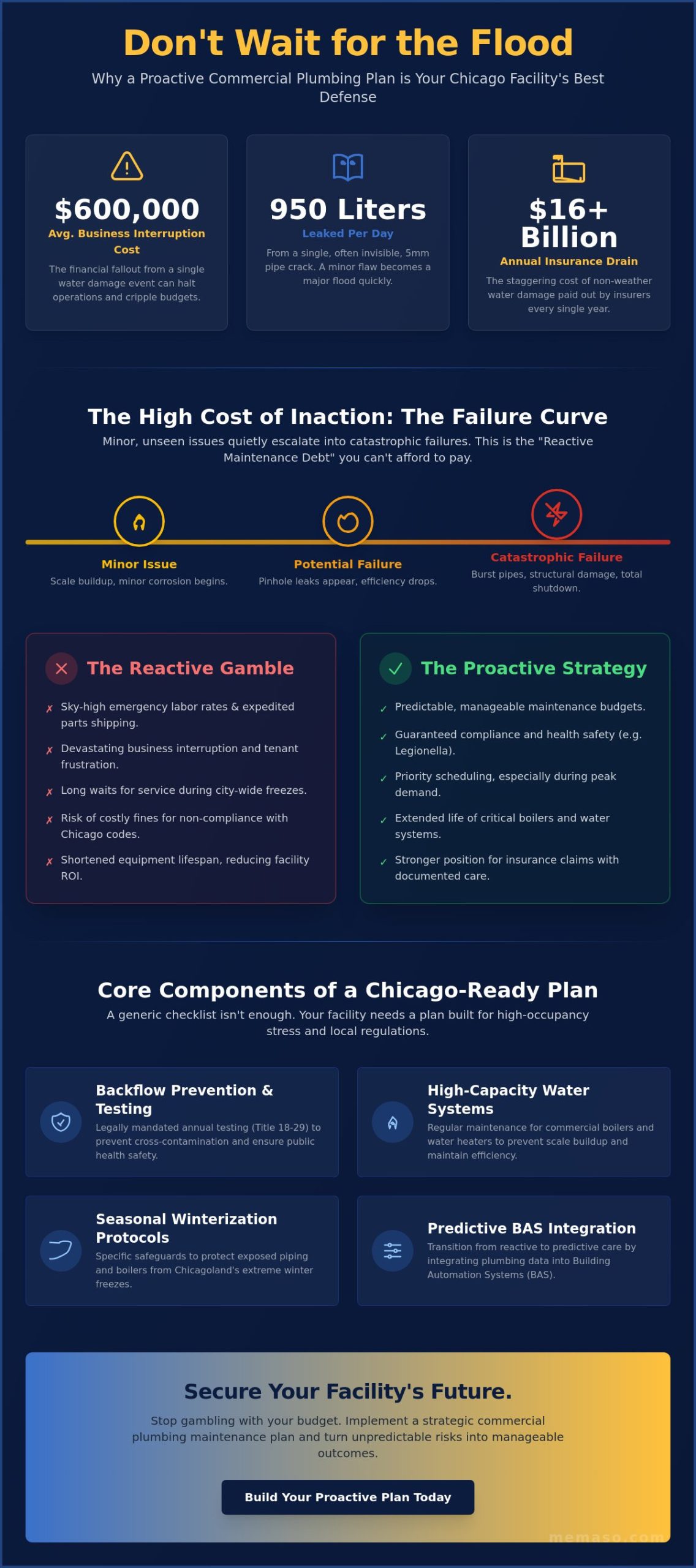
Many facility managers treat plumbing like an invisible utility until a pipe bursts in the middle of a January freeze. This reactive approach is a gamble that ignores the “Failure Curve,” where minor issues like scale buildup or pinhole leaks quietly escalate into catastrophic structural damage. A strategic commercial plumbing maintenance plan serves as a proactive risk-mitigation strategy, identifying these vulnerabilities before they manifest as property-destroying events. When you wait for a failure, you aren’t just paying for a repair; you’re paying for the “Reactive Maintenance Debt” accumulated over years of neglect. This debt represents the loss in facility ROI caused by shortened equipment lifespans and the compounded costs of emergency interventions.
Emergency repairs carry hidden financial weights that rarely appear on a standard quote. You’ll face premium labor rates and the staggering costs of expedited parts shipping to get your building back online. Beyond the invoice, the impact of unplanned water shut-offs is devastating. For a Chicago high-rise or a suburban medical office, losing water means halted operations and frustrated tenants. The Allianz Risk Barometer estimates the average cost of business interruption from water damage at $600,000, a figure that can easily bankrupt a mid-sized operation. A single 5mm crack in a pipe can leak up to 950 liters of water per day, turning a small oversight into a six-figure disaster before the next shift even begins.
The Reality of Emergency Repairs in Cook County
Securing emergency service during a peak Chicago winter is notoriously difficult. When every building in the Loop is dealing with frozen lines, a maintenance plan provides the critical advantage of priority scheduling. It ensures your facility isn’t at the bottom of a long waiting list during high-demand periods. Professional management of commercial plumbing systems keeps your infrastructure robust enough to handle the city’s unique environmental pressures. By addressing wear and tear on your own schedule, you avoid the frantic scramble for help when every other facility manager in the city is making the same call.
Regulatory Compliance and Liability
Chicago operates under its own municipal plumbing code, Title 18-29, which is significantly stricter than the Illinois state standard. Documented inspections are a necessity for staying on the right side of local inspectors and avoiding the new $600 penalties for deficient permit applications introduced in 2026. Regular maintenance also plays a vital role in health safety by preventing issues like Legionella growth in stagnant lines. Perhaps most importantly, a detailed history of professional care protects property owners during insurance claims. When you can prove a history of diligent upkeep, you’re in a much stronger position to recover losses if a major system failure occurs.
Core Components of a Comprehensive Commercial Plumbing Maintenance Plan
A generic checklist often fails because it treats a Chicago high-rise the same as a suburban retail strip. Our city’s infrastructure demands more than a visual walkthrough. A truly effective commercial plumbing maintenance plan prioritizes technical precision and accounts for high-occupancy stress on aging municipal connections. It’s about moving beyond the “if it isn’t broken, don’t fix it” mentality and focusing on the specific systems that keep your facility operational.
Backflow Prevention and Water Quality
Backflow occurs when a sudden drop in municipal water pressure causes non-potable or contaminated water to flow backward into your clean supply. This isn’t just a technical glitch; it’s an essential connection with public health that requires strict adherence to City of Chicago Title 18-29. Annual testing of backflow assemblies is a legal mandate. A professional maintenance plan simplifies this by managing the certification process and ensuring your pressure levels remain within safe margins to prevent cross-contamination risks.
High-Capacity Water Systems: Boilers and Heaters
Commercial water heaters and boilers are the workhorses of your building. Over time, calcium and magnesium deposits settle at the bottom of these tanks, creating an insulating layer that forces the burner to work harder. Even a 1% efficiency drop in a commercial boiler can increase annual utility costs by thousands of dollars in a large-scale facility. Regular flushing removes this sediment, while inspecting safety relief valves and expansion tanks ensures the system doesn’t fail under pressure. If you’ve noticed inconsistent temperatures, a professional boiler maintenance and repair audit can determine if you’re losing money through simple heat loss or mechanical wear.
Beyond the heavy machinery, your plan should address the high-traffic drain lines that traditional snaking can’t handle. Hydro-jetting uses high-pressure water to scour pipe walls clean of grease and mineral scale, which is vital for restaurants and high-density residential buildings. Finally, fixture and valve audits help identify “silent” water waste. A leaking flush valve in a single restroom might seem minor, but across a 20-story facility, it represents a massive spike in your metered water bill. Identifying these small leaks is the easiest way to see an immediate return on your maintenance investment.
Preventative vs. Predictive: Integrating Building Automation into Your Plan
While preventative maintenance follows a calendar, predictive maintenance follows the data. It’s the difference between changing your oil every 3,000 miles and having a smart sensor tell you exactly when the fluid is failing. For a modern commercial plumbing maintenance plan, this shift is revolutionary. By integrating your plumbing infrastructure into Building Automation Systems (BAS), we move beyond guesswork. These systems monitor water flow and pressure in real-time, catching anomalies that a human inspector might miss during a monthly walkthrough.
In multi-story Chicago office buildings, gravity is both a tool and a threat. A leak on the 20th floor doesn’t stay on the 20th floor; it cascades through ceilings and electrical closets. Smart leak detection sensors, strategically placed in mechanical rooms and near high-risk riser points, provide an immediate line of defense. These IoT devices feed data directly into a centralized facility management dashboard, allowing you to see the health of your entire system at a glance. Commercial plumbing tips often emphasize basic manual checks, but the true power lies in automated oversight that never sleeps.
The Role of Smart Sensors and IoT
Wireless sensors now detect moisture in the hardest-to-reach mechanical rooms, areas often neglected due to accessibility issues. When these sensors pair with automatic shut-off valves, the risk of catastrophic flood damage drops significantly. If a pipe fails at 3:00 AM on a Sunday, the system can isolate the zone before a single gallon hits the floor. At MEMASO, we leverage these BAS integrations to provide a higher tier of maintenance oversight, turning your plumbing from a hidden liability into a managed, visible asset.
Data-Driven Decision Making for Facility Managers
Using real-time flow data allows facility managers to identify water-saving opportunities that directly impact ROI. You can pinpoint exactly where consumption spikes and address inefficiencies immediately. This historical data also informs long-term capital planning. Instead of guessing when a main line might need replacement, you can track its performance over years to justify the investment. This approach marks a fundamental shift in operations, moving your team from the inefficiency of inspecting on a schedule to the precision of inspecting on demand.
Seasonal Safeguards: Adapting Your Plan for Chicago’s Climate
Chicago’s weather isn’t just a topic for small talk; it’s a relentless stress test for your building’s infrastructure. A standard commercial plumbing maintenance plan that works in milder climates will fail here during the first “Polar Vortex.” Our region requires a strategy that breathes with the seasons, anticipating the physical expansion of pipes and the heavy load placed on heating systems. Protecting your facility means understanding that the transition from a deep freeze to a spring soak is the most vulnerable time for your plumbing. Without a seasonal roadmap, you’re essentially waiting for the environment to find the weakest link in your system.
During the peak of summer, high humidity creates its own set of challenges. Cold water lines often “sweat” as moisture from the heavy Chicago air condenses on uninsulated metal surfaces. This persistent dripping can lead to mold growth in wall cavities or the slow corrosion of pipe supports. A comprehensive plan includes checking the integrity of pipe insulation and ensuring that mechanical room ventilation is actually managing the moisture load. By addressing these environmental factors early, you prevent the secondary damage that often follows a humid Midwestern July.
Chicagoland Winter Readiness
Winterization is about more than just turning off outdoor spigots. In large facilities, unheated zones like loading docks, parking garages, and vacant suites are prime targets for burst pipes. We focus on insulating critical water lines and testing heat trace cables long before the first deep freeze hits Cook County. It’s also vital to ensure that backup heating systems for your mechanical rooms are functional. If your primary heating fails, those rooms can drop below freezing in hours, leading to a total facility shutdown. For buildings relying on steam, we prioritize boiler maintenance and repair to check steam traps. A stuck trap can cause water hammer or frozen return lines, both of which are expensive to remediate in the middle of a blizzard.
Sump Pumps and Flood Prevention
The spring thaw in Chicago often brings rapid snowmelt followed by heavy rains, putting immense pressure on your drainage systems. Every commercial facility needs redundant sump pump systems equipped with battery backups. We test check valves and clear discharge lines to ensure that water has a clear path away from your foundation. For industrial sites, professional “wet well” cleaning is a critical step to remove the silt and debris that accumulates over the winter. This ensures your pumps don’t burn out when you need them most. If you haven’t audited your flood prevention hardware recently, now is the time to schedule a professional assessment of your commercial plumbing maintenance plan to avoid a basement catastrophe.
The MEMASO Advantage: Seasoned Professional Plumbing Management
Choosing a partner for your facility’s health requires more than just finding a contractor with a wrench. At Mechanical Management & Design Solutions (MEMASO), we take a consultative approach to every commercial plumbing maintenance plan we design. We understand that a Skokie industrial plant has vastly different drainage requirements than a professional office suite in Northbrook. Our team functions as a stable, knowledgeable partner, positioning ourselves as local experts who understand the unique municipal landscape of Chicagoland. You won’t be dealing with a national call center; you’ll be working with seasoned professionals who have spent decades mastering the specific challenges of Cook County infrastructure.
Our philosophy is rooted in precision and efficiency. We don’t just look for leaks; we look for the systemic causes of inefficiency. This high-level technical expertise allows us to lower your anxiety regarding complex mechanical projects. By treating your plumbing as a vital component of your building’s overall performance, we provide a level of reliability that newer competitors simply cannot match. We’re here to ensure your facility remains a safe, comfortable, and compliant environment for your tenants and employees alike.
Comprehensive MEP Synergy
Plumbing is rarely an isolated system. Our integrated MEP (Mechanical, Electrical, Plumbing) expertise allows us to see the connections other providers miss. For instance, our deep knowledge of boiler maintenance and repair bridges the gap between your heating and plumbing needs, ensuring that hot water delivery is both consistent and energy-efficient. We also recognize that your plumbing’s safety depends on your electrical health. A failure in your electrical panel can silence your leak detection sensors or shut down the booster pumps that keep water flowing to the upper floors of your facility. To provide the ultimate safety net, we offer 24/7 emergency support for our plan members, ensuring that your critical systems are protected around the clock.
Next Steps: Securing Your Facility’s Future
Securing your building starts with a comprehensive facility audit. We begin by mapping your entire system, documenting every valve, pump, and sensor to create a clear digital blueprint of your infrastructure. This onboarding process includes staff training to ensure your on-site team knows exactly how to respond during an isolation event. We don’t believe in one-size-fits-all solutions. Instead, we build a custom roadmap that addresses your specific “Reactive Maintenance Debt” and sets a course for long-term stability. When you’re ready to move from guesswork to professional certainty, we’re ready to help.
Request a Commercial Plumbing Maintenance Audit to begin protecting your Chicago facility today.
Securing Your Building’s Infrastructure for the Years Ahead
Transitioning from reactive repairs to a data-driven commercial plumbing maintenance plan is the most effective way to protect your bottom line and ensure compliance with strict Chicago codes. By integrating smart sensors and seasonal winterization protocols, you can avoid the catastrophic water damage that often follows a Midwestern deep freeze. This proactive approach turns a hidden liability into a managed asset that preserves your property’s long-term value and lowers your daily operational stress.
MEMASO has served the Chicago area since 2000, bringing seasoned MEP expertise to every facility we manage. Our integrated Building Automation System (BAS) capabilities offer the real-time monitoring you need to catch failures before they start. We prioritize our plan partners with 24/7 emergency support, providing a reliable safety net when the unexpected happens. Peace of mind comes from knowing your critical systems are managed by local experts who understand the unique demands of our city. We’re ready to help you build a more resilient facility today.
Protect Your Facility with a MEMASO Commercial Plumbing Maintenance Plan
Frequently Asked Questions
What is typically included in a commercial plumbing maintenance plan?
A comprehensive commercial plumbing maintenance plan typically includes annual backflow prevention testing, high-pressure drain jetting, and detailed inspections of all fixtures and valves. It also covers critical system tuning for commercial boilers and water heaters to ensure peak efficiency. By documenting these services, you create a clear maintenance history that protects your facility’s infrastructure and simplifies your future capital planning.
How often should a commercial building have its plumbing inspected?
Most commercial facilities require a full professional inspection at least once a year to maintain safety and efficiency. However, high-traffic environments or historic Chicago buildings with aging cast iron lines often benefit from quarterly walkthroughs. These more frequent checkups allow for seasonal adjustments, such as winterization protocols, ensuring your systems are prepared for the city’s extreme temperature swings before they cause a failure.
Is a maintenance plan required by Chicago building codes?
While the City of Chicago doesn’t mandate a formal maintenance contract, it does legally require specific upkeep tasks that a plan manages. For example, Title 18-29 of the municipal code requires annual testing and certification of backflow prevention assemblies. A structured plan ensures you never miss these critical deadlines, helping you avoid the city’s new $600 penalty for deficient or incomplete permit applications and inspections.
Can a maintenance plan help reduce my facility’s water bill?
Yes, a commercial plumbing maintenance plan is a direct defense against rising utility costs. With Chicago’s water rates set to increase by 1.85% in June 2026, identifying silent leaks in flush valves or faucets becomes a financial priority. By optimizing boiler efficiency and ensuring pipes are free of mineral scale, you reduce the volume of water and energy required to keep your building operational.
What is the difference between residential and commercial plumbing maintenance?
Commercial maintenance focuses on high-capacity systems and complex infrastructure that residential service rarely encounters. In a commercial setting, we manage large-scale boilers, industrial grease traps, and multi-story riser systems that serve hundreds of occupants simultaneously. The regulatory stakes are also much higher. Commercial properties must adhere to specific municipal codes and health safety standards that don’t apply to private residences.
How does building automation improve plumbing maintenance?
Building Automation Systems (BAS) transform maintenance from a scheduled task into a real-time monitoring service. These systems use IoT sensors to track water flow, pressure, and temperature across your entire facility. If an anomaly occurs, such as a sudden pressure drop or a moisture alert in a mechanical room, the system sends an immediate notification. This data allows our team to address issues before they escalate.
What happens if I have a plumbing emergency but I am on a maintenance plan?
Plan members receive priority scheduling for all service calls, which is vital during Chicago’s peak winter months. If a pipe bursts or a pump fails, you aren’t stuck at the bottom of a long waiting list. We provide 24/7 emergency support specifically for our maintenance partners. This rapid response minimizes business downtime and helps mitigate the high costs associated with water damage and structural repairs.
How do I choose the right commercial plumbing contractor in Chicago?
Look for a partner with extensive local tenure and a deep understanding of Chicago’s unique municipal codes. It’s important to choose a firm with integrated MEP expertise, as plumbing systems often rely on electrical panels and heating systems to function. Verify that the contractor is specifically licensed for work within city limits and has experience managing large-scale institutional facilities in the Chicagoland area. Just as you would vet a commercial HVAC contractor for certifications and local compliance knowledge, apply the same rigorous standards when selecting your plumbing partner.