


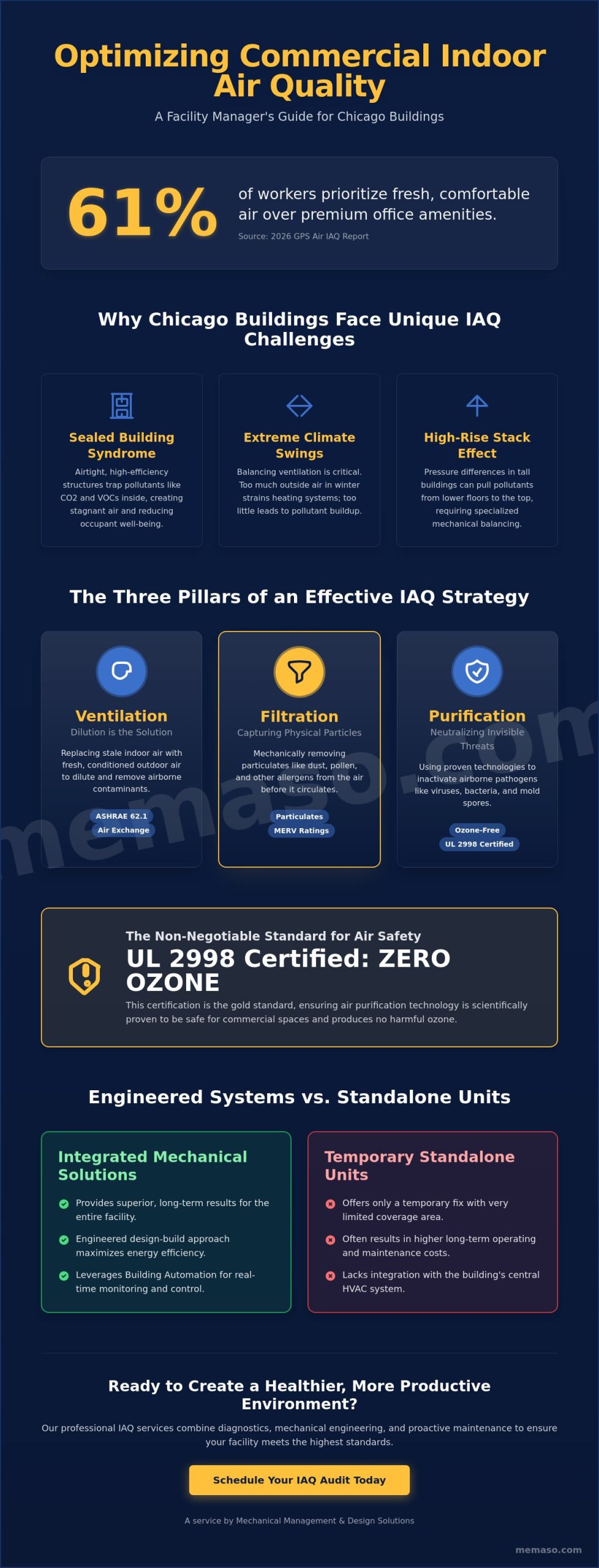
Did you know that 61% of workers would choose a workplace with fresher, more comfortable air over one with premium office amenities? According to the 2026 GPS Air IAQ Report, the atmosphere inside your facility is now a primary factor in talent retention and employee satisfaction. For Chicago facility managers, investing in professional commercial indoor air quality services is no longer just a luxury. It’s a fundamental operational requirement that directly impacts your bottom line and your team’s health.
You probably recognize the frustration of persistent “stale air” complaints or the sting of high energy bills caused by over-ventilation. It’s difficult to balance these daily pains with the need for strict ASHRAE 62.1 compliance and the prevention of airborne pathogen transmission. This guide will show you how to optimize your building’s air health, reduce absenteeism, and manage the technical complexities of modern IAQ solutions. We’ll explore how precision-engineered ventilation, building automation systems, and targeted filtration work together to create a safer, more efficient environment for every tenant in your building.
Key Takeaways
- Learn to identify “Sealed Building Syndrome” and why Chicago’s airtight structures require a precise mix of ventilation and filtration.
- Discover why UL 2998 certification is the non-negotiable standard for safe, ozone-free air purification technology in professional spaces.
- Understand how professional commercial indoor air quality services leverage building automation systems to monitor pollutants and optimize air health in real time.
- Master the process of creating a baseline IAQ audit to map pollutants while maintaining your building’s energy efficiency targets.
- Explore why engineered, design-build mechanical solutions provide superior long-term results compared to temporary, standalone air cleaning units.
What Are Commercial Indoor Air Quality Services?
Professional commercial indoor air quality services represent a comprehensive strategy for managing the air your tenants and employees breathe. This isn’t just about sticking a new filter in a rooftop unit; it’s a technical discipline that combines diagnostic testing, mechanical engineering, and proactive maintenance. To understand the baseline of these efforts, facility managers often look at What is Indoor Air Quality (IAQ)? and how it affects occupant health. In a high-stakes professional setting, these services ensure that ventilation rates meet the specific demands of high-occupancy environments while keeping energy costs under control.
Chicago’s harsh climate has led to a boom in high-efficiency, airtight building envelopes. While great for insulation, these “sealed” structures often trap pollutants inside. This leads to “Sealed Building Syndrome,” where the lack of fresh air exchange creates a stagnant environment. Unlike residential systems that handle small families, commercial requirements involve managing massive volumes of air for hundreds of people. This is why ASHRAE 62.1 standards are the non-negotiable benchmark. They define the exact amount of outdoor air needed to maintain a safe, productive workspace and prevent the buildup of carbon dioxide and volatile organic compounds (VOCs).
The Core Components of Professional Air Care
Effective air management relies on a steady, methodical approach to mechanical health:
- Source control: This is the first line of defense. It involves identifying and eliminating pollutants at their origin, such as moisture that leads to biological growth or off-gassing from building materials.
- Mechanical intervention: Sometimes, the existing HVAC system simply isn’t equipped for modern health standards. This may involve upgrading infrastructure or utilizing Design-Build Construction Services to ensure the ductwork and air handlers are engineered for maximum delivery efficiency.
- Continuous monitoring: Modern commercial indoor air quality services utilize smart sensors. By integrating Building Automation Systems, facility managers can track CO2 levels and particulate matter in real time, allowing the system to adjust automatically before air quality dips.
Why Chicago Businesses Face Unique IAQ Challenges
Our local climate presents hurdles that national chains often overlook. Chicago’s extreme temperature swings mean ventilation rates must be precisely balanced. If you pull in too much sub-zero air in January, your heating system works overtime. If you pull in too little, pollutants build up. High humidity in the summer and bone-dry air in the winter also change how particles stay suspended in the air, requiring different filtration strategies for different seasons.
High-rise facilities must also contend with the “Stack Effect.” This phenomenon occurs when pressure differences pull air upward through the building’s core. It can distribute pollutants from the lobby all the way to the top floor if the mechanical system isn’t properly balanced. Managing this requires a deep understanding of the local landscape and the specific mechanical needs of Chicago’s iconic architecture.
The Three Pillars of Effective Commercial IAQ Strategy
A high-performing building environment doesn’t happen by accident. It requires a deliberate, three-pronged approach that addresses air health from multiple technical angles. When engineers design commercial indoor air quality services, they rely on the pillars of ventilation, filtration, and purification. While ventilation focuses on “dilution as the solution” by bringing in fresh air, filtration captures physical particles, and purification neutralizes invisible biological threats. These pillars must work in synergy; a system with great filters but poor air exchange will still feel stagnant and heavy.
Facility managers should consult resources like the EPA’s Guide for Facility Managers to understand how these elements integrate into a broader management plan. Balancing these priorities ensures that your facility remains compliant with modern safety standards while protecting your mechanical equipment from premature wear.
Mechanical Ventilation and Air Exchange
Ventilation is the mechanical process of replacing stale indoor air with fresh, conditioned outdoor air. In Chicago’s variable climate, we often utilize Economizers and Energy Recovery Ventilators (ERVs) to manage this exchange efficiently. Energy Recovery Ventilators (ERVs) balance moisture and temperature during air exchange by transferring energy between the exhaust and intake streams. This prevents the “shock” of sub-zero winter air or humid summer air from hitting your coils directly. Calculating the necessary Air Changes per Hour (ACH) is vital, as a high-density call center requires significantly more air movement than a low-traffic warehouse to maintain safe CO2 levels.
Advanced Filtration Standards (MERV vs. HEPA)
Filtration is your primary defense against dust, pollen, and smoke. In recent years, MERV-13 has become the industry baseline for commercial office spaces because it’s effective at capturing microscopic droplets that carry pathogens. However, you can’t simply slide a thicker filter into an old unit. Denser filters create a “pressure drop,” which forces your blowers to work much harder to move the same volume of air. If your system isn’t designed for high-resistance filters, you risk motor burnout and reduced airflow. For specialized environments like Chicago medical clinics or labs, HEPA filtration may be required to capture 99.97% of particles. To ensure your system can handle these upgrades without failing, consider integrating Building Automation Systems to monitor real-time static pressure and filter health.
Evaluating Air Purification Technologies for Facility Managers
While filtration acts as a passive barrier, modern air purification represents an active approach to neutralizing contaminants. In the context of commercial indoor air quality services, active technologies don’t just wait for air to pass through a mesh; they release ions or use light to seek out and destroy pathogens in the airstream. This proactive layer is essential for high-volume Chicago facilities where occupancy density fluctuates throughout the day. For those looking to build a long-term strategy, the EPA Building Air Quality Guide provides a solid framework for choosing between these technical interventions.
Safety is the primary concern when introducing active cleaners. You must ensure any device is UL 2998 certified, which confirms it produces zero ozone. Ozone is a powerful lung irritant that can exacerbate the very respiratory issues you’re trying to prevent. By selecting certified equipment and integrating it with Building Automation Systems, managers can monitor performance in real-time. This integration ensures that purification levels scale based on actual occupancy, which extends the life of your mechanical components and reduces energy waste.
UVGI (Ultraviolet Germicidal Irradiation) Systems
UVGI systems use short-wavelength ultraviolet (UVC) light to disrupt the DNA and RNA of bacteria, viruses, and mold. When installed in ductwork, these systems provide constant disinfection of the air as it circulates. Facility managers usually choose between coil-mounted or airstream disinfection. Coil-mounted units focus on keeping the cooling coils free of biological biofilm, which improves heat transfer efficiency and lowers energy bills. Airstream units are designed for “kill on the fly” performance, neutralizing pathogens as they move through the ducts at high speeds. While UVGI has a higher initial cost, the ROI comes from cleaner coils and reduced system strain. Bulbs typically require replacement every 9,000 to 12,000 hours to maintain effective intensity.
Bipolar Ionization and Carbon Filtration
Bipolar ionization works by creating a plasma field that generates positive and negative ions. These ions travel through the air and attach to fine particles, causing them to “cluster” together. This makes them larger and much easier for your existing filters to capture. It’s a cost-effective way to boost the performance of MERV-rated filters without the heavy pressure drop associated with HEPA upgrades. For Chicago restaurants or facilities with high traffic, adding activated carbon filtration provides an extra layer of odor control by adsorbing gases and VOCs. When comparing ROI, ionizers often win out over frequent high-frequency filter changes because they reduce the overall particulate load on the system, allowing for more predictable maintenance cycles.
Steps to Implementing a Professional IAQ Management Plan
A high-performance air strategy requires more than just high-end hardware; it needs a structured roadmap that aligns with your facility’s operational goals. Implementing commercial indoor air quality services starts with a clear understanding of your building’s current state. Without a baseline, you’re merely guessing at which interventions will provide the best return on investment. A seasoned professional approach moves beyond reactive repairs and focuses on a long-term management plan that balances occupant health with the rigorous energy efficiency and decarbonization targets currently facing Chicago building owners.
Transparency is a critical, often overlooked component of this plan. According to the 2026 GPS Air IAQ Report, 67% of workers would be more willing to work in-person if their company communicated the specific steps taken to ensure a healthy environment. Sharing real-time data from your sensors builds trust and demonstrates a commitment to safety. This communication should be backed by a steady, methodical preventative maintenance schedule for all air-side components, ensuring that your investment continues to perform at peak efficiency year after year.
The Professional IAQ Audit Process
The foundation of any plan is a technical audit. This process involves precise testing for CO2, PM2.5, VOCs, and formaldehyde levels to identify specific pollutant hotspots. Our team conducts deep visual inspections of ductwork, cooling coils, and drain pans to check for biological growth that can compromise air health. We also review your original building design specifications against your current occupancy loads. If your facility was designed for 100 people but now holds 200, your ventilation rates must be recalibrated to remain compliant with ASHRAE standards.
Duct Sealing and System Optimization
Duct integrity is vital for ensuring that treated air actually reaches its destination. Air duct leaks create “bypass,” where unconditioned and unfiltered air skips your purification stages and enters the workspace. This imbalance disrupts pressure throughout the facility, making it harder to control humidity and temperature. By integrating IAQ sensors directly into your Building Automation Systems, you can automate your response to shifting air quality levels. For facilities looking to modernize their entire mechanical core, our Design-Build Construction Services provide an integrated path to superior air distribution and long-term energy savings.
If you are ready to move from guesswork to a data-driven air health strategy, contact us today for a professional facility assessment.
Why Integrated Mechanical Solutions Outperform Standalone Units
Many facility managers attempt to solve air health issues with “plug-and-play” portable purifiers. While these units might work for a small private office, they inevitably fail in large-scale commercial volumes. They lack the necessary “throw” to circulate air across an entire floor and don’t address the root cause of stagnation. True commercial indoor air quality services require an integrated approach where filtration and purification are engineered directly into the central HVAC system. This ensures that every cubic foot of air is treated before it even enters the ductwork, providing a uniform level of protection that standalone units can’t match.
Winter in Chicago introduces specific mechanical challenges that affect air health. As your heating system works to combat the cold, indoor humidity levels often plummet. Low humidity makes it easier for certain pathogens to stay suspended and can cause physical discomfort for tenants. This is why consistent Boiler Maintenance and Repair is a critical part of an IAQ strategy. A well-maintained boiler system supports the precise humidification levels needed to keep occupants comfortable and reduce the transmission of airborne illness. By viewing your mechanical room as the heart of your air quality plan, you create a more resilient and efficient facility.
The MEMASO Approach: Seasoned Professional Reliability
Our team leverages decades of collective experience in the Chicago market to provide custom air care designs. We understand the local building codes and the unique architectural demands of our city’s high-rises and industrial spaces. Through our Design-Build Construction Services, we eliminate the friction often found between separate design and installation firms. This integrated model ensures that your IAQ goals are baked into the project from day one. It leads to lower installation costs and a system that’s perfectly sized for your current occupancy loads. We’ve optimized air care for complex multi-family developments and corporate headquarters alike, proving that a unified mechanical strategy is the most dependable path to long-term safety.
Next Steps for Chicago Building Owners
Future-proofing your facility means staying ahead of evolving health regulations and environmental standards. Investing in high-efficiency heat pump replacement or upgrading your Building Automation Systems can often qualify for energy rebates while simultaneously improving your air health metrics. The first step is moving away from guesswork and toward a data-driven assessment of your mechanical infrastructure. Our process is methodical and transparent, designed to give you peace of mind that your building is operating at the highest possible standards.
If you’re ready to enhance your building’s performance and protect your workforce, Contact the experts at Mechanical Management & Design Solutions for a comprehensive facility assessment. Our seasoned professionals will help you navigate the technical landscape to find the right balance of efficiency, comfort, and safety.
Secure Your Building’s Future with Precision Air Health
Optimizing your facility’s atmosphere requires a shift from reactive repairs to a data-driven, integrated mechanical strategy. We’ve explored how a precise balance of ventilation, filtration, and active purification creates a healthier environment that reduces absenteeism and satisfies modern tenant expectations. By moving beyond standalone units and engineering solutions directly into your HVAC core, you ensure long-term compliance and operational efficiency across your entire Chicago property.
Choosing professional commercial indoor air quality services is a strategic investment in your building’s longevity and your workforce’s well-being. As a seasoned Chicago mechanical authority, we provide the integrated design-build expertise necessary to navigate our region’s complex climate and regulatory landscape. Whether you need to recalibrate your ventilation or require 24/7 emergency support for your critical systems, we’re here to help you maintain a safe, high-performing environment. Take the first step toward a cleaner, more efficient workspace today.
Schedule a Professional IAQ Audit for Your Chicago Facility
Frequently Asked Questions
How often should commercial air quality testing be performed?
Professional air quality testing should be performed at least once a year to establish a reliable baseline for your facility. You should consider more frequent assessments if you notice a spike in tenant health complaints or immediately following major interior renovations that introduce new building materials. Regular monitoring ensures your building remains compliant with the latest Chicago building codes and ASHRAE standards.
What is the difference between MERV 8 and MERV 13 filters for office buildings?
MERV 13 filters are the modern benchmark for office environments because they are dense enough to capture microscopic droplets that carry pathogens. MERV 8 filters are significantly more porous and are generally only effective for larger particles like dust, lint, and pollen. While MERV 13 provides superior protection, it requires a system with enough blower capacity to handle the increased air resistance.
Can poor indoor air quality really lead to ‘Sick Building Syndrome’?
Yes, the EPA defines “Sick Building Syndrome” as situations where occupants experience acute health and comfort effects that appear linked to time spent in a building. Symptoms often include headaches, dizziness, and respiratory irritation that disappear once the individual leaves the premises. This is frequently caused by inadequate ventilation or the buildup of volatile organic compounds (VOCs) from office furniture and cleaning supplies.
How do air quality services impact energy efficiency and utility bills?
Comprehensive commercial indoor air quality services actually lower long-term utility costs by reducing mechanical strain. When your filters are clean and your ductwork is properly sealed, your HVAC motors don’t have to work as hard to move air through the facility. This increased efficiency translates directly to lower monthly energy bills and fewer emergency repairs for your blowers and compressors.
Are UV lights in HVAC systems effective against viruses and bacteria?
UVGI (Ultraviolet Germicidal Irradiation) systems are highly effective when they are correctly sized for the velocity of your airstream. These systems use UVC light to disrupt the DNA of airborne pathogens, effectively neutralizing bacteria and viruses before they can circulate through the building. They are especially useful when mounted over cooling coils to prevent the growth of biological biofilm.
What are the most common pollutants found in Chicago commercial buildings?
Chicago facilities often contend with high levels of carbon dioxide (CO2) from dense occupancy and particulate matter drawn in from the urban environment. Volatile organic compounds (VOCs) from industrial cleaning agents and seasonal mold spores triggered by our high summer humidity are also primary concerns. Managing these requires a localized strategy that accounts for our city’s specific environmental shifts.
Do I need to replace my entire HVAC system to improve air quality?
You don’t necessarily need a full system replacement to achieve high health standards. Many facilities can significantly improve their environment through targeted commercial indoor air quality services like retrofitting bipolar ionizers or integrating advanced sensors into existing Building Automation Systems. Our design-build experts can help you determine if a retrofit or a targeted upgrade is the most cost-effective path for your specific mechanical core.
What is an ERV and why is it important for Chicago winters?
An Energy Recovery Ventilator (ERV) is a mechanical component that exchanges stale indoor air for fresh outdoor air while transferring heat and moisture between the two. This is critical during Chicago winters because it pre-warms the freezing intake air using the warmth of the exhaust air. This process protects your boiler from redlining and ensures the indoor air remains at a comfortable humidity level during the driest months. For facilities also evaluating their primary heating equipment, understanding the latest options for heat pump replacement in Chicago can help you select a system that works in tandem with your ERV for maximum efficiency.