

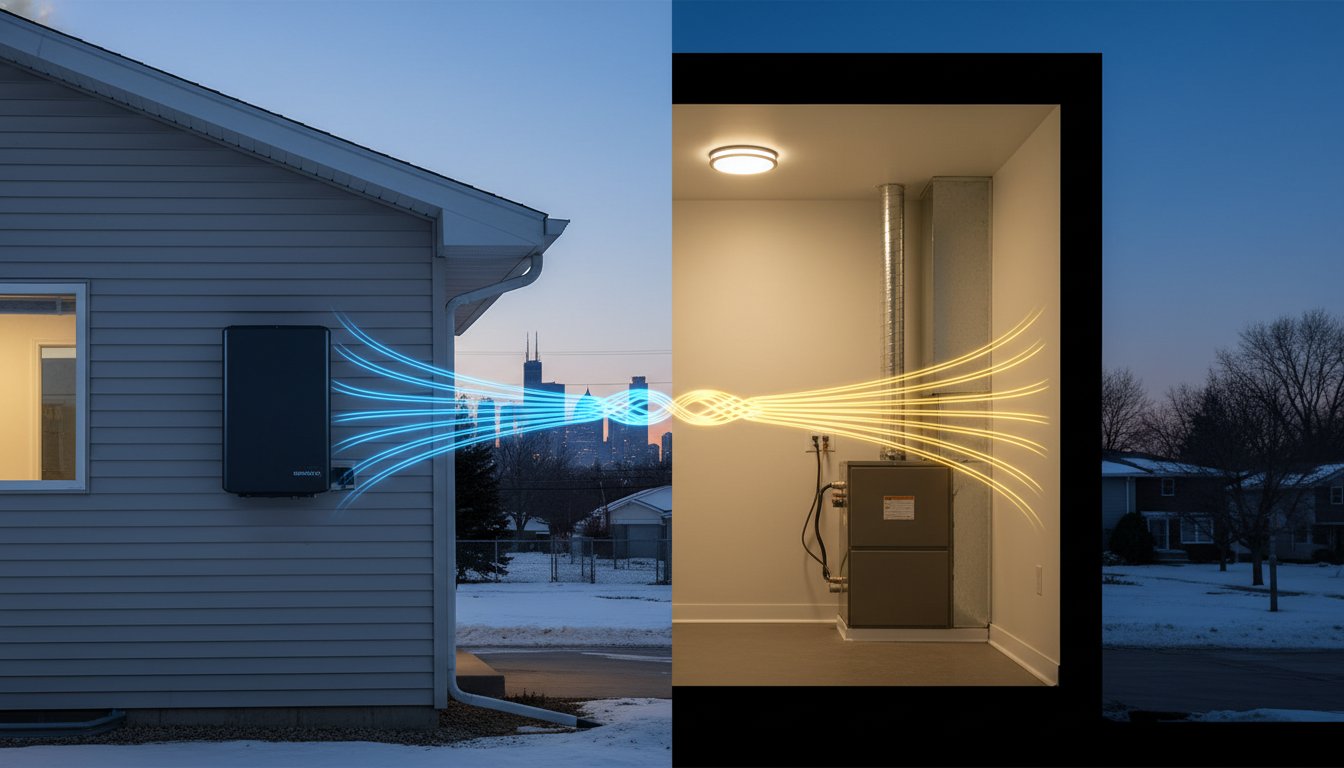
Most Wheeling homeowners believe choosing between a heat pump and a furnace is a zero-sum game, but in 2026, the most resilient choice isn’t picking one; it’s combining both. When you’re weighing the pros and cons of a heat pump vs furnace wheeling winters can make the decision feel high-stakes. You’ve likely felt the sting of rising utility rates, with ComEd delivery costs climbing and Illinois electricity prices now averaging around 17 cents per kWh. It’s natural to worry about whether a modern system can actually survive a sub-zero polar vortex without sending your monthly bills into orbit.
We understand that the confusion over expired 2025 federal tax credits and the new Illinois state rebate programs makes this even more stressful. You deserve a heating solution that provides peace of mind when the temperature drops below zero. You’ll discover how to maximize your home’s ROI by accessing new state-administered rebates that offer up to $8,000 for high-efficiency upgrades. This guide compares installation costs, operating efficiency, and why a dual-fuel hybrid system is the gold standard for keeping your family comfortable in our unique northern Illinois climate.
Key Takeaways
- Learn why Wheeling’s extreme temperature swings require a heating system that balances high-efficiency heat transfer with reliable heat generation.
- Understand the critical “switchover point” when evaluating a heat pump vs furnace wheeling homeowners need to know exactly when gas becomes more cost-effective than electricity.
- Discover how modern cold-climate heat pumps maintain performance in sub-zero temperatures, ensuring your home remains a sanctuary even during a polar vortex.
- Navigate the 2026 incentive landscape by identifying state-administered rebates that can provide up to $8,000 for qualifying high-efficiency electric upgrades.
- Explore why a dual-fuel hybrid system offers the ultimate return on investment by automatically selecting the most economical fuel source based on real-time outdoor conditions.
Heat Pump vs. Furnace: Understanding the Wheeling Winter Challenge
Choosing between a heat pump vs furnace wheeling homeowners often feel caught between tradition and innovation. The primary difference lies in how they treat thermal energy. A furnace generates heat by burning fuel, usually natural gas, to create a flame that warms a heat exchanger. Conversely, a heat pump doesn’t create heat; it captures existing thermal energy from the outdoor air and moves it inside. Understanding How a Heat Pump Works is essential because it explains why these systems behave differently when the Chicago wind starts howling across the flatlands.
Wheeling’s climate presents a brutal testing ground. Our winters aren’t just cold; they’re volatile. Systems must handle heavy humidity from Lake Michigan and sudden drops into negative double digits. By 2026, technology has matured significantly, but your choice still depends heavily on your home’s existing setup. If your residence lacks a gas line or if your electrical panel is nearing its capacity, the installation path for one system might be significantly more complex than the other. We often find that evaluating the infrastructure is just as vital as evaluating the equipment itself.
The Furnace: A Chicago Staple
Natural gas furnaces have long been the gold standard for reliability in Cook County. They provide what many locals call “scorched air” comfort, which is the high-velocity, high-temperature output that can quickly raise a home’s temperature from 60 to 70 degrees even when it’s -10°F outside. Most of Wheeling’s housing stock was built specifically for gas combustion. This means the ductwork and ventilation are already optimized for this technology. When the temperature drops into the danger zone during a polar vortex, a furnace offers a sense of mechanical certainty that remains a top priority for many families.
The Modern Heat Pump: More Than Just AC
The 2026 landscape for heat pumps is vastly different than it was even five years ago. These units are no longer just for mild southern climates; they now serve as high-performance, year-round solutions that handle both heating and cooling. As Cook County moves toward electrification, we’re seeing these systems add measurable value to local properties. A cold-climate heat pump is a specialized system capable of maintaining 100% of its heating capacity even when outdoor temperatures drop to 5°F. This advancement bridges the gap between environmental goals and the practical reality of living through a northern Illinois winter without sacrificing personal comfort.
Performance Comparison: Efficiency vs. Reliability in Illinois
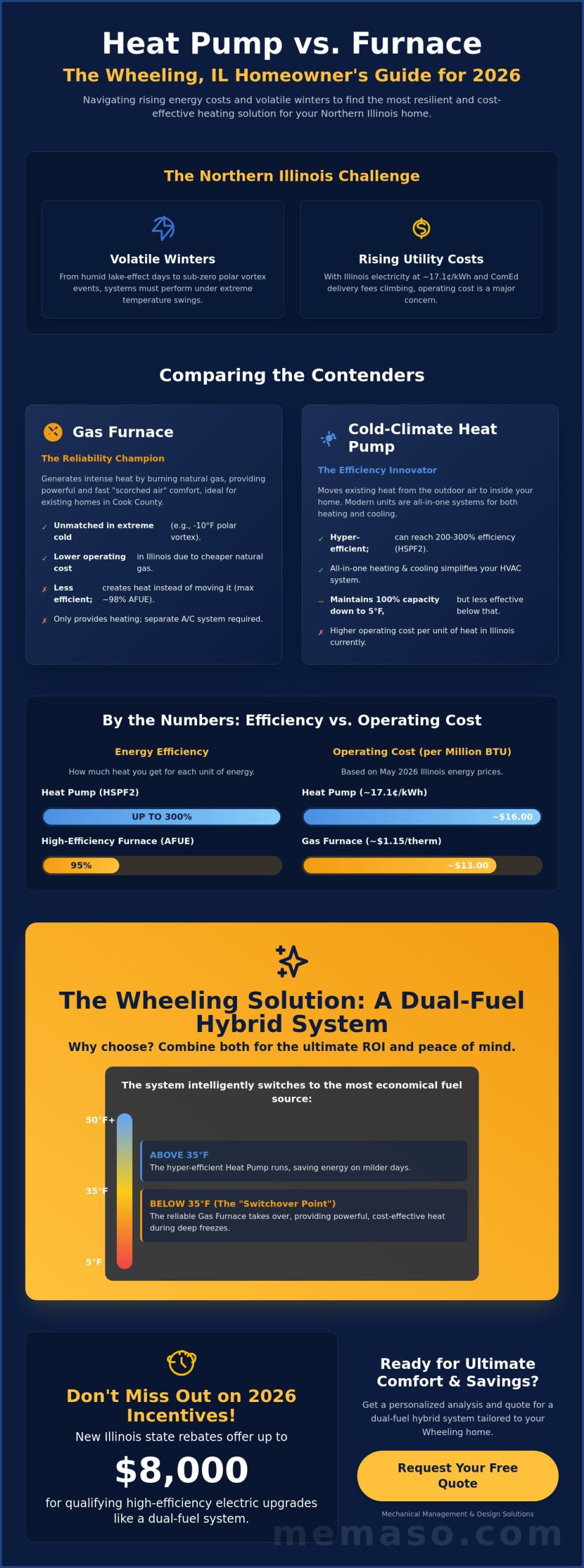
Traditional furnaces are measured by AFUE, or Annual Fuel Utilization Efficiency. In 2026, new gas furnaces must meet an 81% AFUE minimum, meaning 81% of the fuel is converted to heat while only 19% is lost through exhaust. Heat pumps use HSPF2 (Heating Seasonal Performance Factor 2), which measures efficiency over an entire season. While a furnace can’t exceed 100% efficiency, Cold Climate Heat Pumps often reach 200% to 300% efficiency by moving heat rather than creating it. This makes the heat pump vs furnace wheeling debate a contest between raw power and sophisticated energy transfer.
The financial “switchover point” is where the decision becomes personal for Wheeling residents. Based on May 2026 energy prices of $1.15 per therm for natural gas and roughly 17.1¢ per kWh for electricity, a high-efficiency gas furnace currently costs about $13 per million BTU of heat. A modern heat pump costs about $16 for that same amount of warmth. This gap means that while the heat pump is technically more efficient at transferring energy, the lower cost of natural gas in Illinois keeps the furnace competitive for raw operating expenses. However, you must factor in that a heat pump also replaces your air conditioner, which changes the total return on investment.
Humidity from the Great Lakes adds another layer of complexity. When moisture in the air freezes on the outdoor coils, a heat pump must enter a defrost cycle. This temporarily reverses the system to melt the ice, which can slightly dip the indoor temperature. Furnaces don’t face this issue, but they do require consistent venting to manage combustion byproducts. Because of these moving parts and outdoor exposure, heat pumps typically require more frequent professional check-ups to ensure the sensors and reversing valves stay in peak condition.
BTU Output and Comfort Levels
Comfort is about more than just a number on the thermostat. A gas furnace delivers a blast of air around 120°F, which feels “hot” to the touch and satisfies the need for immediate warmth after a day in the Chicago wind. Heat pumps produce air closer to 95°F. It’s still warm enough to heat your home, but it feels more like a gentle, steady breeze. This makes system sizing critical. If a unit is too small, it’ll run constantly without ever making the room feel truly cozy. Modern inverter technology helps by varying the motor speed, which reduces the loud “on-off” cycles common with older blowers.
Longevity and Durability
A well-maintained furnace can reliably serve a Wheeling home for 15 to 20 years. Since the entire unit sits indoors, it’s protected from the elements. Heat pumps generally have a shorter lifespan of 12 to 15 years because the primary mechanical components live outside. In our region, road salt and winter debris can accelerate corrosion on the outdoor fins. Maintaining these specialized components requires expert hvac repair chicago to prevent premature failure. Consulting with a professional for heating replacement ensures you select a model built to withstand our local environmental stressors.
Addressing the #1 Objection: “Will It Work During a Polar Vortex?”
When the wind chill drops to -30°F, Wheeling residents don’t care about theoretical efficiency; they care about survival. The most common fear in the heat pump vs furnace wheeling debate is that a heat pump will simply give up when the mercury hits zero. While that was true for older models, University of Illinois research on cold climate heat pumps confirms that modern units can now operate efficiently at temperatures as low as -13°F or even -20°F. These aren’t your parents’ heat pumps. They’re engineered with enhanced vapor injection and advanced refrigerants designed specifically for northern latitudes.
Despite these technological leaps, auxiliary heat remains a safety requirement in our region. In Wheeling, you can’t risk a system failure when the frost is an inch thick on the windows. You usually have two choices for backup: electric resistance strips or a gas furnace. Electric strips act like a giant toaster inside your air handler, but they’re expensive to run during a prolonged freeze. A gas backup provides a secondary layer of protection that doesn’t rely on the electrical grid’s efficiency during peak demand. We’ve seen properly sized systems in local homes handle 72-hour deep freezes without the indoor temperature dropping a single degree, proving that the right configuration is vortex-proof.
Inverter Technology: The Game Changer
Older systems were binary; they were either 100% on or completely off. This led to the “cold blow” effect where the air felt chilly before the heater kicked back in. Modern inverter technology changed the game. These variable-speed compressors act more like a dimmer switch than a light switch. They modulate their output to match the heat loss of your home exactly. During a peak cold snap, your ComEd bill will reflect higher usage, but the steady operation prevents the massive energy spikes caused by traditional systems constantly restarting in the middle of the night.
The Reliability of Gas
Gas furnaces remain the gold standard for raw emergency heating because they aren’t fighting the outdoor air for energy. They create their own. If Wheeling experiences a winter power outage, a gas furnace paired with a small generator can keep a house safe much more easily than an all-electric system. This infrastructure reality is why we often recommend a dual-fuel configuration. It gives you the peace of mind that no matter how deep the vortex goes, you have a fail-safe that doesn’t care about the outdoor temperature. It’s about combining the efficiency of the future with the proven reliability of the past.
Financial Analysis: Installation Costs and Local Rebates
Comparing the financial impact of a heat pump vs furnace wheeling homeowners must look past the initial price tag. By May 2026, the incentive landscape has shifted dramatically. The federal Section 25C tax credits that many relied on expired at the end of 2025, meaning you can’t claim those for new 2026 installs. Instead, the focus has moved to state-administered programs and local utility rebates. While a gas furnace generally requires a lower upfront investment, a heat pump serves as both your heating and cooling system. When you factor in the cost of a high-efficiency air conditioner, a single heat pump often becomes the more cost-effective long-term asset.
Operating costs in Illinois currently favor gas for raw heating power, but the margin is narrowing. With natural gas prices averaging $1.15 per therm and ComEd electricity rates around 17 cents per kWh, a furnace is slightly cheaper to run per million BTU. However, these figures don’t account for the substantial point-of-sale discounts now available through the Illinois Home Electrification and Appliance Rebates (HEAR) program. These federally funded, state-run incentives can offer up to $8,000 for qualifying heat pump systems, significantly lowering the barrier to entry for moderate-income households.
Maximizing Your ROI
The payback period for a high-efficiency system in Cook County depends heavily on how you manage your energy usage. Smart thermostats like ecobee or Nest are no longer optional accessories; they’re essential tools that optimize fuel switching based on real-time utility rates. These devices ensure your system only uses the electric heat pump when it’s most efficient and switches to gas backup only when necessary. Beyond the hardware, the quality of your hvac installation is the single biggest factor in long-term savings. A poorly commissioned system can lose up to 30% of its rated efficiency through duct leaks or incorrect refrigerant charging, erasing any potential rebate gains. Before committing to any contractor, it’s worth reviewing a thorough checklist for vetting HVAC companies in Chicago to ensure you’re working with a qualified professional who can properly commission your new system.
Local Utility Programs
Wheeling residents have access to some of the most robust utility incentives in the Midwest. ComEd provides tiered rebates for qualifying high-efficiency heat pumps, while Nicor Gas offers smaller incentives for high-AFUE furnaces. It’s important to note that rebate amounts for high-performance heat pumps can often exceed $2,000 depending on the SEER2 and HSPF2 ratings. To secure these funds, you’ll need to work with a registered contractor who can provide the necessary AHRI certificates and proof of installation. If you’re ready to upgrade your home’s efficiency, we recommend scheduling a professional consultation for heating replacement to identify which specific rebates apply to your property.
The Wheeling Solution: Why Dual-Fuel Systems Are the Logical Choice
After evaluating the strengths and weaknesses of a heat pump vs furnace wheeling residents often realize that the most resilient strategy isn’t choosing one technology over the other. The logical resolution for our volatile Chicago climate is the dual-fuel system, also known as a hybrid heating system. This configuration pairs an electric heat pump with a high-efficiency gas furnace. By integrating both, you capitalize on the heat pump’s incredible efficiency during the mild autumn and spring months and rely on the furnace’s raw combustion power when the temperature takes a nose dive into negative territory.
The intelligence of a hybrid system lies in its ability to choose the most cost-effective fuel source automatically. Most modern setups utilize an outdoor temperature sensor or a smart thermostat to manage the “crossover point.” When it’s 40°F outside, the system uses the heat pump to move warmth into your home at a fraction of the cost of burning gas. Once the temperature drops below the efficiency threshold of the electric unit, the system seamlessly engages the gas furnace. This eliminates the “range anxiety” many homeowners feel regarding all-electric systems, ensuring you never have to worry about your family’s safety during a record-breaking freeze.
At Mechanical Management & Design Solutions, our approach is rooted in integrated design-build principles. We don’t just swap out boxes; we analyze how your entire facility performs as a single unit. By looking at the synergy between your mechanical equipment and your home’s envelope, we ensure your new system is sized with precision. This seasoned professional perspective helps us deliver a solution that maximizes both comfort and your long-term return on investment.
Why Expertise Matters in Wheeling
Hybrid systems are technically complex. They require precise calibration between the heat pump’s refrigerant cycle and the furnace’s blower speeds. Low-bid installations often skip the critical commissioning phase, leading to “short cycling” or incorrect fuel switching that can drive up your utility bills. Mechanical Management & Design Solutions brings decades of cumulative experience to every project, treating private residences with the same technical rigor we apply to large-scale institutional facilities. We often incorporate Building Automation Systems to provide homeowners with granular control over their indoor environment, turning a standard HVAC upgrade into a truly smart home climate solution.
Next Steps for Your Home
Transitioning to a more efficient system starts with a clear understanding of your current infrastructure. We recommend scheduling a comprehensive home energy audit to identify where your property is losing heat. This is also the ideal time to evaluate your electrical capacity. Many older Wheeling homes require Electrical Panel Upgrades to handle the increased load of a high-performance heat pump. Taking these steps now ensures your home is ready for the future of heating technology. If you’re ready to lower your bills and increase your winter reliability, contact Mechanical Management & Design Solutions for a professional heat pump vs. furnace consultation today.
Securing Your Home’s Comfort for the Decade Ahead
Deciding on a heat pump vs furnace wheeling homeowners must navigate requires looking at the big picture of efficiency, comfort, and safety. We’ve established that while traditional gas furnaces provide familiar warmth, the evolution of cold-climate heat pumps and the availability of state-administered rebates make 2026 a pivotal year for home upgrades. The most resilient path forward is a hybrid strategy that leverages the strengths of both systems, protecting your household from rising utility costs and extreme weather events alike.
With 25+ years of Chicagoland experience, Mechanical Management & Design Solutions provides the technical expertise needed to engineer these complex systems. Our status as certified building automation specialists ensures your home’s climate control is optimized for both performance and precision. We stand by our work with 24/7 emergency support, giving you peace of mind that your comfort is never left to chance. Take the next step toward a more efficient home by partnering with a team that treats your private residence with the same rigor as a large-scale institutional facility. Get a Professional HVAC Consultation from Wheeling’s Seasoned Experts at Mechanical Management & Design Solutions and ensure your home is prepared for whatever the Illinois winter brings.
Frequently Asked Questions
Do heat pumps work in Chicago winters when it’s -20°F?
Modern cold-climate heat pumps can operate efficiently at temperatures as low as -13°F, but they typically reach their physical limit before hitting -20°F. While technology has improved, a primary heat pump in Wheeling usually requires an auxiliary heat source for these extreme peaks. We recommend a dual-fuel setup so your home automatically switches to gas heat during a record-breaking polar vortex, ensuring your family stays safe and warm.
Is it cheaper to heat a home with gas or electricity in Wheeling?
Natural gas remains slightly more cost-effective for raw heating power at May 2026 prices, costing approximately $13 per million BTU compared to $16 for a heat pump. However, the total annual cost often balances out because heat pumps are incredibly efficient during the milder spring and autumn months. When weighing a heat pump vs furnace wheeling homeowners should look at the combined year-round utility expenses rather than focusing solely on January’s bill.
How long does it take to install a new heat pump vs. a furnace?
A standard furnace replacement is typically completed in a single day, whereas a heat pump installation often requires one to two days of labor. The extra time for a heat pump is usually due to the specialized refrigerant piping and potential electrical upgrades. If your home requires an electrical panel upgrade to support the new system, we coordinate that process to ensure the entire installation meets local building codes and high safety standards.
What are the current ComEd rebates for heat pump installation in 2026?
ComEd provides rebates of up to $2,000 for qualifying high-efficiency heat pumps installed in the Wheeling area. These incentives are based on the system’s SEER2 and HSPF2 ratings, with higher efficiency models commanding the largest rebates. You must use a professional contractor who can provide the required AHRI certificates to verify the equipment meets the utility’s specific performance criteria for the 2026 program year.
Can I keep my existing furnace and just add a heat pump?
You can often add a heat pump to your current HVAC setup to create a dual-fuel hybrid system, provided your existing furnace is in good mechanical condition. This approach allows you to enjoy the high-efficiency cooling and mild-weather heating of a heat pump while keeping your furnace as a reliable backup for the coldest nights. It requires a compatible evaporator coil and a smart thermostat capable of managing two different fuel sources seamlessly.
What maintenance does a heat pump need compared to a furnace?
Heat pumps require professional maintenance twice a year because they operate during both the heating and cooling seasons. A furnace typically only needs an annual inspection before the winter begins. Since the heat pump’s outdoor unit runs year-round, it’s vital to check for debris, coil corrosion from road salt, and proper refrigerant levels. Regular service prevents unexpected system failure and maintains the high efficiency you expect from your investment.
Does a heat pump replace the need for an air conditioner?
A heat pump functions as a full replacement for your central air conditioner by moving heat out of your home during the summer. In fact, many modern heat pumps offer higher SEER2 cooling ratings than traditional entry-level AC units. This two-in-one capability is a significant advantage in the heat pump vs furnace wheeling comparison, as it simplifies your mechanical systems and provides year-round climate control from a single outdoor unit.
Are there tax credits available for HVAC replacement in Cook County?
The federal tax credits previously available under Section 25C expired on December 31, 2025, and are not available for systems installed in 2026. Instead, Wheeling residents should focus on Illinois state-administered rebates like the HEAR program, which can offer up to $8,000 for qualifying heat pump upgrades. While the program is approved, the application portal status can vary, so it’s important to verify current availability before starting your project. When comparing HVAC companies in Chicago for your upgrade, look for contractors who are registered with these rebate programs and can guide you through the application process.