


What if your next HVAC upgrade paid for itself while standing up to a Chicago polar vortex? Many local homeowners hesitate to switch to electric heating because they fear high upfront costs or equipment failure during our brutal sub-zero winters. It is a valid concern, but the 2026 ComEd heat pump rebates have changed the financial landscape for property owners across the Chicagoland area. You deserve a system that provides both high-efficiency cooling in July and dependable warmth in January without the stress of a massive price tag.
This guide will show you how to unlock thousands in savings by leveraging the new tiered incentive structure that went into effect on March 1, 2026. We promise to clear up the confusion surrounding technical jargon like SEER2 and HSPF2 so you can choose a system that qualifies for the maximum $2,075 rebate. We will preview the specific tonnage requirements for your property, explain how to combine utility incentives with federal tax credits, and detail the mandatory contractor training standards that ensure your installation is handled by a seasoned professional who understands our unique local climate.
Key Takeaways
- Learn how the 2026 transition to instant discounts allows you to receive your savings immediately at the point of sale rather than waiting for a check in the mail.
- Navigate the updated 2026 ComEd heat pump rebates tiers to determine how your system’s tonnage and efficiency ratings impact the total financial incentive you can claim.
- Understand why HSPF2 is the most critical metric for Chicago homeowners and how it dictates your system’s performance during the coldest months of the year.
- Discover the advantage of working with a seasoned professional who handles the complex technical verification and AHRI certification required for rebate approval.
- Identify the specific smart thermostat bonuses and federal tax credit combinations that can further reduce the total cost of your high-efficiency HVAC upgrade.
Understanding the 2026 ComEd Heat Pump Rebate Structure
The ComEd Energy Efficiency Program serves as a strategic, ratepayer-funded initiative designed to stabilize the local power grid by reducing total energy demand. It isn’t a traditional marketing gimmick; it’s a targeted effort to lower the carbon footprint of the Chicagoland area. For 2026, the program places a heavy emphasis on decarbonization, specifically pushing to replace outdated electric resistance systems and aging gas furnaces with high-performance alternatives. The goal is simple: reduce the strain on our infrastructure while lowering your monthly utility costs.
To grasp why these incentives are so aggressive, you first need to understand what a heat pump is and how it transfers thermal energy rather than creating it. This inherent efficiency is the engine behind ComEd heat pump rebates. The current program structure moved toward “Instant Discounts” as of March 1, 2026, ensuring that the financial benefit reaches you much faster than previous mail-in versions that often took months to process.
Residential vs. Commercial Incentive Paths
The path to savings depends on your specific property type. Single-family homeowners typically follow a streamlined residential track with fixed rebate amounts based on equipment specifications. If you manage a multi-family building or a commercial facility in Chicago neighborhoods like Logan Square or Bronzeville, the process is more rigorous. Commercial rebates often require a formal pre-approval process, especially for custom energy-saving projects that involve complex building automation. There are also enhanced incentives for income-eligible customers, ensuring that high-efficiency comfort remains accessible to all residents across the city.
The Distributor-Led Discount Model
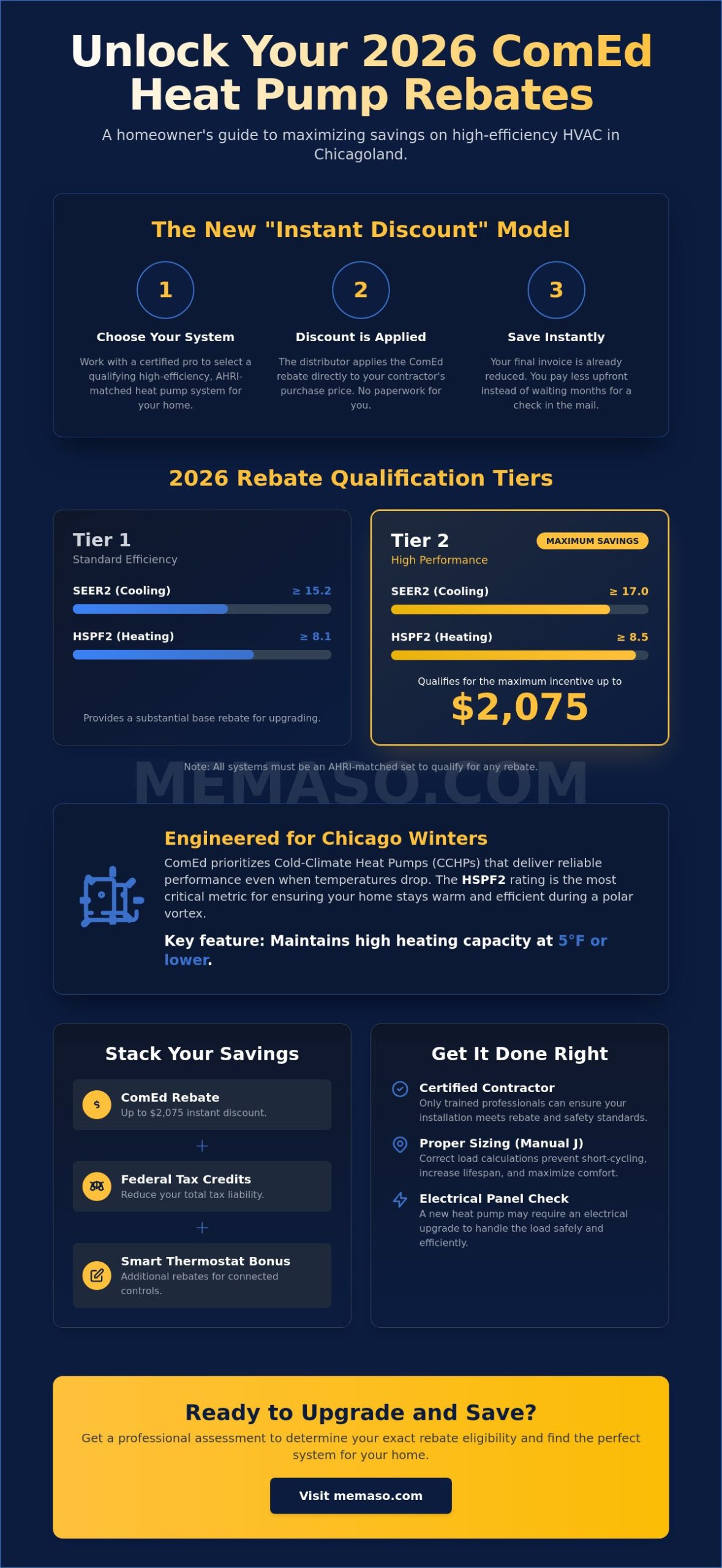
One of the most significant changes in 2026 is how you actually receive the money. You likely won’t see a check in the mail months after the work is finished. Instead, ComEd utilizes a distributor-led model. Participating distributors verify the equipment’s eligibility and apply the discount directly to the contractor’s purchase price. This allows your HVAC partner to provide a lower total invoice price upfront. It reduces your out-of-pocket costs immediately, though it places the burden of technical verification on the distributor and the participating contractor. It’s a faster, more efficient way to fund your home upgrades.
Technical Eligibility: What Your System Needs to Qualify
To qualify for ComEd heat pump rebates, your equipment must meet rigorous performance standards. It isn’t enough to simply install a high-efficiency unit; the entire system must be an AHRI-matched set. This means the indoor coil, outdoor unit, and air handler are certified to work together at a specific efficiency level. For 2026, Tier 1 incentives require a minimum of 15.2 SEER2 for cooling and 8.1 HSPF2 for heating. If you’re aiming for the maximum Tier 2 savings, you’ll need a system rated at 17 SEER2 and 8.5 HSPF2 or higher. These technical benchmarks are detailed in the official ComEd heating and cooling discounts documentation.
Proper sizing is just as critical as efficiency ratings. We use Manual J load calculations to determine the exact heating and cooling requirements of your property. An oversized unit will short-cycle, leading to premature mechanical wear and uneven temperatures, while an undersized unit will fail when the mercury drops. If you’re unsure about your home’s specific requirements, scheduling a professional assessment is the first step toward long-term reliability and rebate approval.
Cold-Climate Heat Pump (CCHP) Standards
Chicago’s climate demands equipment that doesn’t quit at freezing. Cold-climate rated units are designed to maintain high performance at 5°F or lower without relying solely on expensive backup heat. ComEd prioritizes these systems because they ensure grid stability and homeowner comfort during extreme weather events. HSPF2 is the updated standard for measuring heating efficiency in 2026.
The Electrical Infrastructure Prerequisite
Transitioning from a gas furnace to a high-capacity heat pump often requires more than just mechanical work. Your home’s current service might not handle the increased electrical load, making an electrical panel upgrade in Northbrook or Chicago a necessary prerequisite. Some ComEd incentives can even be applied toward the cost of this essential electrical work, helping you modernize your entire home infrastructure while securing your heating rebate.
Maximizing Savings with MEMASO Installation
Choosing the right equipment is only half the battle. The other half is ensuring the installation meets the strict documentation standards required for ComEd heat pump rebates. MEMASO brings over 20 years of collective local experience to every project, operating as a seasoned partner who understands the complex intersection of HVAC, electrical, and plumbing systems. Our heat pump replacement Chicago service manages the entire technical verification process on your behalf, from AHRI matching to final distributor submission. This integrated approach ensures you don’t leave money on the table due to clerical errors or technical mismatches.
We pride ourselves on being more than just a service provider; we are a neighborly presence in the local market. By handling the electrical panel requirements and the mechanical installation under one roof, we eliminate the communication gaps that often lead to project delays. Our goal is to instill confidence through high standards, ensuring your system is safe, efficient, and fully compliant with utility requirements.
Stacking ComEd Rebates with Federal Tax Credits
While the utility incentives lower your immediate invoice, you can also leverage federal incentives to maximize your total return. The Inflation Reduction Act (IRA) 25C tax credit offers a significant incentive, providing up to $2,000 annually for qualifying heat pump installations. You can use the ENERGY STAR Rebate Finder to cross-reference additional local or manufacturer-specific savings that might apply to your specific zip code. Think of it as a two-pronged financial strategy. ComEd reduces the upfront capital required, while the federal credit lowers your year-end tax liability. Commercial entities can further leverage 179D deductions for large-scale facility upgrades.
The Professional Design-Build Advantage
For complex properties, our commercial design and build team integrates rebate eligibility into the initial project ROI analysis. We don’t just swap equipment; we implement building automation systems that sustain energy savings for the long term. This high-level technical oversight ensures that your high-efficiency system remains reliable during extreme Chicago weather. Because we are a local entity with deep roots in the community, we provide the peace of mind that comes with 24/7 emergency support for the systems we install. Request a rebate-eligible heat pump consultation from MEMASO today.
Secure Your Year-Round Comfort and Savings
Navigating the 2026 landscape of ComEd heat pump rebates requires a blend of technical precision and local insight. You’ve seen how the shift to instant discounts and tiered tonnage requirements makes right-sizing your equipment more important than ever. By selecting a system that meets the new SEER2 and HSPF2 benchmarks, you aren’t just qualifying for a payout; you’re investing in a property that remains comfortable through every brutal Chicago season.
MEMASO brings over 20 years of collective tenure to your project, offering integrated MEP solutions that cover everything from the mechanical installation to necessary electrical panel upgrades. Whether you’re focused on residential comfort or complex commercial building automation, our seasoned team ensures your project meets the highest standards of safety and efficiency. Don’t let technical jargon stand in the way of thousands in potential savings.
Get a Professional Quote on a Rebate-Qualified Heat Pump
The transition to high-efficiency heating is a major step toward a more sustainable and cost-effective home. We’re ready to help you navigate every step of the process with the confidence of a local expert by your side.
Frequently Asked Questions
Do I need to replace my furnace to get the ComEd heat pump rebate?
No, you don’t have to remove your existing furnace to benefit from ComEd heat pump rebates. You can opt for a dual-fuel or hybrid system where the heat pump replaces your traditional air conditioner and handles heating during milder months. Your existing gas furnace remains as a backup for extreme cold. This setup still requires the new unit to meet AHRI matching standards to ensure all components work together safely and efficiently.
How much can I actually save with ComEd heat pump rebates in 2026?
You can save a maximum of $2,075 in 2026 for a Tier 2 air source heat pump bundled with an ENERGY STAR smart thermostat. The specific amount depends on the system’s tonnage and efficiency ratings. Because these are instant discounts rather than mail-in checks, the savings are deducted directly from your contractor’s invoice. This reduces your upfront investment immediately while you wait for additional year-end federal tax benefits.
What is the difference between a standard heat pump and a cold-climate heat pump?
A cold-climate heat pump is engineered with a variable-speed inverter compressor that allows it to extract heat even when outdoor temperatures drop to -15°F. Standard models typically see a sharp decline in efficiency once the mercury hits 30°F. In the Chicagoland area, these high-performance units are often necessary to minimize reliance on expensive backup electric resistance heat, providing reliable comfort through a typical polar vortex.
Can I install the heat pump myself and still claim the ComEd rebate?
No, DIY installations are not eligible for these incentives. ComEd requires that all qualifying equipment be installed by a professional to guarantee system performance and grid safety. As of January 1, 2025, participating contractors must also meet specific training quotas for their technicians. This requirement protects your investment by ensuring the system is sized correctly and the refrigerant charge is precise, which prevents mechanical failure.
How do I find a ComEd participating contractor in Chicago?
You can locate an approved professional through the official ComEd Service Provider Directory or by partnering with a seasoned local entity like MEMASO. It’s vital to choose a contractor who understands the distributor-led discount model. We handle the technical verification and paperwork with the distributor directly. This ensures your equipment qualifies for the highest possible rebate tier based on its AHRI certification and local performance standards.